
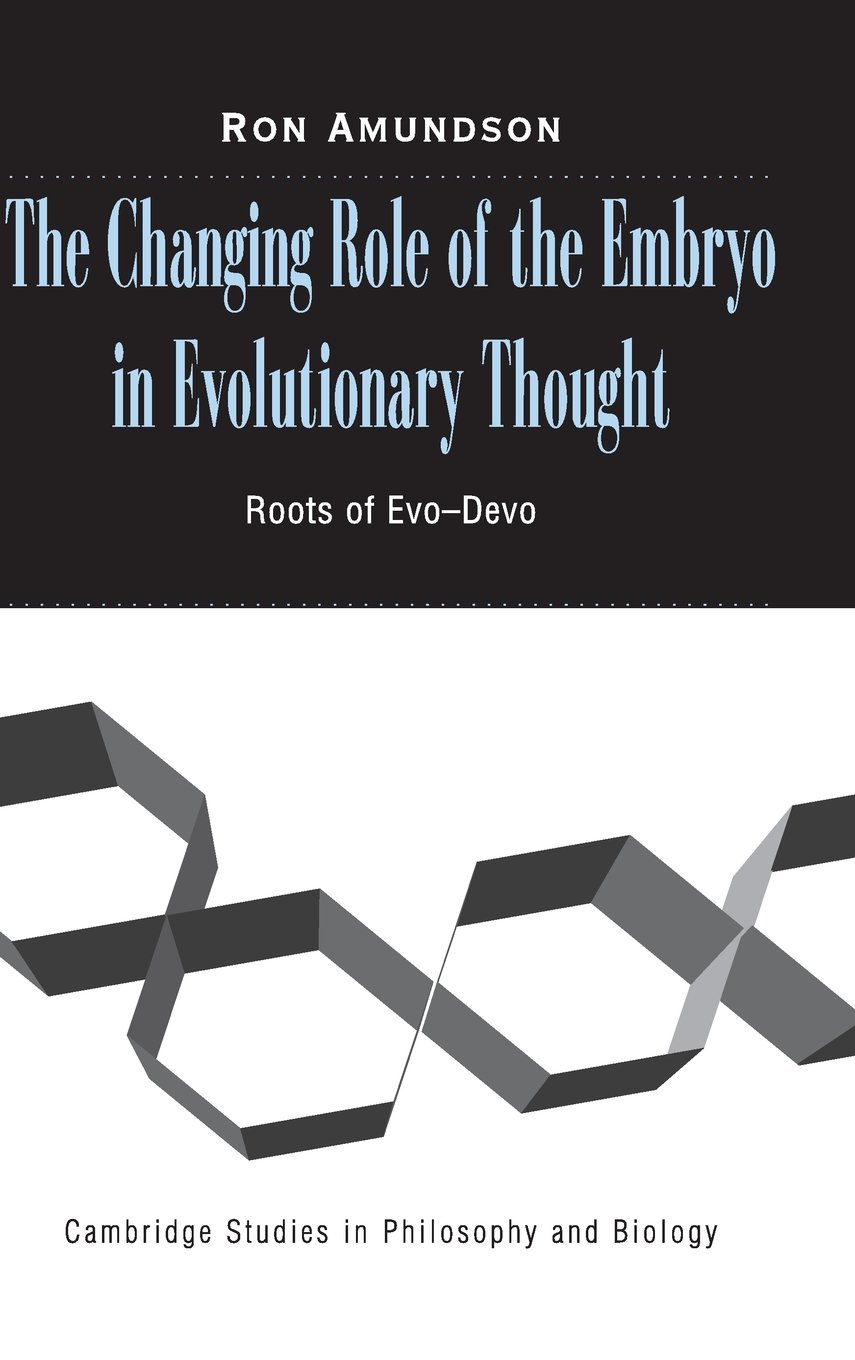
The Changing Role of the Embryo in Evolutionary Thought: Roots of Evo-Devo by Ron Amundson – A Comprehensive History of
Inclusive of all applicable taxes. FREE shipping on all orders.
Available Offers
- 🚚Free Delivery — Free shipping on all orders
- 💵Cash on Delivery — Pay when your order arrives
- ↩️15-Day Easy Returns — Hassle-free return policy
- 🔒Cash on Delivery — Pay safely when your order arrives
Check Delivery
Product Description
Introduction
In the vast landscape of evolutionary biology, few debates have been as persistent and transformative as the relationship between embryonic development and evolutionary change. Ron Amundson’s The Changing Role of the Embryo in Evolutionary Thought: Roots of Evo-Devo offers a compelling and meticulously researched journey through two centuries of scientific inquiry. Published by the prestigious Cambridge University Press, this hardcover volume is an essential addition to the library of any serious student or scholar of biology, philosophy of science, or the history of scientific ideas. It delves deep into the roots of evolutionary developmental biology (evo-devo), a field that has reshaped our understanding of how organisms evolve and develop.
Book Overview
This book is not merely a chronological account; it is a critical re-examination of the history of evolutionary thought. Amundson challenges widely held narratives, particularly those that emerged from the Modern Evolutionary Synthesis of the mid-twentieth century. He argues that many earlier naturalists and embryologists had insights that were unjustly sidelined or misinterpreted. By tracing the shifting status of the embryo—from a central player in nineteenth-century evolutionary theories to a largely ignored subject during the Synthesis, and finally to its resurgence in evo-devo—this book provides a fresh and provocative perspective. It is a work that bridges history, philosophy, and biology, making it uniquely valuable for interdisciplinary study.
Key Highlights
- Revised Historical Narrative: A groundbreaking reinterpretation of nineteenth-century evolutionary thought, highlighting the contributions of embryologists often overlooked in standard accounts.
- Critical Analysis of the Synthesis: An in-depth investigation into how and why development became irrelevant to mainstream evolutionary theory during the Modern Synthesis.
- Evo-Devo Foundations: A clear and accessible explanation of the core contrasts between traditional evolutionary theory and the evo-devo perspective.
- Philosophical Depth: Engages with fundamental questions about causality, explanation, and the nature of biological change.
- Rigorous Scholarship: Backed by extensive primary sources and a thoughtful engagement with both historical and contemporary scientific literature.
Inside the Book
The narrative begins with a revised history of nineteenth-century evolutionary thought, focusing on key figures such as Étienne Geoffroy Saint-Hilaire, Karl Ernst von Baer, and Charles Darwin himself. Amundson shows how embryological concepts like homology, recapitulation, and developmental constraints were integral to early evolutionary debates. He then moves to the early twentieth century, documenting the rise of genetics and the subsequent marginalization of embryology. The core of the book examines the Modern Synthesis, revealing how its architects—such as Ernst Mayr, Theodosius Dobzhansky, and Julian Huxley—actively constructed a framework that excluded developmental processes. Finally, the book explores the resurgence of developmental thinking in the late twentieth century, culminating in the formation of evo-devo as a distinct and powerful discipline. Each chapter is rich with detailed analysis, making complex ideas accessible without oversimplification.
Key Topics
- The role of embryology in pre-Darwinian and Darwinian thought
- The concept of developmental constraints and their evolutionary significance
- The rise of population genetics and the decline of morphological thinking
- The ideological and methodological foundations of the Modern Synthesis
- Core evo-devo concepts: modularity, plasticity, genetic toolkit, and deep homology
- Philosophical issues in evolutionary biology: adaptationism, reductionism, and causation
Reader Benefits
- Deepen Your Understanding: Gain a richer, more nuanced view of evolutionary theory beyond the textbook version.
- Bridge Disciplines: Connect insights from history, philosophy, and biology in a single, coherent narrative.
- Challenge Assumptions: Learn to critically evaluate scientific narratives and appreciate the contingency of scientific progress.
- Enhance Academic Work: Perfect for writing research papers, preparing for seminars, or developing a comprehensive literature review.
- Stay Current: Understand the historical roots of one of the most exciting and rapidly growing fields in modern biology.
Learning Outcomes
After reading this book, you will be able to: articulate the historical trajectory of the embryo in evolutionary thought; identify key figures and their contributions to pre-Synthesis and post-Synthesis biology; explain why development was excluded from the Modern Synthesis and how evo-devo has challenged that exclusion; critically evaluate the philosophical assumptions underlying different evolutionary frameworks; and apply historical insights to contemporary debates in evolutionary biology. This is not just a history lesson—it is a tool for thinking more clearly about how science works and how it changes.
Who Should Read
This book is ideal for undergraduate and postgraduate students in biology, zoology, genetics, and developmental biology. It is equally valuable for students and researchers in the history and philosophy of science, as well as for curious general readers with a strong background in biology. Science educators looking to bring a richer historical perspective to their teaching will also find it indispensable. Indian readers, in particular, will appreciate the global scope of the narrative, which situates Western scientific developments within a broader intellectual context.
About the Author
Ron Amundson is a distinguished philosopher of biology and professor emeritus at the University of Hawaii at Hilo. His research has focused on the history and philosophy of evolutionary biology, especially the relationship between development and evolution. He is known for his clear, critical, and engaging writing style, which makes complex philosophical and scientific ideas accessible to a wide audience. His work has been influential in shaping contemporary discussions on evo-devo and the nature of biological explanation.
About the Publisher
Cambridge University Press is one of the oldest and most respected academic publishers in the world. With a history dating back to 1534, Cambridge University Press is renowned for its rigorous editorial standards and its commitment to publishing high-quality scholarly works across all disciplines. This book is a testament to that tradition, offering readers a reliable and authoritative resource that has been carefully edited and produced. When you hold a Cambridge University Press book, you are holding a piece of academic excellence.
Conclusion
The Changing Role of the Embryo in Evolutionary Thought: Roots of Evo-Devo is a masterful work that will change how you think about evolution. It is a must-read for anyone who wants to understand not just the history of a scientific idea, but the very process by which scientific knowledge is constructed, challenged, and renewed. Whether you are a student preparing for a career in biology, a scholar seeking a deeper philosophical perspective, or a curious mind eager to explore the frontiers of science, this book offers a rewarding and enlightening experience. Add it to your collection today and embark on a journey through the fascinating interplay of embryos, evolution, and ideas.
Quick Summary
The Changing Role of the Embryo in Evolutionary Thought: Roots of Evo-Devo by Ron Amundson is a groundbreaking historical analysis that re-evaluates two centuries of scientific thinking about the relationship between evolution and development. Published by Cambridge University Press, this hardcover book challenges conventional narratives that have made the Evolutionary Synthesis appear as the natural endpoint of evolutionary theory. Amundson shows how the embryo was central to 19th-century evolutionary debates but was systematically excluded during the Modern Synthesis, only to be rediscovered by the emerging field of evo-devo. Readers will learn how philosophical assumptions, disciplinary boundaries, and historical biases have shaped our understanding of evolution. The book is ideal for Indian graduate students, researchers, and academics in evolutionary biology, developmental biology, philosophy of science, and history of science. It provides critical insights into why development matters for evolution and how current evo-devo research is reshaping evolutionary theory. By purchasing from Bookshops.in, Indian readers get access to a premium print edition with reliable delivery and customer service.
Book Highlights
Book Specifications
| ISBN-13 | 9780521806992 |
| ISBN-10 | 0521806992 |
| Publisher | Cambridge University Press |
| Language | English |
| Dimensions | 16.51 x 3.18 x 22.86 cm |
| Weight | 560 g |
| Country | India |
| Category | Sciences, Technology & Medicine › Biology & Life Sciences |
| Genre | Science & Mathematics |
| Original Language | English |
Frequently Asked Questions
What is the main focus of this book?
Who is the author Ron Amundson?
Is this book suitable for Indian students?
Does the book cover Darwin's views on embryos?
What is evo-devo?
Why was development ignored in the Modern Synthesis?
How does this book challenge standard histories?
What time period does the book cover?
Is the book technical?
Does it include discussions on Haeckel?
What is the ISBN of this book?
Can I use this book for my PhD research?
Where can I buy this book in India?
Readers Also Search For
Customers Also Bought
Research
Mathematical Modeling of Biological Systems, Volume I (English, Andreas Deutsch | Lutz Brusch | Helen Byrne)
Research
Intermediate Statistics (English, James P. Stevens)
Research
Statistics Explained by Steve McKillup – Life Science Statistics Guide

Research
Data Analysis and Graphics Using R by John Maindonald – Statistical Computing

Research
Applied Longitudinal Data Analysis (English, Judith D. Singer | John B. Willett)
Research
Bayesian Biostatistics (STATISTICS, A SERIES OF TEXTBOOKS AND MONOGRAPHS)
Related Products
View All
Sciences, Technology & Medicine
African Philosophy and the Epistemic Marginalization of Women (Routledge African Studies)
Sciences, Technology & Medicine
Evolution Interrupted: How We Change Nature and How Nature Changes Us
Sciences, Technology & Medicine
The Tragicomedy of Classical Thermodynamics: Course Held at the Department of Mechanics of Solids (July 1971): 70 (CISM International Centre for Mechanical Sciences)
Sciences, Technology & Medicine
DNA Repair Protocols: 113 (Methods in Molecular Biology)
Sciences, Technology & Medicine
Acoustic Fish Reconnaissance: 32 (Marine Science, 32)
Sciences, Technology & Medicine