
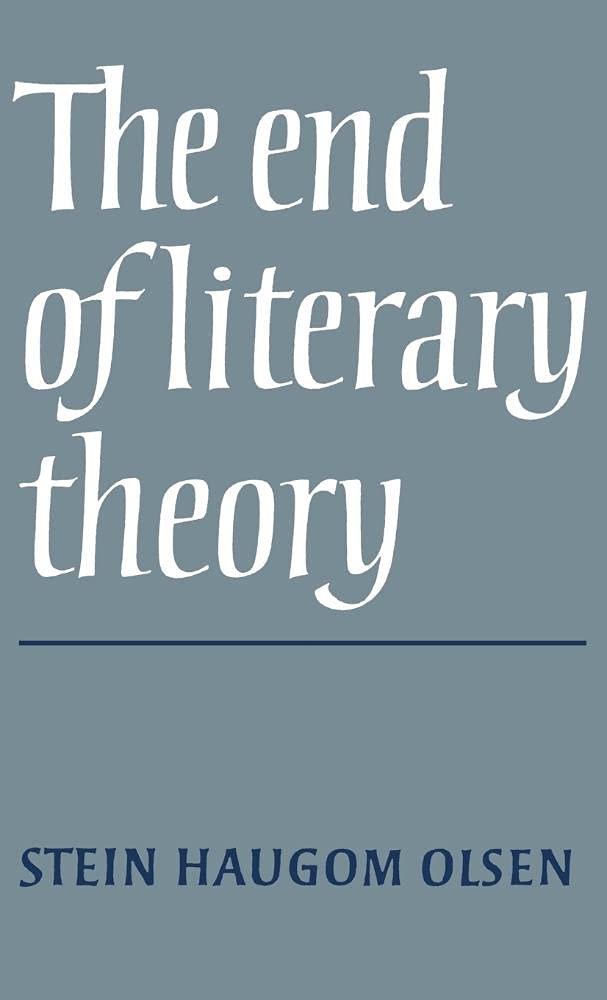
The End of Literary Theory by Stein Haugom Olsen – A Philosophical Examination of Literary Conventions and Interpretatio
Inclusive of all applicable taxes. FREE shipping on all orders.
Available Offers
- 🚚Free Delivery — Free shipping on all orders
- 💵Cash on Delivery — Pay when your order arrives
- ↩️15-Day Easy Returns — Hassle-free return policy
- 🔒Cash on Delivery — Pay safely when your order arrives
Check Delivery
Product Description
Introduction
In an age where literary criticism often feels tangled in jargon and abstract systems, The End of Literary Theory by Stein Haugom Olsen stands as a refreshing and rigorous counterpoint. This hardbound volume, published by the prestigious Cambridge University Press, offers a bold philosophical interrogation of the very foundations of literary theory. For Indian students and scholars navigating the dense landscape of modern criticism, this book provides a clear, convention-based framework to understand literature as a social institution rather than a playground for endless theoretical speculation.
Book Overview
This collection of essays tackles the deepest philosophical puzzles that arise when we try to interpret and evaluate literature. Olsen challenges the dominant orthodoxies of modern literary theory, particularly the ambition to build a comprehensive, all-encompassing system that claims to explain every aspect of literary meaning. Instead, he argues that we must turn our attention to the conventions that govern literature as a social practice. The book explores key issues such as authorial intention, the relationship between a work and the world (reference and truth), and the very definition of what constitutes a literary work. Olsen’s approach is systematic yet accessible, making complex ideas feel grounded and relevant.
Key Highlights
- Philosophical Rigour: Each essay is built on a foundation of analytic philosophy, offering clear arguments and logical precision that cut through vague theoretical claims.
- Convention-Based Approach: Olsen proposes that literature is best understood not through abstract theories but by examining the shared conventions that readers, writers, and critics implicitly follow.
- Critical of Orthodoxies: The book takes a firm stand against the trend of building grand theories, advocating instead for a more modest, practice-oriented understanding of literary interpretation.
- Interdisciplinary Relevance: Perfect for those interested in the growing dialogue between literary studies and philosophy, especially in Indian academic circles where both disciplines are increasingly intertwined.
- Authoritative Publisher: Cambridge University Press ensures a standard of scholarship that is both reliable and globally respected.
Story Themes
While this is not a work of fiction, the book addresses timeless themes that resonate deeply with anyone who loves literature. The central theme is the nature of meaning—how do we know what a text truly says? Another major theme is the role of the author: should an author’s intention matter when we interpret a poem or novel? Olsen also explores the relationship between language and reality, asking whether literature can make truth claims about the world. Finally, the book reflects on the limits of theory itself, questioning whether our desire for a systematic explanation of literature might actually obscure the very experience it seeks to illuminate.
Reader Benefits
- Clarity in Complexity: Gain a clear, logical framework for understanding literary theory without getting lost in abstract jargon.
- Enhanced Critical Thinking: Develop the tools to evaluate competing critical approaches and form your own informed opinions about literature.
- Academic Edge: Ideal for Indian university students preparing for exams, writing dissertations, or pursuing research in English literature, philosophy, or cultural studies.
- Practical Insight: Learn how conventions shape our reading habits, making literary interpretation a more grounded and less intimidating task.
- Intellectual Growth: Engage with a perspective that challenges fashionable trends, encouraging independent thought and deeper reflection.
Who Should Read
This book is essential for postgraduate students and scholars of literary theory, philosophy, and aesthetics. It is also highly valuable for teachers and professors who want to bring a fresh, critical perspective into their classrooms. Indian students preparing for NET, SET, or MPhil entrance exams will find Olsen’s arguments particularly useful for building a strong theoretical foundation. Additionally, any curious reader who has ever felt frustrated by the opacity of modern criticism will appreciate Olsen’s clear-headed approach.
About the Author
Stein Haugom Olsen is a distinguished Norwegian philosopher and literary theorist known for his work in analytic aesthetics and the philosophy of literature. He has taught at universities in Norway, the United Kingdom, and the United States, and his writings have significantly influenced the field of literary theory. Olsen’s scholarship is marked by a commitment to logical clarity and a deep respect for the social practices that shape our understanding of art and literature.
About the Publisher
Cambridge University Press is one of the oldest and most respected academic publishers in the world. With a history spanning over four centuries, it is renowned for producing scholarly works of the highest quality. For Indian readers, a Cambridge publication represents a benchmark of academic excellence, ensuring that the content is rigorously peer-reviewed and globally relevant.
Conclusion
The End of Literary Theory is not a book that dismisses theory altogether; rather, it invites us to reconsider what theory can and should do. By grounding literary understanding in social conventions, Stein Haugom Olsen offers a path that is both intellectually satisfying and practically useful. For anyone in India who wishes to engage with literature in a serious, thoughtful manner—whether as a student, teacher, or lifelong reader—this hardcover volume is an invaluable addition to your library. It will challenge you, clarify your thinking, and ultimately deepen your love for the written word.
Quick Summary
The End of Literary Theory by Stein Haugom Olsen is a rigorous philosophical critique of modern literary theory. The book challenges the prevailing orthodoxy that literature can be understood through comprehensive, systematic theories. Instead, Olsen proposes that literature is a social institution governed by conventions, and that problems of interpretation, evaluation, and meaning must be addressed by analyzing these conventions. Key topics include authorial intention, reference and truth in literary works, and the definition of literature itself. This work is intended for advanced students and scholars of literary criticism, philosophy, and aesthetics. Readers will gain a deep understanding of the limitations of theoretical frameworks and develop a nuanced approach to literary analysis. By purchasing from Bookshops.in, Indian readers receive a genuine hardcover edition from Cambridge University Press, ideal for academic libraries and personal collections.
Book Highlights
Book Specifications
| ISBN-13 | 9780521333269 |
| ISBN-10 | 0521333261 |
| Publisher | Cambridge University Press |
| Language | English |
| Dimensions | 15.44 x 2.29 x 22.15 cm |
| Weight | 420 g |
| Country | India |
| Category | Literature › Literary Theory |
| Genre | Literary Criticism |
| Original Language | English |
Frequently Asked Questions
What is The End of Literary Theory about?
Who is the author of this book?
Is this book suitable for Indian students?
What is the main argument of the book?
Does the book cover authorial intention?
Is this a hardcover edition?
What are the key themes?
Can I use this for my research?
Is the language complex?
What is the price in INR?
Does the book discuss Indian literature?
Is this book available in India?
What is the ISBN?
Readers Also Search For
Customers Also Bought
Contemporary Fiction
Stepladder Junction and Other Stories

Contemporary Fiction
Fabrications by Pamela Painter – Short Story Collection

Contemporary Fiction
The Double Life of an Alaskan Sled Dog (English, Andrea Finney Aufder Heyde)

Contemporary Fiction
The Alabaster Girl by Zan Perrion

Contemporary Fiction
Grimm and Grimmer: Classic Fairy Tales Rebooted by Mark Russell
Classic Literature
The Prose Works of Andrew Marvell: 1676-1678 by Andrew Marvell – Restoration Literature
Related Products
View All
Literature & Fiction
Shakespeare, Madness, and Music: Scoring Insanity in Cinematic Adaptations
Literature & Fiction
Literary Research and Canadian Literature: Strategies and Sources: 10 (Literary Research: Strategies and Sources, 10)

Literature & Fiction
Crime Fiction and National Identities in the Global Age | by Julie H. Kim | McFarland & Company | by Julie H. Kim | McFarland & Company | by Julie H. Kim | McFarland & Company | by Julie H. Kim | McFarland & Company | by Julie H. Kim | McFarland & Company | by Julie H. Kim | McFarland & Company | by Julie H. Kim | McFarland & Company | by Julie H. Kim | McFarland & Company | by Julie H. Kim | McFarland & Company | by Julie H. Kim | McFarland & Company | by
Literature & Fiction
Greek Literature in the Classical Period: The Poetics of Drama in Athens: 4 (Greek Literature Vol. 4)
Literature & Fiction
Greek Literature and Philosophy (Greek Literature, Volume 6)
Literature & Fiction