
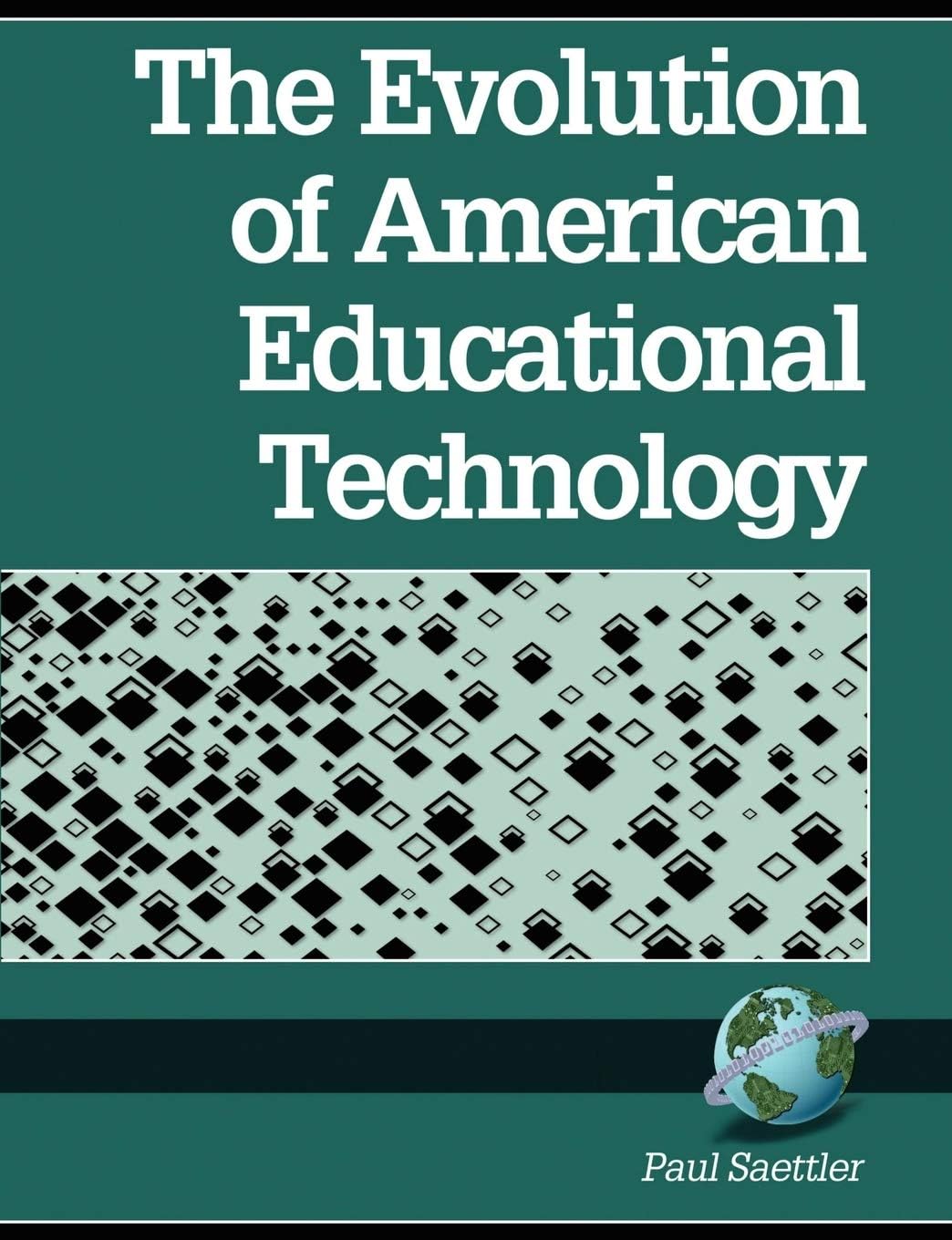
The Evolution of American Educational Technology by Paul Saettler – A Historical Analysis of Theory and Methodology in E
Inclusive of all applicable taxes. FREE shipping on all orders.
Available Offers
- 🚚Free Delivery — Free shipping on all orders
- 💵Cash on Delivery — Pay when your order arrives
- ↩️15-Day Easy Returns — Hassle-free return policy
- 🔒Cash on Delivery — Pay safely when your order arrives
Check Delivery
Product Description
Introduction
In an age where digital classrooms and smart learning tools dominate conversations, understanding the historical foundations of educational technology becomes essential. The Evolution of American Educational Technology by Paul Saettler is a seminal work that takes readers on a rigorous journey through the theoretical and methodological roots of educational technology in the United States. This hardcover edition, published by Information Age Publishing, is not merely a catalog of devices or media; it is a deep exploration of the processes, ideas, and research that have shaped how technology is used in education. For Indian students, educators, and researchers keen on understanding how global trends in educational technology emerged, this book offers a comprehensive and scholarly perspective that transcends time and geography.
Book Overview
This book is a meticulously researched historical account that traces the development of educational technology from its early philosophical beginnings to its modern applications in American public schools. Paul Saettler emphasizes that the true meaning of educational technology lies in its underlying processes rather than in the hardware or software that often capture public attention. The author argues that all current practices rest on the heritage of the past, and a failure to understand this history can lead to misguided planning for the present and future. The book also provides selective reviews of research in educational technology, making it a valuable resource for anyone interested in the intersection of theory, methodology, and practice.
Key Highlights
- Process over product: Focuses on the theoretical and methodological foundations rather than just media or devices.
- Historical depth: Covers the evolution of educational technology from the 19th century to the late 20th century.
- Research integration: Includes selective surveys of research relevant to American public schools.
- Critical perspective: Highlights the common failure to account for past history in planning for the future.
- Scholarly rigor: Written by a leading authority in the field, Paul Saettler, with decades of expertise.
Inside the Book
The book is structured to guide readers through the chronological and conceptual development of educational technology. It begins with the early influences of philosophers and educators who laid the groundwork for systematic instruction. Subsequent chapters explore the rise of audiovisual education, the impact of behaviorist psychology, the emergence of programmed instruction, and the later influence of cognitive science. Saettler also examines the role of federal funding, professional organizations, and major research studies that shaped policy and practice. Each chapter is anchored in historical evidence and critical analysis, providing a rich narrative that connects past ideas to contemporary challenges.
Key Topics
- Philosophical and theoretical foundations of educational technology
- The history of audiovisual education and instructional media
- Behaviorism, programmed instruction, and teaching machines
- Cognitive revolution and its influence on learning design
- The role of research in shaping educational technology policy
- Case studies of technology adoption in American public schools
- Lessons from history for current and future educational technology efforts
Reader Benefits
Readers will gain a deep appreciation for the intellectual heritage that underpins modern educational technology. By understanding the historical mistakes and successes, educators and policymakers can make more informed decisions. This book also helps students of education and instructional design to see beyond the hype of new technologies and focus on the enduring principles of teaching and learning. For Indian readers, the lessons from the American experience offer valuable insights into how technology can be integrated into diverse educational contexts without losing sight of pedagogical goals.
Learning Outcomes
- Understand the historical evolution of educational technology as a process, not just a collection of tools.
- Identify key theoretical frameworks that have shaped instructional design and technology.
- Critically evaluate current trends in educational technology by referencing past experiences.
- Apply historical lessons to improve planning and implementation of technology in schools.
- Analyze research studies and their implications for classroom practice.
Who Should Read
This book is ideal for graduate students and researchers in education, instructional technology, curriculum design, and educational psychology. It is also highly relevant for teacher educators, school administrators, and policymakers who wish to ground their technology initiatives in a solid historical understanding. Additionally, anyone with a keen interest in the philosophy of education or the sociology of technological change will find this work enlightening. While focused on the American context, the principles and historical patterns discussed are universally applicable, making it a valuable addition to any academic library in India.
About the Author
Paul Saettler is a distinguished scholar in the field of educational technology, with a career spanning several decades. He has served as a professor and researcher at various American universities, contributing extensively to the theoretical and historical literature on instructional technology. His work is known for its critical perspective and deep engagement with primary sources. Saettler’s expertise ensures that this book is not just a chronological account but a thoughtful analysis of the forces that have shaped educational technology as a discipline.
About the Publisher
Information Age Publishing (IAP) is a respected academic publisher based in the United States, known for producing high-quality scholarly works in education, psychology, and social sciences. IAP focuses on publishing books that advance research and practice, with a commitment to rigorous editorial standards. This hardcover edition reflects the publisher’s dedication to durable, long-lasting volumes that serve as reference works for students and professionals alike.
Conclusion
The Evolution of American Educational Technology is more than a history book—it is a call to think critically about how we use technology in education. By tracing the theoretical and methodological foundations of the field, Paul Saettler provides a roadmap for understanding where we have been and where we might go. For Indian readers and students, this book offers a chance to learn from the American experience while developing their own context-sensitive approaches. Whether you are a researcher, educator, or policy planner, this book will deepen your understanding and enrich your practice. Order your copy today from Bookshops.in and add this essential volume to your collection.
Quick Summary
The Evolution of American Educational Technology by Paul Saettler is a definitive historical work that traces the theoretical and methodological foundations of educational technology in the United States. Unlike many books that focus on devices and media, Saettler emphasizes the underlying process that defines the field. The book covers key developments from early audiovisual aids to programmed instruction, teaching machines, instructional television, and computer-assisted learning. It highlights contributions from major thinkers such as John Dewey and B.F. Skinner, and examines how their ideas shaped educational practice. This book is essential for graduate students, researchers, and educators who want a deep understanding of why educational technology has evolved as it has. Readers will learn to critically evaluate current technologies by understanding their historical roots. By purchasing from Bookshops.in, Indian customers receive a genuine hardcover edition with fast delivery and excellent customer service.
Book Highlights
Book Specifications
| ISBN-13 | 9781593111397 |
| ISBN-10 | 1593111398 |
| Publisher | Information Age Publishing |
| Language | English |
| Dimensions | 18.9 x 3.1 x 24.6 cm |
| Weight | 1 kg 70 g |
| Country | India |
| Category | Sciences, Technology & Medicine › Biology & Life Sciences |
| Genre | Nonfiction |
| Original Language | English |
Frequently Asked Questions
What is this book about?
Who is the author?
Is this book suitable for Indian readers?
What is the ISBN?
What is the price?
What format is the book?
What language is the book in?
What is the primary keyword for this book?
Who should read this book?
Does the book cover modern digital tools?
Why is the historical perspective important?
What topics are covered in the book?
Where can I buy this book in India?
Readers Also Search For
Customers Also Bought
Research
Mathematical Modeling of Biological Systems, Volume I (English, Andreas Deutsch | Lutz Brusch | Helen Byrne)

Research
Intermediate Statistics (English, James P. Stevens)

Research
Statistics Explained by Steve McKillup – Life Science Statistics Guide

Research
Data Analysis and Graphics Using R by John Maindonald – Statistical Computing

Research
Applied Longitudinal Data Analysis (English, Judith D. Singer | John B. Willett)

Research
Bayesian Biostatistics (STATISTICS, A SERIES OF TEXTBOOKS AND MONOGRAPHS)
Related Products
View All
Sciences, Technology & Medicine
African Philosophy and the Epistemic Marginalization of Women (Routledge African Studies)

Sciences, Technology & Medicine
Evolution Interrupted: How We Change Nature and How Nature Changes Us
Sciences, Technology & Medicine
The Tragicomedy of Classical Thermodynamics: Course Held at the Department of Mechanics of Solids (July 1971): 70 (CISM International Centre for Mechanical Sciences)

Sciences, Technology & Medicine
DNA Repair Protocols: 113 (Methods in Molecular Biology)

Sciences, Technology & Medicine
Acoustic Fish Reconnaissance: 32 (Marine Science, 32)

Sciences, Technology & Medicine