
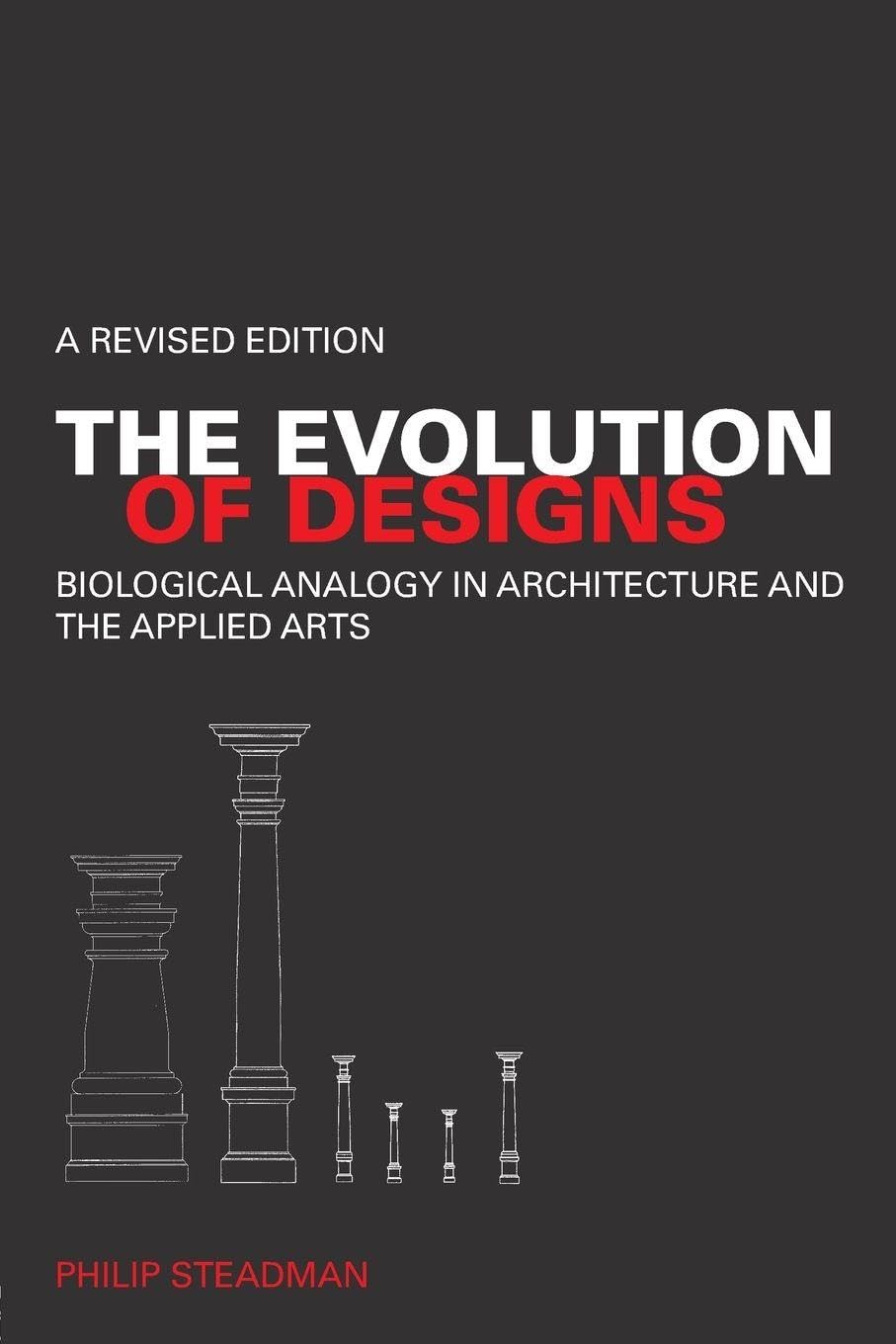
The Evolution of Designs: Biological Analogy in Architecture and the Applied Arts by Philip Steadman – A Classic Study o
Inclusive of all applicable taxes. FREE shipping on all orders.
Available Offers
- 🚚Free Delivery — Free shipping on all orders
- 💵Cash on Delivery — Pay when your order arrives
- ↩️15-Day Easy Returns — Hassle-free return policy
- 🔒Cash on Delivery — Pay safely when your order arrives
Check Delivery
Product Description
Introduction
In the world of architecture and design, inspiration often springs from the most unexpected sources. 'The Evolution of Designs: Biological Analogy in Architecture and the Applied Arts' by Philip Steadman offers a fascinating journey into how the natural world—specifically biological evolution—has shaped human creativity. This classic work, now in a revised hardcover edition from Routledge, explores the deep connections between the growth of organisms and the creation of buildings, furniture, and everyday objects. For Indian students, architects, and designers, this book opens a window to understanding how nature’s principles can guide sustainable and innovative design practices, making it a must-have addition to any serious library.
Book Overview
First published decades ago and now updated with a substantial new Afterword, this book traces the history of biological analogies in design from the early 19th century to the present day. Philip Steadman examines how thinkers, architects, and craftsmen have looked to biology not just for forms to imitate, but for processes to emulate—such as growth, adaptation, and natural selection. The new edition covers the rise of computer methods in the 1980s and 1990s, including genetic algorithms that have enabled a new kind of 'biomorphic' architecture. This hardbound volume is an essential reference for anyone interested in the intersection of science, art, and technology.
Key Highlights
- Revised and updated classic: Includes an extended Afterword covering recent developments in computational design and genetic algorithms.
- Interdisciplinary approach: Bridges architecture, biology, design theory, and the applied arts.
- Rich historical perspective: Explores analogies from the 19th century to modern digital methods.
- Practical relevance: Offers insights for sustainable design, biomimicry, and creative problem-solving.
- Premium hardcover edition: Durable binding perfect for students and professionals.
Inside the Book
Readers will find a carefully structured narrative that moves from early biological metaphors in the works of Gottfried Semper and Viollet-le-Duc to the functionalist theories of the 20th century. Steadman delves into the idea of 'type' in biology and architecture, the concept of 'organic' design, and the influence of Darwinian thought on design movements. The new Afterword discusses how computer-aided design and artificial life simulations have revived biological analogies, allowing designers to generate forms that evolve and adapt—much like living organisms. The book is richly illustrated with diagrams and photographs that clarify complex ideas.
Key Topics
- The history of biological analogy in design theory
- Architectural morphology and typology
- Darwinian evolution and its influence on applied arts
- Genetic algorithms and computational design
- Biomimicry and sustainable architecture
- Organic vs. mechanical design philosophies
Reader Benefits
This book empowers readers to think beyond conventional design boundaries. By understanding how natural evolution works, architects and designers can develop more adaptive, efficient, and aesthetically rich solutions. Students will gain a solid foundation in design theory that connects biology to creativity. Professionals will find the updated content on digital tools invaluable for contemporary practice. The hardcover format ensures longevity, making it a resource to return to again and again.
Learning Outcomes
- Understand the historical roots of biological analogies in architecture and design.
- Analyze how evolutionary concepts have shaped design movements from the 1800s onward.
- Evaluate the role of computer algorithms in creating biomorphic forms.
- Apply principles of natural selection and adaptation to design problems.
- Critically assess the limits and potentials of biomimicry in the built environment.
Who Should Read
This book is ideal for architecture students, design professionals, and educators in India and abroad. It is also highly relevant for researchers in environmental studies, product design, and the history of science. Anyone curious about how nature inspires human creativity—from artists to engineers—will find this work enlightening. The updated content makes it especially useful for those exploring parametric design and generative architecture.
About the Author
Philip Steadman is a renowned scholar in the field of architectural theory and urban morphology. He has taught at several leading institutions, including the Bartlett School of Architecture, University College London. His research spans the history of design, biological analogies, and the application of scientific methods to architecture. With a background in both architecture and the history of science, Steadman brings a unique interdisciplinary perspective to this book.
About the Publisher
Routledge is a prestigious international publisher known for its high-quality academic and professional books. Part of the Taylor & Francis Group, Routledge has a strong reputation in architecture, design, and the sciences. This hardcover edition reflects their commitment to producing durable, authoritative works that serve students and scholars worldwide.
Conclusion
'The Evolution of Designs' is more than a historical account—it is a bridge between two worlds: the organic and the artificial. For Indian readers, where traditional crafts and modern architecture coexist, this book offers timeless lessons in creativity and sustainability. Whether you are a student preparing for a career in design or a professional seeking fresh inspiration, this volume will deepen your appreciation for the patterns that connect nature and human invention. Order your hardcover copy from Bookshops.in today and explore the fascinating dialogue between biology and design.
Quick Summary
The Evolution of Designs: Biological Analogy in Architecture and the Applied Arts by Philip Steadman is a seminal work that traces the rich history of how architects and designers have looked to biology for creative inspiration. From early 19th-century attempts to imitate natural forms to the latest computational biomorphic methods, Steadman unpacks the analogies between the evolution of organisms and the design of artefacts. This revised edition adds an insightful afterword covering the impact of computer methods on design since the 1980s. The book is ideal for students and professionals in architecture, design theory, applied arts, and biomimicry. Readers will learn how nature’s processes of growth and adaptation have been translated into design principles, and how these ideas continue to shape contemporary creativity. By purchasing from Bookshops.in, Indian readers gain access to a genuine hardcover edition with reliable delivery and customer support.
Book Highlights
Book Specifications
| ISBN-13 | 9780415447539 |
| ISBN-10 | 0415447534 |
| Publisher | Routledge |
| Language | English |
| Dimensions | 15.6 x 1.85 x 23.39 cm |
| Weight | 699 g |
| Category | Engineering Textbooks › Civil Engineering |
| Genre | Non-fiction |
| Original Language | English |
Frequently Asked Questions
What is The Evolution of Designs about?
Who is the author of this book?
Is this book suitable for students?
Does the book cover modern design methods?
What makes this edition different?
Can I use this book for biomimicry research?
Does the book focus only on architecture?
Is the language technical?
Is this book available in India?
Does it include illustrations?
What is the ISBN?
Why should I buy from Bookshops.in?
Readers Also Search For
Customers Also Bought
Mathematics
Stereotype Spaces and Algebras: 73 (De Gruyter Expositions in Mathematics, 73)

Mathematics
Semigroups in Algebra, Geometry and Analysis: 20 (De Gruyter Expositions in Mathematics, 20)

Mathematics
Geometry from the Pacific Rim: Proceedings of the Pacific Rim Geometry Conference held at National University of Singapore, Republic of Singapore, ... 1994 (De Gruyter Proceedings in Mathematics)

Mathematics
First International Tainan-Moscow Algebra Workshop: Proceedings of the International Conference held at National Cheng Kung University Tainan, Taiwan, ... 1994 (De Gruyter Proceedings in Mathematics)
Mathematics
Differential Geometry - Proceedings of the VIII International Colloquium (English, Jesus A. Alvarez Lopez | Eduardo Garcia-Rio)

Mathematics
Mathematical Theory of Optimal Processes (Classics of Soviet Mathematics)
Related Products
View All
Science & Mathematics
Elements of Pelagos Biology: With Focus on the Mediterranean Sea

Science & Mathematics
Squid - Superconducting Quantum Interference Devices and Their Applications: Proceedings of the International Conference on Superconducting Quantum Devices, Berlin-west, October 4-8, 1976
Science & Mathematics
Thermodynamics and Pattern Formation in Biology
Science & Mathematics
The Nature of Mathematics and the Mathematics of Nature by S. Andersson – Mathematics & Science

Science & Mathematics
Linear Algebra | by Stephen Friedberg | Arnold Insel | Lawrence Spence | Pearson | by Stephen Friedberg | Arnold Insel | Lawrence Spence | Pearson | by Stephen Friedberg | Arnold Insel | Lawrence Spence | Pearson | by Stephen Friedberg | Arnold Insel | Lawrence Spence | Pearson | by Stephen Friedberg | Arnold Insel | Lawrence Spence | Pearson | by Stephen Friedberg | Arnold Insel | Lawrence Spence | Pearson | by Stephen Friedberg | Arnold Insel | Lawrence Spence | Pearson | by Stephen Friedberg

Science & Mathematics