
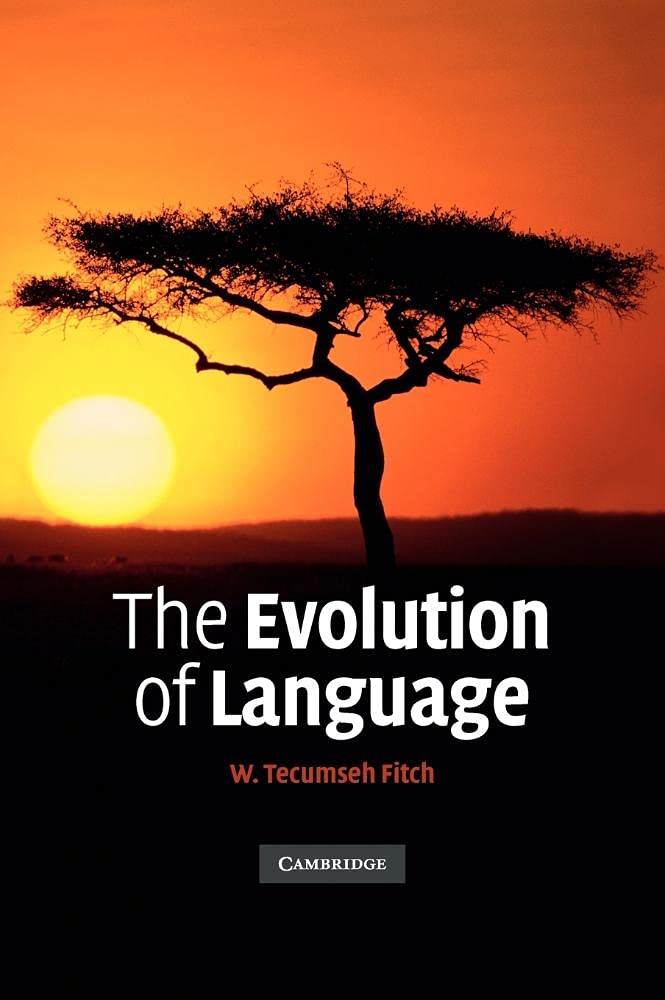
The Evolution of Language by W. Tecumseh Fitch – A Deep Dive into the Origins of Human Communication
Inclusive of all applicable taxes. FREE shipping on all orders.
Available Offers
- 🚚Free Delivery — Free shipping on all orders
- 💵Cash on Delivery — Pay when your order arrives
- ↩️15-Day Easy Returns — Hassle-free return policy
- 🔒Cash on Delivery — Pay safely when your order arrives
Check Delivery
Product Description
Introduction
What truly sets humans apart from every other creature on Earth? The answer, many scientists believe, lies in our capacity for language. In The Evolution of Language, W. Tecumseh Fitch tackles one of the most profound and enduring mysteries of human history: how did language emerge in our species, and why does it remain uniquely human? This hardcover edition from Cambridge University Press offers a comprehensive and accessible journey through the scientific landscape that seeks to answer these questions.
Book Overview
Since Charles Darwin first pondered the origins of language, researchers from linguistics, anthropology, neuroscience, genetics, and evolutionary biology have generated a vast and often bewildering body of work. Fitch masterfully synthesises these diverse perspectives into a coherent narrative. The book explores why any human child can acquire language from sparse environmental cues, while even the most intelligent chimpanzee, raised in the same surroundings, cannot. It examines the biological, cognitive, and evolutionary foundations of our unique linguistic ability, presenting a balanced view of competing theories and the latest evidence.
Key Highlights
- An interdisciplinary approach that bridges the gap between specialised scientific fields
- Clear explanations of complex concepts such as vocal learning, recursion, and the FOXP2 gene
- Critical analysis of major theories, including Chomsky's Universal Grammar and Darwinian gradualist perspectives
- Richly illustrated with diagrams and examples that make abstract ideas tangible
- Thought-provoking discussions on the relationship between language, thought, and consciousness
Inside the Book
Structured in five parts, the book begins with the historical context of language evolution studies, from Darwin's original insights to modern debates. It then delves into the biological underpinnings of speech and syntax, comparing human communication with animal calls and gestures. Fitch examines the fossil and archaeological record for clues about when language emerged, and explores the genetic and neural mechanisms that make language possible. The final chapters synthesise this evidence into a compelling evolutionary scenario, addressing unresolved questions and future research directions.
Key Topics
- The comparative anatomy of the vocal tract and its evolution
- Animal communication systems: songs, calls, and gestures in birds, primates, and other species
- The role of mirror neurons, imitation, and social learning in language origins
- Genetic foundations of language: the FOXP2 gene and its implications
- Theories of syntax evolution: from protolanguage to full grammatical systems
- Archaeological evidence for symbolic behaviour and cognitive modernity
Reader Benefits
This book empowers readers to understand the cutting-edge science behind one of humanity's greatest puzzles. It demystifies technical jargon, making it accessible to students and curious minds alike. You will gain a solid grounding in the major debates and discoveries, enabling you to critically evaluate new findings in the field. Whether you are a student of linguistics, psychology, or biology, or simply someone fascinated by what makes us human, this volume will deepen your appreciation of the miracle of language.
Learning Outcomes
- Understand why language is considered a uniquely human trait
- Identify the key biological and cognitive prerequisites for language
- Evaluate different theories of language evolution with informed scepticism
- Recognise the interdisciplinary nature of the field and how each discipline contributes
- Apply evolutionary thinking to questions about human cognition and culture
Who Should Read
This book is ideal for undergraduate and postgraduate students in linguistics, anthropology, cognitive science, psychology, and evolutionary biology. It is also a rewarding read for science enthusiasts, educators, and anyone curious about the origins of human communication. The clear writing style and structured presentation make it suitable for self-study or as a supplementary text for courses on language evolution.
About the Author
W. Tecumseh Fitch is a professor of cognitive biology at the University of Vienna, where he leads the Department of Cognitive Biology. His research spans animal communication, vocal learning, and the evolution of language. He is widely regarded as one of the foremost authorities in the field, having published numerous influential papers and given lectures worldwide. Fitch brings a rare combination of scientific rigour and accessible exposition to this complex subject.
About the Publisher
Cambridge University Press is one of the world's oldest and most prestigious academic publishers, with a history dating back to 1534. Renowned for its rigorous editorial standards and commitment to scholarly excellence, Cambridge University Press publishes works that shape research and education globally. This hardcover edition reflects the publisher's dedication to producing high-quality, durable books that stand the test of time.
Conclusion
The Evolution of Language is an essential addition to the library of anyone seeking to understand the origins of our most defining human trait. W. Tecumseh Fitch navigates the complex interdisciplinary landscape with clarity and insight, offering a balanced and up-to-date account of the science. Whether you are a student beginning your journey or a seasoned researcher looking for a comprehensive overview, this book will inform, challenge, and inspire. Order your hardcover copy from Bookshops.in today and take a deep dive into the evolutionary story of language.
Quick Summary
The Evolution of Language by W. Tecumseh Fitch is a landmark work that tackles one of the deepest questions about humanity: why do we alone possess language? Drawing on decades of research across linguistics, evolutionary biology, neuroscience, genetics, and anthropology, Fitch presents a comprehensive account of how language evolved. The book explains why even the brightest chimpanzee cannot learn a human language, while any human child does so effortlessly. It covers the genetic underpinnings (such as the FOXP2 gene), the neural adaptations for speech, and the comparative evidence from animal communication systems, including birdsong and primate calls. Fitch also evaluates competing theories, from gestural origins to vocal learning, and synthesises them into a coherent evolutionary framework. This book is ideal for Indian students and researchers in linguistics, cognitive science, psychology, and anthropology who want a deep, evidence-based understanding of language origins. It is also accessible to curious general readers with a scientific bent. By purchasing from Bookshops.in, you get a genuine, high-quality hardcover edition at a competitive price, with fast delivery across India. This is not just a textbook; it is an intellectual journey into what makes us human.
Book Highlights
Book Specifications
| ISBN-13 | 9780521859936 |
| ISBN-10 | 052185993X |
| Publisher | Cambridge University Press |
| Language | English |
| Dimensions | 17.78 x 3.18 x 26.04 cm |
| Weight | 1 kg 290 g |
| Country | India |
| Category | Humanities › Language & Linguistics |
| Genre | Nonfiction |
| Reading Age | Adult |
| Original Language | English |
Frequently Asked Questions
What is The Evolution of Language about?
Who is W. Tecumseh Fitch?
Is this book suitable for beginners?
Does the book cover animal communication?
What is the main argument of the book?
How is the book structured?
Does it discuss the FOXP2 gene?
Is this book used in Indian universities?
What makes this book different from others on language evolution?
Does the book include illustrations or diagrams?
Is the language of the book technical?
Can I use this book for my research project?
Is this a hardcover or paperback?
Readers Also Search For
Customers Also Bought
Mathematics
Stereotype Spaces and Algebras: 73 (De Gruyter Expositions in Mathematics, 73)

Mathematics
Semigroups in Algebra, Geometry and Analysis: 20 (De Gruyter Expositions in Mathematics, 20)

Mathematics
Geometry from the Pacific Rim: Proceedings of the Pacific Rim Geometry Conference held at National University of Singapore, Republic of Singapore, ... 1994 (De Gruyter Proceedings in Mathematics)

Mathematics
First International Tainan-Moscow Algebra Workshop: Proceedings of the International Conference held at National Cheng Kung University Tainan, Taiwan, ... 1994 (De Gruyter Proceedings in Mathematics)

Mathematics
Differential Geometry - Proceedings of the VIII International Colloquium (English, Jesus A. Alvarez Lopez | Eduardo Garcia-Rio)

Mathematics
Mathematical Theory of Optimal Processes (Classics of Soviet Mathematics)
Related Products
View All
Science & Mathematics
Elements of Pelagos Biology: With Focus on the Mediterranean Sea

Science & Mathematics
Squid - Superconducting Quantum Interference Devices and Their Applications: Proceedings of the International Conference on Superconducting Quantum Devices, Berlin-west, October 4-8, 1976

Science & Mathematics
Thermodynamics and Pattern Formation in Biology
Science & Mathematics
The Nature of Mathematics and the Mathematics of Nature by S. Andersson – Mathematics & Science

Science & Mathematics
Linear Algebra | by Stephen Friedberg | Arnold Insel | Lawrence Spence | Pearson | by Stephen Friedberg | Arnold Insel | Lawrence Spence | Pearson | by Stephen Friedberg | Arnold Insel | Lawrence Spence | Pearson | by Stephen Friedberg | Arnold Insel | Lawrence Spence | Pearson | by Stephen Friedberg | Arnold Insel | Lawrence Spence | Pearson | by Stephen Friedberg | Arnold Insel | Lawrence Spence | Pearson | by Stephen Friedberg | Arnold Insel | Lawrence Spence | Pearson | by Stephen Friedberg

Science & Mathematics