
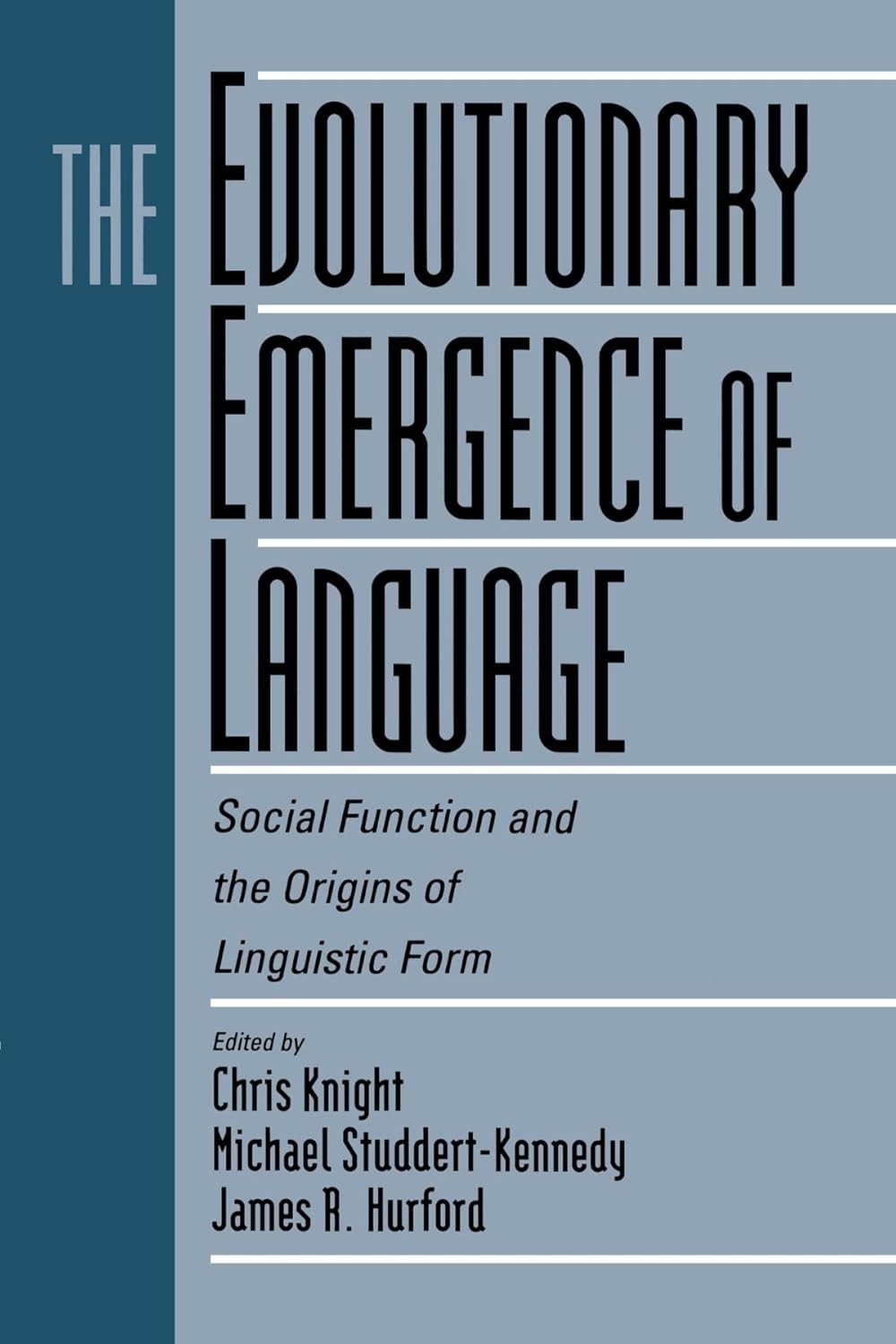
The Evolutionary Emergence of Language: Social Function and the Origins of Linguistic Form by Chris Knight – A Cambridge
Inclusive of all applicable taxes. FREE shipping on all orders.
Available Offers
- 🚚Free Delivery — Free shipping on all orders
- 💵Cash on Delivery — Pay when your order arrives
- ↩️15-Day Easy Returns — Hassle-free return policy
- 🔒Cash on Delivery — Pay safely when your order arrives
Check Delivery
Product Description
Introduction
Language, in its dazzling complexity and universal presence, remains one of the most profound mysteries of human existence. Unlike any other species, Homo sapiens possesses the extraordinary ability to weave thoughts into intricate strings of sounds and symbols. But how did this remarkable capacity arise? Was it a sudden evolutionary leap or a gradual social adaptation? The Evolutionary Emergence of Language: Social Function and the Origins of Linguistic Form, edited by Chris Knight and published by Cambridge University Press, dives deep into these questions. This hardcover volume brings together leading linguists, anthropologists, and cognitive scientists to explore language not as a mere biological fluke, but as a sophisticated social tool shaped by the unique pressures of human cooperation. For Indian readers, students, and researchers fascinated by the origins of communication, this book offers a compelling, evidence-based journey into our shared past.
Book Overview
This authoritative work presents a bold synthesis of the human and natural sciences, adopting a modern Darwinian perspective to explain why language is exclusive to our species. The central argument is that language evolved as a direct consequence of our biologically anomalous levels of social cooperation. Unlike the solitary communication systems of other animals, human language demands trust, shared intentionality, and a willingness to learn from others. The contributors build a case that phonetic competence, grammatical structure, and even syntax emerged from the social pressures of group living, vocal imitation, and cultural transmission. Rather than treating language as an isolated cognitive module, this book situates it firmly within the broader context of human social evolution, making it a landmark text for anyone interested in the deep history of our species.
Key Highlights
- Interdisciplinary Approach: Unites insights from linguistics, anthropology, evolutionary psychology, and cognitive science for a holistic understanding.
- Social Cooperation as a Driver: Presents the groundbreaking idea that language is rooted in our unique capacity for social cooperation and altruism.
- Modern Darwinian Framework: Applies evolutionary theory rigorously, avoiding simplistic just-so stories in favour of testable hypotheses.
- Phonetic and Syntactic Origins: Explores how vocal learning and social imitation gave rise to the complex sound systems and grammatical rules of speech.
- Global Relevance: While drawing on universal principles, the discussion remains accessible and engaging for readers across the world, including India’s diverse linguistic landscape.
Inside the Book
Readers will find a meticulously structured exploration of language origins. The opening chapters establish the theoretical groundwork, critiquing older models and proposing a cooperative framework. Subsequent sections delve into the evolution of speech sounds, the role of gesture and mimesis, and the emergence of syntax. Each chapter is written by a specialist, yet the editorial hand ensures a coherent narrative. The book avoids unnecessary jargon, making it suitable for advanced undergraduates, postgraduate students, and curious general readers. Case studies and comparative analyses with primate communication enrich the discussion, while the final chapters reflect on the implications for understanding human nature itself. This is not a dry academic tome; it is a vibrant conversation about what makes us human.
Key Topics
- The social brain hypothesis and language evolution
- Cooperative breeding and the origins of shared intentionality
- Vocal learning and phonetic diversity
- From protolanguage to fully modern syntax
- The role of cultural transmission in linguistic change
- Comparative perspectives on animal communication systems
- Evolutionary psychology and the modularity of language
Reader Benefits
By engaging with this book, you will gain a deeper appreciation for the social foundations of language. You will learn to think critically about evolutionary explanations and understand why human communication is fundamentally different from that of any other creature. The book equips you with a robust conceptual toolkit to evaluate competing theories in linguistics and anthropology. For Indian students, who often study multiple languages, the insights into how social cooperation shapes grammar and vocabulary will feel particularly relevant. Moreover, the hardcover edition from Cambridge University Press ensures durability, making it a valuable addition to any personal or institutional library.
Learning Outcomes
- Understand the key evolutionary pressures that led to the emergence of language.
- Analyse the relationship between social cooperation and linguistic complexity.
- Evaluate the evidence for language as a biological adaptation versus a cultural invention.
- Identify the roles of imitation, learning, and social transmission in phonetic development.
- Critique major theories of language origins using a Darwinian framework.
- Apply interdisciplinary perspectives to questions about human uniqueness.
Who Should Read
This book is ideal for undergraduate and postgraduate students of linguistics, anthropology, and evolutionary psychology. It will also appeal to researchers in cognitive science and philosophy of mind. For Indian readers, particularly those studying the rich tapestry of Indian languages, this volume provides a universal backdrop against which to understand local linguistic phenomena. General readers with a keen interest in human evolution or the science of communication will find it both accessible and intellectually stimulating. If you have ever wondered why we speak while chimpanzees do not, this book is for you.
About the Author
Chris Knight is a prominent anthropologist and a leading figure in the field of language evolution. He is a professor at the University of East London and a co-founder of the Evolution of Language conferences series. Knight is known for his pioneering work on the social origins of language, particularly the idea that female cooperative alliances and the need for social bonding drove the emergence of symbolic communication. His previous works, including Blood Relations: Menstruation and the Origins of Culture, have challenged conventional narratives in anthropology. In this edited volume, he brings together a stellar cast of contributors, ensuring a rigorous yet accessible discussion.
About the Publisher
Cambridge University Press is one of the world’s oldest and most respected academic publishers, with a history dating back to 1534. Known for its commitment to scholarly excellence, Cambridge University Press publishes groundbreaking works across all disciplines. This hardcover edition reflects the publisher’s high standards of editing, design, and durability. For Indian academics and students, a Cambridge title carries significant weight in research and coursework, making this book a trusted resource for serious study.
Conclusion
The Evolutionary Emergence of Language is more than a book; it is a gateway to understanding the very fabric of human society. By placing social cooperation at the heart of linguistic evolution, Chris Knight and his contributors offer a fresh and compelling narrative. Whether you are a student preparing for exams, a researcher seeking new insights, or a curious reader exploring the origins of speech, this volume will enrich your perspective. Order your hardcover copy from Bookshops.in today and embark on an intellectual journey that bridges biology, culture, and the magic of human communication.
Quick Summary
The Evolutionary Emergence of Language: Social Function and the Origins of Linguistic Form, edited by Chris Knight, is a landmark multidisciplinary volume published by Cambridge University Press. It brings together linguists, anthropologists, and cognitive scientists to examine language as a uniquely human trait that emerged from biologically anomalous levels of social cooperation. The book argues that phonetic competence and complex syntax are products of social pressures for vocal imitation, learning, and cultural transmission. Adopting a Darwinian framework, it synthesizes insights from the natural and human sciences to present language as a remarkable social adaptation. This hardcover edition is ideal for Indian postgraduate students, researchers, and academics in linguistics, anthropology, and cognitive science. Readers will gain a deep understanding of how cooperation shaped the very structure of speech. By purchasing from Bookshops.in, Indian customers receive a genuine, high-quality print edition with reliable delivery and customer support, making it a valuable addition to any academic library.
Book Highlights
Book Specifications
| ISBN-13 | 9780521781572 |
| ISBN-10 | 0521781574 |
| Publisher | Cambridge University Press |
| Language | English |
| Dimensions | 15.24 x 2.54 x 22.86 cm |
| Weight | 704 g |
| Country | India |
| Category | Humanities › Language & Linguistics |
| Genre | Non-fiction |
| Original Language | English |
Frequently Asked Questions
What is this book about?
Who edited this book?
Is this book suitable for beginners?
What disciplines are covered?
Does it include Indian perspectives?
Who is the publisher?
Is this a hardcover book?
What is the ISBN?
Can I use this for my university coursework?
Does it cover animal communication?
Is the book based on Darwinian theory?
What makes this book unique?
Where can I buy it in India?
Readers Also Search For
Customers Also Bought
Mathematics
Stereotype Spaces and Algebras: 73 (De Gruyter Expositions in Mathematics, 73)

Mathematics
Semigroups in Algebra, Geometry and Analysis: 20 (De Gruyter Expositions in Mathematics, 20)

Mathematics
Geometry from the Pacific Rim: Proceedings of the Pacific Rim Geometry Conference held at National University of Singapore, Republic of Singapore, ... 1994 (De Gruyter Proceedings in Mathematics)

Mathematics
First International Tainan-Moscow Algebra Workshop: Proceedings of the International Conference held at National Cheng Kung University Tainan, Taiwan, ... 1994 (De Gruyter Proceedings in Mathematics)

Mathematics
Differential Geometry - Proceedings of the VIII International Colloquium (English, Jesus A. Alvarez Lopez | Eduardo Garcia-Rio)

Mathematics
Mathematical Theory of Optimal Processes (Classics of Soviet Mathematics)
Related Products
View All
Science & Mathematics
Squid - Superconducting Quantum Interference Devices and Their Applications: Proceedings of the International Conference on Superconducting Quantum Devices, Berlin-west, October 4-8, 1976

Science & Mathematics
Thermodynamics and Pattern Formation in Biology
Science & Mathematics
The Nature of Mathematics and the Mathematics of Nature by S. Andersson – Mathematics & Science

Science & Mathematics
Linear Algebra | by Stephen Friedberg | Arnold Insel | Lawrence Spence | Pearson | by Stephen Friedberg | Arnold Insel | Lawrence Spence | Pearson | by Stephen Friedberg | Arnold Insel | Lawrence Spence | Pearson | by Stephen Friedberg | Arnold Insel | Lawrence Spence | Pearson | by Stephen Friedberg | Arnold Insel | Lawrence Spence | Pearson | by Stephen Friedberg | Arnold Insel | Lawrence Spence | Pearson | by Stephen Friedberg | Arnold Insel | Lawrence Spence | Pearson | by Stephen Friedberg

Science & Mathematics
University Calculus | by Joel Hass | Christopher Heil | Maurice Weir | Pearson | by Joel Hass | Christopher Heil | Maurice Weir | Pearson | by Joel Hass | Christopher Heil | Maurice Weir | Pearson | by Joel Hass | Christopher Heil | Maurice Weir | Pearson | by Joel Hass | Christopher Heil | Maurice Weir | Pearson | by Joel Hass | Christopher Heil | Maurice Weir | Pearson | by Joel Hass | Christopher Heil | Maurice Weir | Pearson | by Joel Hass | Christopher Heil | Maurice Weir | Pearson | by Joe
Science & Mathematics