
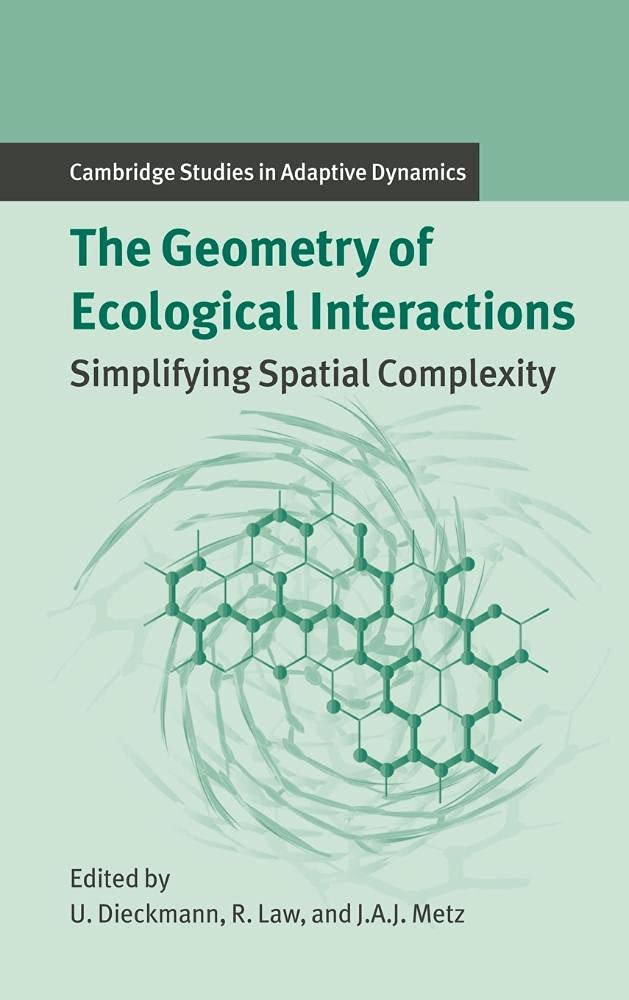
The Geometry of Ecological Interactions: Simplifying Spatial Complexity by Richard Law – A Cambridge University Press Pu
Inclusive of all applicable taxes. FREE shipping on all orders.
Available Offers
- 🚚Free Delivery — Free shipping on all orders
- 💵Cash on Delivery — Pay when your order arrives
- ↩️15-Day Easy Returns — Hassle-free return policy
- 🔒Cash on Delivery — Pay safely when your order arrives
Check Delivery
Product Description
Introduction
In the vast and intricate tapestry of nature, the spatial arrangement of organisms and their interactions forms the backbone of ecological dynamics. The Geometry of Ecological Interactions: Simplifying Spatial Complexity, authored by Richard Law and published by Cambridge University Press, is a seminal hardcover volume that delves into the mathematical and theoretical underpinnings of spatial ecology. For Indian researchers, graduate students, and enthusiasts in science and mathematics, this book offers a rigorous yet accessible pathway to understanding how spatial patterns shape ecological outcomes. It is an essential addition to any serious academic library, bridging field ecology with advanced quantitative methods.
Book Overview
This comprehensive text is designed to guide readers from foundational concepts to cutting-edge spatial theory. The book integrates perspectives from empirical ecology with novel mathematical frameworks, gradually increasing in sophistication. It addresses a critical question: how can we simplify the overwhelming complexity of spatial interactions to predict ecological phenomena? By focusing on emerging spatial patterns and their quantitative impacts, the volume sets the stage for 21st-century ecological theory. Written for a multidisciplinary audience, it serves as both a textbook and a reference work for those engaged in theoretical, evolutionary, and spatial ecology, as well as applied mathematics and spatial statistics.
Key Highlights
- Didactic progression from basic spatial concepts to advanced mathematical models, making it suitable for self-study or classroom use.
- World-renowned contributors who are leading experts in spatial ecology and theoretical biology.
- Emphasis on simplifying spatial complexity through innovative methods such as moment closure, pair approximations, and spatial point processes.
- Integration of field ecology with mathematical theory, providing real-world context for abstract models.
- Groundbreaking treatment of how spatial patterns quantitatively influence ecological outcomes like population persistence, species coexistence, and ecosystem stability.
Inside the Book
The volume is structured to offer a coherent journey through spatial ecological theory. Early chapters introduce fundamental spatial phenomena and the necessity of incorporating space into ecological models. As readers progress, they encounter detailed expositions of mathematical tools used to simplify spatial complexity, including lattice models, reaction-diffusion systems, and individual-based models. Each chapter includes illustrative examples, diagrams, and references to empirical studies. The book culminates in discussions of emerging frontiers, such as spatial pattern formation and the role of geometry in species interactions, ensuring that readers grasp both the theoretical depth and practical applications.
Key Topics
- Spatial pattern formation and its ecological consequences
- Moment closure and pair approximation methods for simplifying spatial models
- Lattice models and cellular automata in ecology
- Reaction-diffusion equations for population dynamics
- Individual-based and spatially explicit models
- Metapopulation theory and landscape ecology
- Spatial statistics and point processes for analyzing ecological data
- Evolution of spatial strategies and coexistence mechanisms
Reader Benefits
By engaging with this book, readers will develop a robust analytical framework for tackling spatial problems in ecology. They will learn to move beyond simplistic assumptions of homogeneity and embrace the geometric realities of natural systems. The gradual mathematical progression ensures that even those with a modest background in mathematics can build confidence. For Indian students preparing for competitive exams or research careers, the book provides a solid foundation in quantitative ecology. Researchers will appreciate the state-of-the-art methods that can be directly applied to their own work, whether studying forest dynamics, marine ecosystems, or agricultural landscapes.
Learning Outcomes
- Understand the fundamental role of space in ecological interactions and population dynamics.
- Apply mathematical techniques such as moment closure and pair approximations to simplify complex spatial systems.
- Analyze spatial patterns using statistical tools and interpret their ecological significance.
- Evaluate models of species coexistence, invasion, and extinction in spatially structured environments.
- Design original research projects that incorporate spatial complexity into ecological theory.
- Synthesize empirical observations with theoretical predictions for a deeper understanding of natural systems.
Who Should Read
This book is indispensable for graduate students and researchers in theoretical ecology, evolutionary biology, and spatial ecology. It is also highly relevant for applied mathematicians and statisticians seeking ecological applications, as well as advanced undergraduate students with a strong interest in quantitative biology. Indian ecologists working on biodiversity conservation, forest fragmentation, or climate change impacts will find the spatial frameworks directly useful. Additionally, faculty members teaching courses in population ecology, mathematical biology, or spatial statistics will benefit from the didactic structure and comprehensive coverage.
About the Author
Richard Law is a distinguished ecologist and mathematician whose work has profoundly influenced the field of theoretical ecology. With a career spanning decades, he has contributed extensively to the understanding of spatial dynamics, evolutionary theory, and population biology. His research often bridges the gap between abstract mathematical models and real-world ecological systems, making him a leading voice in simplifying spatial complexity. This book reflects his commitment to rigorous, accessible science that empowers the next generation of ecologists.
About the Publisher
Cambridge University Press is one of the world's oldest and most respected academic publishers, with a legacy of excellence in science and mathematics. Their publications are known for high editorial standards, authoritative content, and contributions to global scholarship. This hardcover edition is crafted with durability in mind, making it ideal for repeated reference in libraries, laboratories, and field stations across India.
Conclusion
The Geometry of Ecological Interactions: Simplifying Spatial Complexity is more than a textbook—it is a gateway to mastering the spatial dimension of ecology. For Indian students and researchers striving to understand the natural world in all its geometric richness, this volume provides the tools, insights, and inspiration needed to advance the field. By integrating empirical observations with mathematical elegance, Richard Law and his contributors have created a work that will remain relevant for decades. Order your copy from Bookshops.in today and deepen your engagement with the science of spatial ecology.
Quick Summary
The Geometry of Ecological Interactions: Simplifying Spatial Complexity by Richard Law is an authoritative volume that delves into the rapidly expanding field of theoretical ecology, with a special focus on spatial dynamics. Published by Cambridge University Press, this hardcover edition is crafted for researchers and graduate students who seek a rigorous yet accessible treatment of how spatial patterns shape ecological interactions. The book begins with foundational concepts and gradually advances to more complex mathematical models, making it suitable for readers with varying levels of expertise. It integrates perspectives from field ecology with innovative methods for simplifying spatial complexity, allowing ecologists to better predict and understand phenomena such as population distribution, metapopulation dynamics, and ecosystem resilience. Each chapter is written by world experts, offering a rich blend of theory and application. Readers will learn to analyze emerging spatial patterns and their quantitative impact on ecological outcomes, a crucial skill for modern ecology. By purchasing from Bookshops.in, Indian students and professionals gain access to a premium print edition that supports academic growth and research excellence.
Book Highlights
Book Specifications
| ISBN-13 | 9780521642941 |
| ISBN-10 | 0521642949 |
| Publisher | Cambridge University Press |
| Language | English |
| Dimensions | 15.24 x 3.18 x 22.86 cm |
| Weight | 1 kg 30 g |
| Country | India |
| Category | Civil Engineering › Ecology & Environment |
| Genre | Science & Mathematics |
| Reading Age | Adult |
| Original Language | English |
Frequently Asked Questions
What is The Geometry of Ecological Interactions about?
Who is the author of this book?
Who should read this book?
Is this book suitable for beginners in ecology?
What makes this book unique?
Does the book include case studies?
What is the ISBN?
Is this book available in hardcover?
What language is the book in?
Can Indian students benefit from this book?
Does the book cover mathematical modeling?
Where can I buy this book in India?
Readers Also Search For
Customers Also Bought
Mathematics
Stereotype Spaces and Algebras: 73 (De Gruyter Expositions in Mathematics, 73)
Mathematics
Semigroups in Algebra, Geometry and Analysis: 20 (De Gruyter Expositions in Mathematics, 20)

Mathematics
Geometry from the Pacific Rim: Proceedings of the Pacific Rim Geometry Conference held at National University of Singapore, Republic of Singapore, ... 1994 (De Gruyter Proceedings in Mathematics)
Mathematics
First International Tainan-Moscow Algebra Workshop: Proceedings of the International Conference held at National Cheng Kung University Tainan, Taiwan, ... 1994 (De Gruyter Proceedings in Mathematics)

Mathematics
Group Theory, Algebra, and Number Theory: Colloquium in Memory of Hans Zassenhaus held in Saarbrücken, Germany, June 4-5, 1993

Mathematics
Mathematical Theory of Optimal Processes (Classics of Soviet Mathematics)
Related Products
View All
Science & Mathematics
Squid - Superconducting Quantum Interference Devices and Their Applications: Proceedings of the International Conference on Superconducting Quantum Devices, Berlin-west, October 4-8, 1976
Science & Mathematics
Thermodynamics and Pattern Formation in Biology

Science & Mathematics
The Nature of Mathematics and the Mathematics of Nature by S. Andersson – Mathematics & Science

Science & Mathematics
Linear Algebra | by Stephen Friedberg | Arnold Insel | Lawrence Spence | Pearson | by Stephen Friedberg | Arnold Insel | Lawrence Spence | Pearson | by Stephen Friedberg | Arnold Insel | Lawrence Spence | Pearson | by Stephen Friedberg | Arnold Insel | Lawrence Spence | Pearson | by Stephen Friedberg | Arnold Insel | Lawrence Spence | Pearson | by Stephen Friedberg | Arnold Insel | Lawrence Spence | Pearson | by Stephen Friedberg | Arnold Insel | Lawrence Spence | Pearson | by Stephen Friedberg

Science & Mathematics
University Calculus | by Joel Hass | Christopher Heil | Maurice Weir | Pearson | by Joel Hass | Christopher Heil | Maurice Weir | Pearson | by Joel Hass | Christopher Heil | Maurice Weir | Pearson | by Joel Hass | Christopher Heil | Maurice Weir | Pearson | by Joel Hass | Christopher Heil | Maurice Weir | Pearson | by Joel Hass | Christopher Heil | Maurice Weir | Pearson | by Joel Hass | Christopher Heil | Maurice Weir | Pearson | by Joel Hass | Christopher Heil | Maurice Weir | Pearson | by Joe

Science & Mathematics