
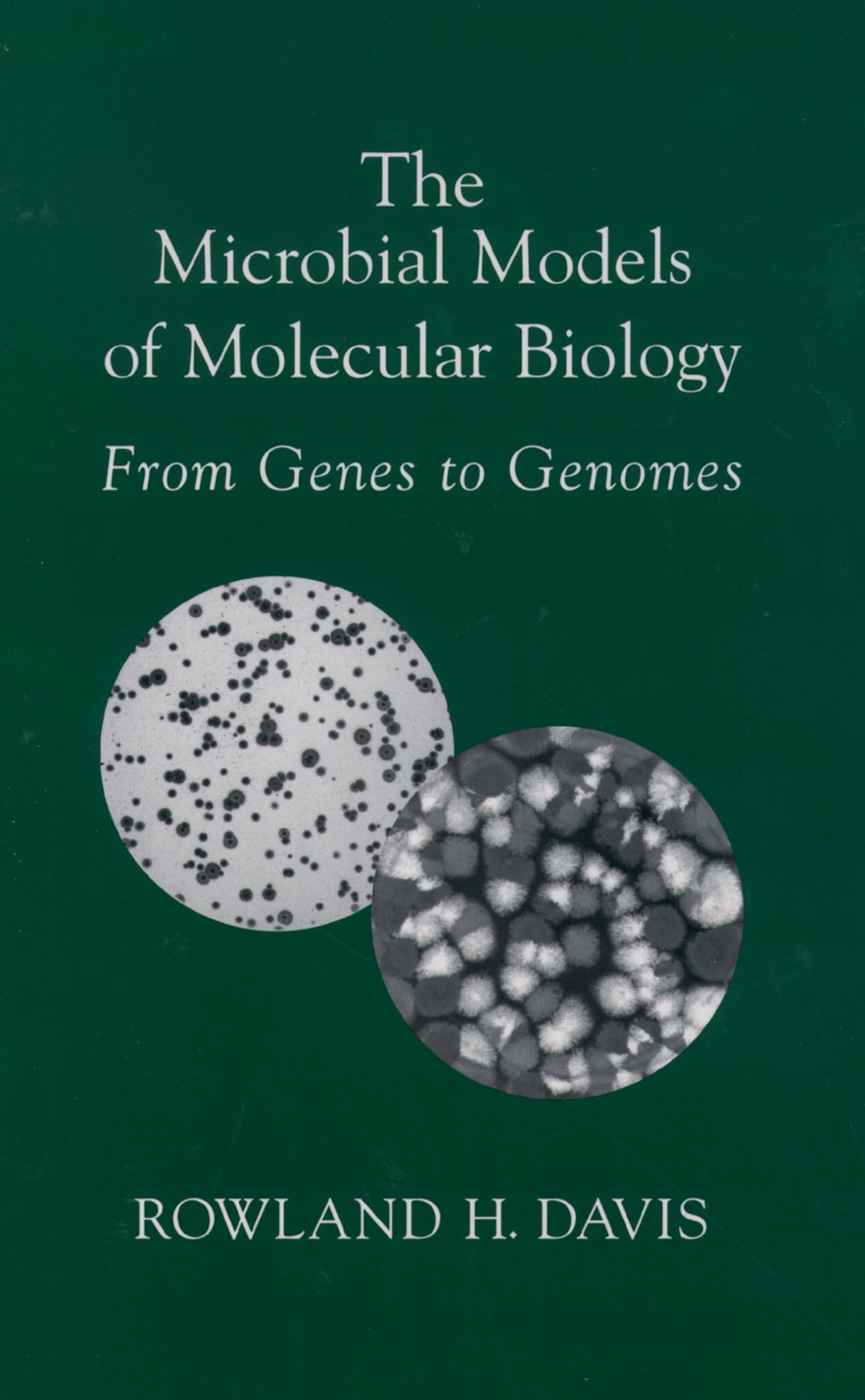
The Microbial Models of Molecular Biology: From Genes to Genomes by Rowland H. Davis – A Deep Dive into the History of M
Inclusive of all applicable taxes. FREE shipping on all orders.
Available Offers
- 🚚Free Delivery — Free shipping on all orders
- 💵Cash on Delivery — Pay when your order arrives
- ↩️15-Day Easy Returns — Hassle-free return policy
- 🔒Cash on Delivery — Pay safely when your order arrives
Check Delivery
Product Description
Introduction
In the vast tapestry of molecular biology, the threads of discovery are woven through the careful study of simple organisms. The Microbial Models of Molecular Biology: From Genes to Genomes by Rowland H. Davis offers a compelling journey into the foundational experiments that shaped our understanding of genes and genomes. For Indian students and researchers, this book serves as a bridge between classical genetics and modern molecular science, illuminating how humble microbes like bacteria, fungi, and algae became the heroes of biological breakthroughs.
Book Overview
This hardcover volume from Oxford University Press traces the evolution of molecular biology through the lens of model organisms. Davis masterfully narrates how scientists used Escherichia coli, bacteriophages, Paramecium, Chlamydomonas, Neurospora, Aspergillus, and yeast to answer fundamental questions about heredity, gene expression, and genome organization. The book moves seamlessly from prokaryotic systems to eukaryotic models, showing how each organism was chosen for its unique experimental advantages. It is not merely a history but a roadmap of scientific reasoning, perfect for anyone curious about how molecular biology grew from simple cultures to the genomic age.
Key Highlights
- Comprehensive coverage of model organisms from bacteria to fungi and algae
- Explains the shift from classical genetics to molecular approaches
- Highlights the communities of scientists who built each model system
- Connects historical experiments to modern genomic tools
- Written in an accessible narrative style suitable for students and researchers
Inside the Book
Davis begins with the early work on bacteriophages in E. coli, the cornerstone of molecular genetics. He then explores other prokaryotic systems, followed by protozoan and algal models like Paramecium and Chlamydomonas. The narrative moves into eukaryotic fungi—Neurospora, Aspergillus, and yeast—showing how each model answered specific biological questions. The book also discusses how some investigators transitioned between models, leaving remnant communities that continued to explore unanswered questions. The final chapters trace the flow of research into higher organisms, including mice and humans, demonstrating the enduring legacy of microbial models.
Key Topics
- Bacteriophage genetics and the birth of molecular biology
- Gene regulation in prokaryotes
- Protozoan models: Paramecium and Chlamydomonas
- Fungal genetics: Neurospora, Aspergillus, and yeast
- From model organisms to human genomics
- The evolution of experimental design in biology
Reader Benefits
- Gain a deep appreciation for how simple organisms unlock complex biological mechanisms
- Understand the logic behind choosing model systems for research
- Learn the historical context of landmark experiments
- Build a strong foundation for advanced studies in genetics and molecular biology
- Enhance your perspective on how science progresses through community and collaboration
Learning Outcomes
After reading this book, you will be able to trace the major milestones in molecular biology from the 1940s to the present. You will understand why certain organisms were chosen as models and how their study led to universal principles of gene action. You will also appreciate the interplay between technology and biological discovery, preparing you for deeper exploration of genomics and systems biology.
Who Should Read
- Undergraduate and postgraduate students in life sciences, biotechnology, and microbiology
- Researchers seeking a historical perspective on molecular biology
- Teachers and educators who want to enrich their lectures with real scientific stories
- Science enthusiasts curious about how we decoded the language of life
- Indian readers preparing for competitive exams like CSIR-NET, GATE, or ICMR
About the Author
Rowland H. Davis is a distinguished biologist and professor emeritus at the University of California, Irvine. With decades of research experience in fungal genetics and molecular biology, Davis brings an insider’s perspective to the history of model organisms. His expertise in Neurospora and yeast genetics lends authenticity and depth to the narrative, making this book both authoritative and engaging.
About the Publisher
Oxford University Press (OUP) is a globally respected academic publisher known for its rigorous editorial standards and wide-ranging catalog in science, medicine, and humanities. This hardcover edition reflects OUP’s commitment to producing high-quality reference works that serve students and scholars worldwide.
Conclusion
The Microbial Models of Molecular Biology: From Genes to Genomes is an essential addition to any Indian science library. It transforms the history of molecular biology into a vivid story of curiosity, ingenuity, and collaboration. Whether you are a student preparing for exams or a researcher seeking inspiration, this book will deepen your understanding of how simple microbes paved the way for the genomic revolution. Order your copy from Bookshops.in today and explore the hidden heroes of molecular science.
Quick Summary
The Microbial Models of Molecular Biology: From Genes to Genomes by Rowland H. Davis is a masterful historical account of how simple organisms—bacteriophages, E. coli, Paramecium, Chlamydomonas, Neurospora, Aspergillus, and yeast—became the workhorses of molecular biology. The book explains why each model was selected for specific experimental questions and how these choices shaped the trajectory of genetic and genomic research. Readers will learn about landmark experiments that revealed the nature of genes, DNA replication, gene regulation, and the transition from prokaryotic to eukaryotic systems. The narrative also highlights the scientific communities and individual researchers who drove these discoveries. This book is ideal for graduate students, researchers, and educators in molecular biology, genetics, and microbiology, especially those in India who seek a deeper understanding of the experimental roots of modern biology. By purchasing from Bookshops.in, you get a genuine hardcover edition with trusted service, supporting your academic journey with quality reading.
Book Highlights
Book Specifications
| ISBN-13 | 9780195154368 |
| ISBN-10 | 0195154363 |
| Publisher | OUP Oxford |
| Language | English |
| Dimensions | 16.21 x 2.46 x 24.13 cm |
| Weight | 726 g |
| Category | Basic Sciences › Genetics |
| Genre | Science & Mathematics |
| Original Language | English |
Frequently Asked Questions
What is the main focus of this book?
Who is Rowland H. Davis?
Is this book suitable for Indian students?
Does the book cover only prokaryotic models?
Is this book a textbook or a historical narrative?
What is the ISBN of this book?
Can I use this book for my PhD research?
What makes this book different from other molecular biology histories?
Does the book cover the work of famous scientists?
Is the book written in technical language?
What is the price of the book in India?
Where can I buy this book in India?
Readers Also Search For
Customers Also Bought

Anatomy
Ultrastructure of the Digestive Tract: 4 (Electron Microscopy in Biology and Medicine)

Anatomy
Ultrastructure of the Connective Tissue Matrix: 3 (Electron Microscopy in Biology and Medicine)

Anatomy
Reproductive Genetics (Royal College of Obstetricians and Gynaecologists Study Group)

Anatomy
Human Gross Anatomy: An Outline Text by Robert J. Leonard – Medical Anatomy

Pharmacology
Mathematical Modeling and Simulation in Enteric Neurobiology

Anatomy
Nature’s Patterns and the Fractional Calculus: 2 (Fractional Calculus in Applied Sciences and Engineering, 2)
Related Products
View All
Medicine & Health Sciences
Handbook of Hospitality Strategic Management | by Olsen Michael | Taylor & Francis Ltd | by Olsen Michael | Taylor & Francis Ltd | by Olsen Michael | Taylor & Francis Ltd | by Olsen Michael | Taylor & Francis Ltd | by Olsen Michael | Taylor & Francis Ltd | by Olsen Michael | Taylor & Francis Ltd | by Olsen Michael | Taylor & Francis Ltd | by Olsen Michael | Taylor & Francis Ltd | by Olsen Michael | Taylor & Francis Ltd | by Olsen Michael | Taylor & Francis
Medicine & Health Sciences
Pediatrics on Call | by Charles A. Pohl | Kathleen Bradford | Clara Callahan | McGraw Hill / Medical | by Charles A. Pohl | Kathleen Bradford | Clara Callahan | McGraw Hill / Medical | by Charles A. Pohl | Kathleen Bradford | Clara Callahan | McGraw Hill / Medical | by Charles A. Pohl | Kathleen Bradford | Clara Callahan | McGraw Hill / Medical | by Charles A. Pohl | Kathleen Bradford | Clara Callahan | McGraw Hill / Medical | by Charles A. Pohl | Kathleen Bradford | Clara Callahan | McGraw Hill

Medicine & Health Sciences
The Physician's Guide to Depression and Bipolar Disorders | by Dwight L. Evans | Dennis S. Charney | Lydia Lewis | McGraw Hill / Medical | by Dwight L. Evans | Dennis S. Charney | Lydia Lewis | McGraw Hill / Medical | by Dwight L. Evans | Dennis S. Charney | Lydia Lewis | McGraw Hill / Medical | by Dwight L. Evans | Dennis S. Charney | Lydia Lewis | McGraw Hill / Medical | by Dwight L. Evans | Dennis S. Charney | Lydia Lewis | McGraw Hill / Medical | by Dwight L. Evans | Dennis S. Charney | Lydi
Medicine & Health Sciences
First Exposure to Internal Medicine | by Andrew R. Hoellein | Charles H. Griffith | McGraw Hill / Medical | by Andrew R. Hoellein | Charles H. Griffith | McGraw Hill / Medical | by Andrew R. Hoellein | Charles H. Griffith | McGraw Hill / Medical | by Andrew R. Hoellein | Charles H. Griffith | McGraw Hill / Medical | by Andrew R. Hoellein | Charles H. Griffith | McGraw Hill / Medical | by Andrew R. Hoellein | Charles H. Griffith | McGraw Hill / Medical | by Andrew R. Hoellein | Charles H. Griffit
Medicine & Health Sciences
First Exposure to Internal Medicine | by Charles H. Griffith | Andrew R. Hoellein | McGraw Hill / Medical | by Charles H. Griffith | Andrew R. Hoellein | McGraw Hill / Medical | by Charles H. Griffith | Andrew R. Hoellein | McGraw Hill / Medical | by Charles H. Griffith | Andrew R. Hoellein | McGraw Hill / Medical | by Charles H. Griffith | Andrew R. Hoellein | McGraw Hill / Medical | by Charles H. Griffith | Andrew R. Hoellein | McGraw Hill / Medical | by Charles H. Griffith | Andrew R. Hoellei
Medicine & Health Sciences