
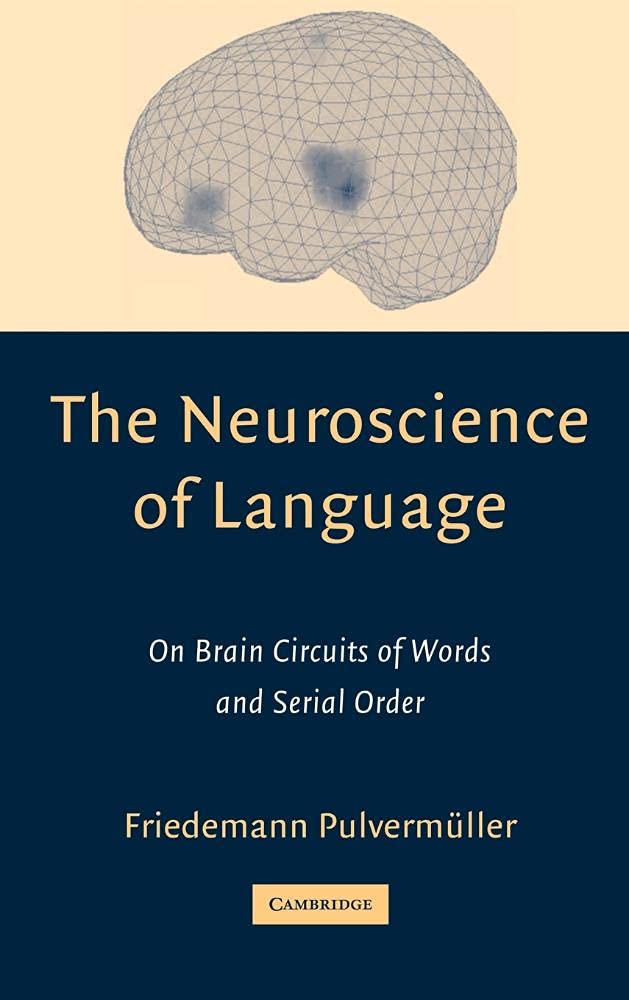
The Neuroscience of Language: On Brain Circuits of Words and Serial Order by Friedemann Pulvermuller – A Comprehensive G
Inclusive of all applicable taxes. FREE shipping on all orders.
Available Offers
- 🚚Free Delivery — Free shipping on all orders
- 💵Cash on Delivery — Pay when your order arrives
- ↩️15-Day Easy Returns — Hassle-free return policy
- 🔒Cash on Delivery — Pay safely when your order arrives
Check Delivery
Product Description
Introduction
How does the human brain weave words into meaning? How are neural circuits organized to produce and understand language? These profound questions lie at the heart of The Neuroscience of Language: On Brain Circuits of Words and Serial Order, a groundbreaking work by renowned cognitive neuroscientist Friedemann Pulvermüller. This hardcover volume, published by Cambridge University Press, offers a rigorous yet accessible exploration of the neural foundations of language, making it an essential resource for Indian students, researchers, and professionals in neuroscience, linguistics, psychology, and cognitive science.
Book Overview
Published in 2003, this book presents a systematic model that bridges the gap between linguistic theory and brain science. Pulvermüller introduces a computational, connectionist neural network approach to explain how words and serial order—the backbone of syntax—are processed in the brain. The book moves from fundamental neuronal structure and function to advanced topics like neural algorithms, basic syntax, and serial order mechanisms. Each concept is illustrated with clear examples, and excursuses provide interactive animations accessible via the book’s companion website, making complex ideas tangible. The text is designed to appeal to both graduate students and seasoned researchers, offering a unified framework for understanding language as a brain-based phenomenon.
Key Highlights
- Bridges Neuroscience and Linguistics: Provides a coherent model linking brain circuits with linguistic structures, a rare synthesis in the field.
- Focus on Words and Serial Order: Emphasizes how individual words are represented and how the brain sequences them into meaningful phrases.
- Computational Approach: Uses connectionist neural networks to simulate language processes, offering testable predictions.
- Comprehensive Coverage: Includes classical aphasia research, modern neuroimaging, and syntactic theories, all grounded in neurobiology.
- Interactive Companion: Excursuses link to animations that demonstrate brain models of language in action, enhancing understanding.
Inside the Book
The book is structured to guide readers from foundational knowledge to cutting-edge models. Introductory chapters cover neuronal structure and function, cognitive brain processes, and the basics of aphasia research and neuroimaging. Core chapters delve into neural algorithms and networks, basic syntax, serial order mechanisms, and neuronal grammar. Each chapter builds logically, with excursuses that pause to illustrate key models. The linguistic focus is on words and elementary syntactic rules, making the content accessible to those with a background in either neuroscience or linguistics.
Key Topics
- Neuronal Structure and Function: Basics of how neurons and neural circuits operate.
- Cognitive Brain Processes: How perception, memory, and action relate to language.
- Aphasia and Neuroimaging: Insights from brain damage and modern imaging techniques like fMRI and PET.
- Connectionist Neural Networks: Computational models that simulate language learning and processing.
- Serial Order in Syntax: How the brain sequences words in time, a core challenge in linguistics.
- Neuronal Grammar: A biologically grounded model of syntactic rules.
Reader Benefits
- Deep Understanding: Gain a clear, mechanistic view of how language emerges from brain activity.
- Interdisciplinary Skills: Learn to integrate concepts from neuroscience, linguistics, and computer science.
- Research Foundation: Equip yourself with a framework for designing experiments or interpreting neuroimaging data.
- Practical Illustrations: Benefit from animations and excursuses that make abstract models concrete.
- Academic Edge: Ideal for coursework, thesis work, or self-study in cognitive neuroscience or psycholinguistics.
Learning Outcomes
By reading this book, you will be able to: describe the neural basis of word and sentence processing; explain how connectionist networks model language functions; critically evaluate neuroimaging studies of language; apply the neuronal grammar model to understand syntactic deficits in aphasia; and synthesize insights from multiple disciplines to form a coherent picture of language in the brain.
Who Should Read
This book is indispensable for graduate students and researchers in neuroscience, linguistics, psychology, cognitive science, and computer science—especially those working on language, brain-computer interfaces, or artificial intelligence. It is also valuable for advanced undergraduates, clinicians in speech-language pathology, and anyone curious about the biological roots of human communication. Indian readers pursuing careers in academia, research institutes, or clinical practice will find it a rigorous yet rewarding read.
About the Author
Friedemann Pulvermüller is a leading figure in cognitive neuroscience, known for his pioneering work on the neural basis of language. He has held professorships at prestigious institutions including the University of Cambridge and the Free University of Berlin. His research combines neuroimaging, behavioral experiments, and computational modeling to understand how words and grammar are represented in the brain. This book distills decades of his groundbreaking research into a coherent and accessible volume.
About the Publisher
Cambridge University Press is a world-renowned academic publisher, known for its rigorous peer-review and high-quality scholarly works. With a history spanning over four centuries, Cambridge University Press publishes authoritative texts in science, humanities, and social sciences. This hardcover edition reflects their commitment to excellence, making it a trusted resource for students and researchers in India and around the globe.
Conclusion
The Neuroscience of Language is a landmark text that offers a deep, biologically plausible account of how the brain enables language. Whether you are a student embarking on research or a professional seeking to understand the latest models, this book provides the tools and insights to navigate the complex intersection of brain and language. Order your copy from Bookshops.in today and explore the neural circuits that make human communication possible.
Quick Summary
The Neuroscience of Language by Friedemann Pulvermuller is a seminal work that systematically explores how language is organized in the human brain. Published by Cambridge University Press, this hardcover book bridges the gap between linguistics and neuroscience by presenting a computational connectionist neural network model of word and serial order processing. It is designed for advanced students and researchers in cognitive neuroscience, psycholinguistics, and related fields. Readers will gain deep insights into neuronal structure, cognitive brain processes, classical aphasia research, modern neuroimaging, and neural network approaches to syntax. The book emphasizes the neural algorithms and circuits that underlie language, making it a vital resource for understanding the brain-language connection. By purchasing from Bookshops.in, Indian readers get a premium physical copy delivered to their doorstep, supporting a trusted local bookstore.
Book Highlights
Book Specifications
| ISBN-13 | 9780521790260 |
| ISBN-10 | 0521790263 |
| Publisher | Cambridge University Press |
| Language | English |
| Dimensions | 15.88 x 2.54 x 23.5 cm |
| Weight | 610 g |
| Country | India |
| Category | Basic Sciences › Neuroscience |
| Genre | Science & Mathematics |
| Original Language | English |
Frequently Asked Questions
What is The Neuroscience of Language about?
Who is the author of this book?
Is this book suitable for beginners?
What topics does the book cover?
Does the book include computational models?
How is this book different from other neuroscience books?
Can Indian students benefit from this book?
Is this a hardcover edition?
Does the book discuss aphasia?
What is the price in INR?
Is it available on Bookshops.in?
What is the ISBN?
Does the book include neuroimaging studies?
Readers Also Search For
Customers Also Bought

Anatomy
Ultrastructure of the Digestive Tract: 4 (Electron Microscopy in Biology and Medicine)

Anatomy
Ultrastructure of the Connective Tissue Matrix: 3 (Electron Microscopy in Biology and Medicine)

Anatomy
Reproductive Genetics (Royal College of Obstetricians and Gynaecologists Study Group)

Anatomy
Human Gross Anatomy: An Outline Text by Robert J. Leonard – Medical Anatomy

Pharmacology
Mathematical Modeling and Simulation in Enteric Neurobiology

Anatomy
Nature’s Patterns and the Fractional Calculus: 2 (Fractional Calculus in Applied Sciences and Engineering, 2)
Related Products
View All
Medicine & Health Sciences
Handbook of Hospitality Strategic Management | by Olsen Michael | Taylor & Francis Ltd | by Olsen Michael | Taylor & Francis Ltd | by Olsen Michael | Taylor & Francis Ltd | by Olsen Michael | Taylor & Francis Ltd | by Olsen Michael | Taylor & Francis Ltd | by Olsen Michael | Taylor & Francis Ltd | by Olsen Michael | Taylor & Francis Ltd | by Olsen Michael | Taylor & Francis Ltd | by Olsen Michael | Taylor & Francis Ltd | by Olsen Michael | Taylor & Francis

Medicine & Health Sciences
Pediatrics on Call | by Charles A. Pohl | Kathleen Bradford | Clara Callahan | McGraw Hill / Medical | by Charles A. Pohl | Kathleen Bradford | Clara Callahan | McGraw Hill / Medical | by Charles A. Pohl | Kathleen Bradford | Clara Callahan | McGraw Hill / Medical | by Charles A. Pohl | Kathleen Bradford | Clara Callahan | McGraw Hill / Medical | by Charles A. Pohl | Kathleen Bradford | Clara Callahan | McGraw Hill / Medical | by Charles A. Pohl | Kathleen Bradford | Clara Callahan | McGraw Hill

Medicine & Health Sciences
The Physician's Guide to Depression and Bipolar Disorders | by Dwight L. Evans | Dennis S. Charney | Lydia Lewis | McGraw Hill / Medical | by Dwight L. Evans | Dennis S. Charney | Lydia Lewis | McGraw Hill / Medical | by Dwight L. Evans | Dennis S. Charney | Lydia Lewis | McGraw Hill / Medical | by Dwight L. Evans | Dennis S. Charney | Lydia Lewis | McGraw Hill / Medical | by Dwight L. Evans | Dennis S. Charney | Lydia Lewis | McGraw Hill / Medical | by Dwight L. Evans | Dennis S. Charney | Lydi
Medicine & Health Sciences
First Exposure to Internal Medicine | by Andrew R. Hoellein | Charles H. Griffith | McGraw Hill / Medical | by Andrew R. Hoellein | Charles H. Griffith | McGraw Hill / Medical | by Andrew R. Hoellein | Charles H. Griffith | McGraw Hill / Medical | by Andrew R. Hoellein | Charles H. Griffith | McGraw Hill / Medical | by Andrew R. Hoellein | Charles H. Griffith | McGraw Hill / Medical | by Andrew R. Hoellein | Charles H. Griffith | McGraw Hill / Medical | by Andrew R. Hoellein | Charles H. Griffit

Medicine & Health Sciences
First Exposure to Internal Medicine | by Charles H. Griffith | Andrew R. Hoellein | McGraw Hill / Medical | by Charles H. Griffith | Andrew R. Hoellein | McGraw Hill / Medical | by Charles H. Griffith | Andrew R. Hoellein | McGraw Hill / Medical | by Charles H. Griffith | Andrew R. Hoellein | McGraw Hill / Medical | by Charles H. Griffith | Andrew R. Hoellein | McGraw Hill / Medical | by Charles H. Griffith | Andrew R. Hoellein | McGraw Hill / Medical | by Charles H. Griffith | Andrew R. Hoellei

Medicine & Health Sciences