
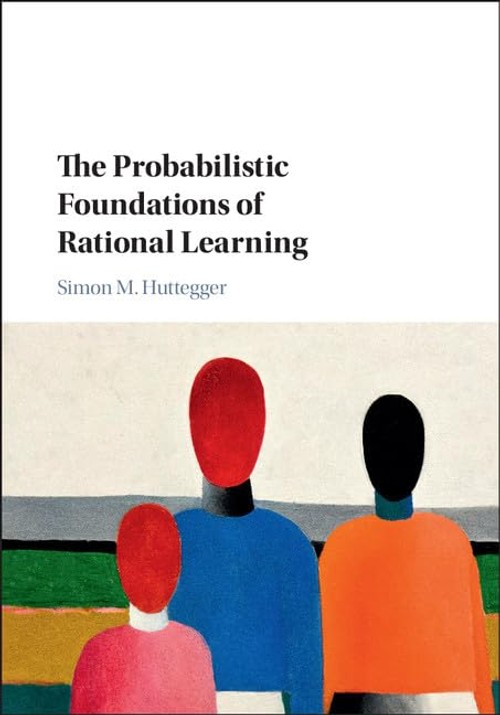
The Probabilistic Foundations of Rational Learning: A Bayesian Epistemology Approach by Simon M. Huttegger – For Philoso
Inclusive of all applicable taxes. FREE shipping on all orders.
Available Offers
- 🚚Free Delivery — Free shipping on all orders
- 💵Cash on Delivery — Pay when your order arrives
- ↩️15-Day Easy Returns — Hassle-free return policy
- 🔒Cash on Delivery — Pay safely when your order arrives
Check Delivery
Product Description
Introduction
In an age where data drives decisions and uncertainty shapes outcomes, the ability to learn rationally from experience is more valuable than ever. Simon M. Huttegger's The Probabilistic Foundations of Rational Learning offers a rigorous yet accessible exploration of how probability theory underpins the very process of learning. This book bridges philosophy, economics, and computer science, providing Indian students and researchers with a unified framework for understanding how agents update beliefs and make optimal choices in uncertain environments. Whether you are a philosopher of science, an economist modeling strategic behavior, or a psychologist studying human cognition, this volume is an indispensable addition to your library.
Book Overview
Published by the prestigious Cambridge University Press, this hardbound edition presents a comprehensive treatment of learning within the Bayesian paradigm. Huttegger develops a general approach that integrates Bayesian epistemology with decision theory and game theory, showing how probabilistic reasoning forms the bedrock of rational learning. The book moves from foundational principles to advanced applications, making it suitable for both graduate students and established scholars. Its interdisciplinary scope ensures relevance across philosophy, economics, psychology, and computer science—a truly cross-cutting resource for the Indian academic community.
Key Highlights
- Unified Bayesian Framework: Develops a coherent probabilistic approach to learning that connects epistemology, decision theory, and game theory.
- Rigorous Yet Accessible: Balances formal mathematical depth with clear conceptual explanations, ideal for advanced undergraduates and researchers.
- Interdisciplinary Relevance: Directly applicable to philosophy, economics, psychology, and computer science—perfect for cross-departmental study.
- Cutting-Edge Research: Incorporates recent developments in Bayesian epistemology and their implications for rational agency.
- Cambridge Quality: Published by one of the world's most respected academic presses, ensuring editorial excellence and scholarly credibility.
Inside the Book
The book systematically builds from basic probabilistic concepts to sophisticated models of learning and decision-making. Early chapters introduce the foundations of Bayesian epistemology, including conditionalization, coherence, and the representation of beliefs. Subsequent sections explore dynamic learning in strategic contexts, drawing on game theory to analyze how rational agents learn from interactions. Huttegger also addresses challenges such as convergence, consistency, and the role of priors, offering novel solutions that advance the field. Each chapter includes worked examples and exercises that reinforce understanding, making it an excellent textbook for Indian university courses on formal epistemology or decision theory.
Key Topics
- Bayesian epistemology and the logic of belief revision
- Probabilistic representations of uncertainty and learning
- Decision theory under risk and ambiguity
- Game-theoretic models of strategic learning
- Convergence and consistency of learning rules
- The role of priors and updating in rational agency
- Applications to social learning and information cascades
Reader Benefits
By engaging with this book, readers will gain a deep, principled understanding of how probability theory structures rational learning. You will learn to formalize belief updates, evaluate learning strategies, and apply these tools to real-world problems in economics, psychology, and artificial intelligence. The interdisciplinary approach allows you to see connections across fields, enhancing both theoretical insight and practical modeling skills. For Indian students preparing for competitive exams or research careers, this book provides a solid foundation in formal reasoning that is highly valued in academia and industry alike.
Learning Outcomes
- Understand the probabilistic foundations of rational belief and learning.
- Apply Bayesian updating to model how agents revise beliefs in light of new evidence.
- Analyze decision-making under uncertainty using formal probabilistic tools.
- Evaluate strategic learning in game-theoretic settings.
- Critically assess the assumptions and limitations of Bayesian learning models.
- Develop original research questions at the intersection of philosophy, economics, and cognitive science.
Who Should Read
This book is essential for graduate students and researchers in philosophy (especially epistemology and philosophy of science), economics (particularly microeconomics and game theory), psychology (cognitive and behavioral), and computer science (machine learning and AI). Advanced undergraduates with a solid background in probability and logic will also benefit. Indian academics looking to strengthen their quantitative foundations in the social sciences will find this volume a valuable reference. It is also suitable for self-study by professionals in data science and analytics who wish to understand the theoretical underpinnings of their work.
About the Author
Simon M. Huttegger is a professor of philosophy at the University of California, Irvine, where he also holds appointments in logic and philosophy of science. His research focuses on the formal foundations of rationality, learning, and evolution, with numerous publications in top journals such as the Journal of Philosophy, Philosophy of Science, and the British Journal for the Philosophy of Science. Huttegger's work is known for its mathematical rigor and interdisciplinary reach, making him a leading voice in contemporary formal epistemology and decision theory.
About the Publisher
Cambridge University Press is one of the world's oldest and most distinguished academic publishers, with a history dating back to 1534. Renowned for its commitment to excellence, the Press publishes cutting-edge research across all disciplines. This hardcover edition reflects Cambridge's hallmark quality—durable binding, clear typesetting, and meticulous editorial standards. For Indian readers, Cambridge University Press books are widely available through Bookshops.in and are trusted by universities across the country for their scholarly authority.
Conclusion
The Probabilistic Foundations of Rational Learning is a landmark work that will reshape how you think about learning, belief, and decision-making. By grounding rational learning in the elegant language of probability, Simon M. Huttegger provides tools that are as practical as they are profound. Whether you are a philosopher seeking deeper epistemological insights, an economist modeling strategic agents, or a computer scientist building intelligent systems, this book offers a rigorous and rewarding journey. Add this essential volume to your collection today from Bookshops.in—your trusted source for premium academic books in India.
Quick Summary
The Probabilistic Foundations of Rational Learning by Simon M. Huttegger is a rigorous academic work that establishes a Bayesian framework for understanding rational learning. It integrates probability theory with epistemology to explore how agents update beliefs, make decisions, and interact strategically. The book is intended for graduate students and researchers in philosophy, economics, psychology, and computer science who seek a formal, mathematically grounded approach to learning and rationality. Readers will gain deep insights into belief revision, conditional probability, decision theory, and game-theoretic learning. By purchasing from Bookshops.in, Indian students and academics receive a genuine hardcover edition from Cambridge University Press, ensuring reliable access to this essential reference for advanced study.
Book Highlights
Book Specifications
| ISBN-13 | 9781107115323 |
| ISBN-10 | 1107115329 |
| Publisher | Cambridge English |
| Language | English |
| Dimensions | 17.78 x 1.91 x 25.4 cm |
| Weight | 550 g |
| Country | India |
| Category | International Entrance Exams › GRE |
| Genre | Non-fiction |
| Reading Age | Adult |
| Original Language | English |
Frequently Asked Questions
What is the main topic of this book?
Who is the author?
Is this book suitable for beginners?
Does this book cover game theory?
What is Bayesian epistemology?
Can computer scientists benefit from this book?
Is this book available in hardcover?
Does it include exercises or problems?
How does this book relate to decision theory?
Is this book used in Indian universities?
What is the ISBN?
Can I use this book for self-study?
Does the book discuss machine learning?
Why buy from Bookshops.in?
Readers Also Search For
Customers Also Bought
Related Products
View All
Exam Preparation
American Literature in Transition, 1970–1980
Exam Preparation
500 SAT Reading, Writing and Language Questions to Know by Test Day by Inc Anaxos
Exam Preparation
Chaotic Dynamics by Geoffrey R. Goodson – Dynamical Systems

Exam Preparation
Mindfulness and Performance by Amy L. Baltzell – Performance Psychology

Exam Preparation
Probability on Real Lie Algebras

Exam Preparation