
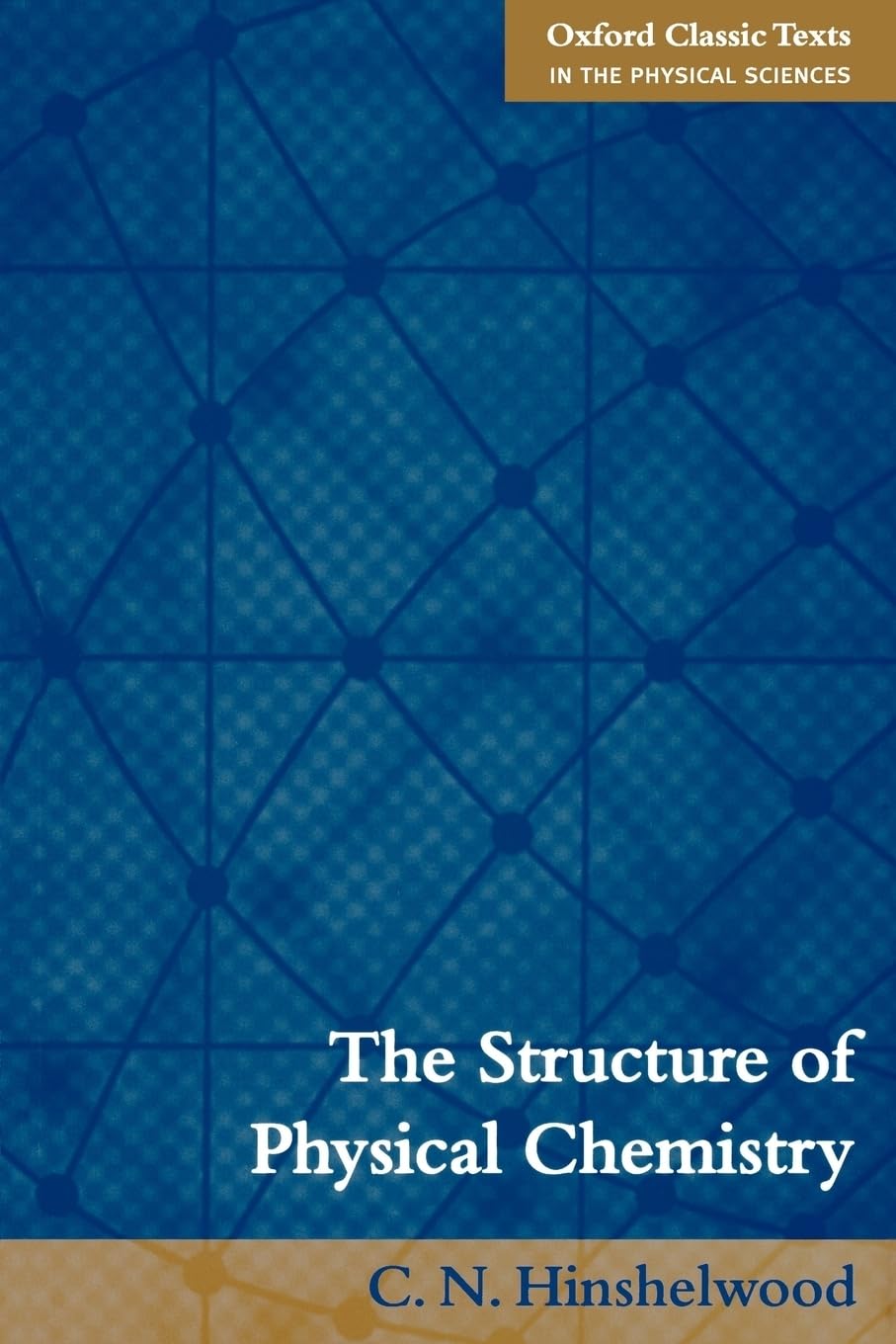
The Structure of Physical Chemistry by Sir Cyril Hinshelwood – A Unified Approach to the Subject for Advanced Learners
Inclusive of all applicable taxes. FREE shipping on all orders.
Available Offers
- 🚚Free Delivery — Free shipping on all orders
- 💵Cash on Delivery — Pay when your order arrives
- ↩️15-Day Easy Returns — Hassle-free return policy
- 🔒Cash on Delivery — Pay safely when your order arrives
Check Delivery
Product Description
Introduction
For students and enthusiasts of chemistry who seek a deeper, more connected understanding of physical chemistry, The Structure of Physical Chemistry by Nobel laureate Sir Cyril Hinshelwood stands as a timeless classic. This hardbound volume, published by OUP Oxford, is not merely a textbook but a thoughtful exploration of the subject's conceptual framework. It is designed to guide Indian readers through the intricate web of principles that govern matter and energy, making it an indispensable addition to any serious science library.
Book Overview
This book is a masterful synthesis of the entire field of physical chemistry. Rather than presenting a fragmented collection of topics, Hinshelwood weaves together the core ideas—such as thermodynamics, kinetics, quantum theory, and molecular structure—into a coherent narrative. The emphasis is on the structure and continuity of the subject, showing how each part relates to the whole. It is ideal for university students, researchers, and teachers who want to see the 'big picture' without losing sight of the details.
Key Highlights
- Unified approach: The book uses recurring themes (or 'leitmotifs') to connect different branches of physical chemistry.
- Conceptual depth: Focuses on the logic and reasoning behind chemical phenomena, not just formulas.
- Authoritative author: Written by Sir Cyril Hinshelwood, a Nobel Prize winner in Chemistry (1956) and a renowned educator.
- Premium hardcover edition: Durable binding suitable for long-term reference and study.
- Indian context relevant: Aligns with advanced undergraduate and postgraduate curricula in Indian universities.
Inside the Book
The book opens with a discussion of the fundamental nature of physical chemistry, then moves systematically through topics like the laws of thermodynamics, statistical mechanics, reaction rates, and the quantum mechanical view of atoms and molecules. Each chapter builds upon the previous one, creating a logical progression that mirrors how an inquiring mind would naturally explore the subject. The text is rich with explanatory prose, making complex ideas accessible without oversimplification.
Key Topics
- Thermodynamics and the concept of energy
- Kinetic theory of gases and transport phenomena
- Chemical kinetics and reaction mechanisms
- Quantum theory and atomic structure
- Molecular spectroscopy and bonding
- Electrochemistry and surface chemistry
- Statistical mechanics and the nature of entropy
Reader Benefits
Readers will gain a holistic perspective of physical chemistry that is often missing in conventional textbooks. The book helps in developing analytical thinking and a deeper appreciation of how physical laws govern chemical behavior. It is particularly useful for those preparing for competitive exams like GATE, CSIR-NET, or IIT-JAM, as it clarifies foundational concepts. The clear, non-mathematical explanations also make it a great companion for self-study.
Learning Outcomes
- Understand the interconnections between thermodynamics, kinetics, and quantum mechanics.
- Apply unified principles to solve complex chemical problems.
- Develop a conceptual framework that supports advanced research or teaching.
- Gain confidence in explaining physical chemistry topics from first principles.
Who Should Read
This book is ideal for undergraduate and postgraduate students of chemistry, physics, and chemical engineering. It is also highly recommended for teachers and professors who want to refresh their understanding or incorporate a thematic approach into their lectures. Research scholars and professionals in the pharmaceutical, materials, and energy sectors will find it a valuable reference for understanding the theoretical underpinnings of their work.
About the Author
Sir Cyril Norman Hinshelwood (1897–1967) was a British chemist and a Nobel laureate. He spent most of his academic career at the University of Oxford, where he made pioneering contributions to chemical kinetics and the understanding of reaction mechanisms. His work on the hydrogen-oxygen reaction and bacterial growth kinetics earned him international acclaim. Hinshelwood was also a gifted writer and teacher, known for his ability to present complex scientific ideas with elegance and clarity.
About the Publisher
OUP Oxford (Oxford University Press) is one of the oldest and most respected academic publishing houses in the world. With a legacy spanning over 500 years, OUP is synonymous with scholarly excellence and rigorous editorial standards. This edition of The Structure of Physical Chemistry reflects OUP's commitment to bringing authoritative scientific works to students and researchers globally, including in India.
Conclusion
The Structure of Physical Chemistry is more than a textbook—it is a guided journey through the intellectual landscape of one of science's most fascinating disciplines. Whether you are a student grappling with the basics or a seasoned researcher seeking a fresh perspective, this book offers enduring insights. Order your hardcover copy today from Bookshops.in and experience physical chemistry as it was meant to be understood: as a unified, beautiful whole.
Quick Summary
The Structure of Physical Chemistry by Sir Cyril Hinshelwood is a classic text that offers a uniquely unified perspective on the subject. Rather than presenting topics in isolation, it traces the leitmotifs—thermodynamics, kinetics, quantum chemistry, and molecular structure—that run through physical chemistry, showing how they connect and support each other. Written for advanced undergraduate and postgraduate students, the book encourages an inquisitive, natural approach to learning, guiding readers to understand the logical framework behind chemical phenomena. Hinshelwood, a Nobel laureate, brings profound insight and clarity, making complex ideas accessible. This hardcover edition from OUP Oxford is ideal for Indian students preparing for university exams, research, or teaching careers. By choosing Bookshops.in, you get a genuine, high-quality print edition with reliable delivery across India, supporting your academic journey with trusted resources.
Book Highlights
Book Specifications
| ISBN-13 | 9780198570257 |
| ISBN-10 | 0198570252 |
| Publisher | Oxford Univ Pr on Demand |
| Language | English |
| Dimensions | 15.88 x 2.79 x 23.5 cm |
| Weight | 748 g |
| Country | India |
| Category | Mechanical Engineering › Material Science & Engineering |
| Genre | Science & Mathematics |
| Original Language | English |
Frequently Asked Questions
What is The Structure of Physical Chemistry about?
Who is the author of this book?
Is this book suitable for Indian university students?
What is the ISBN for this book?
Is the book available in hardcover?
Does this book include exercises or problems?
Can I use this book for self-study?
What makes this book different from other physical chemistry textbooks?
Is the book written in simple language?
Does the book cover quantum chemistry?
What is the price of the book?
Where can I buy this book in India?
Readers Also Search For
Customers Also Bought

Mathematics
Stereotype Spaces and Algebras: 73 (De Gruyter Expositions in Mathematics, 73)

Mathematics
Semigroups in Algebra, Geometry and Analysis: 20 (De Gruyter Expositions in Mathematics, 20)

Mathematics
Geometry from the Pacific Rim: Proceedings of the Pacific Rim Geometry Conference held at National University of Singapore, Republic of Singapore, ... 1994 (De Gruyter Proceedings in Mathematics)

Mathematics
First International Tainan-Moscow Algebra Workshop: Proceedings of the International Conference held at National Cheng Kung University Tainan, Taiwan, ... 1994 (De Gruyter Proceedings in Mathematics)
Mathematics
Differential Geometry - Proceedings of the VIII International Colloquium (English, Jesus A. Alvarez Lopez | Eduardo Garcia-Rio)
Mathematics
Mathematical Theory of Optimal Processes (Classics of Soviet Mathematics)
Related Products
View All
Science & Mathematics
Squid - Superconducting Quantum Interference Devices and Their Applications: Proceedings of the International Conference on Superconducting Quantum Devices, Berlin-west, October 4-8, 1976

Science & Mathematics
Thermodynamics and Pattern Formation in Biology
Science & Mathematics
The Nature of Mathematics and the Mathematics of Nature by S. Andersson – Mathematics & Science

Science & Mathematics
Linear Algebra | by Stephen Friedberg | Arnold Insel | Lawrence Spence | Pearson | by Stephen Friedberg | Arnold Insel | Lawrence Spence | Pearson | by Stephen Friedberg | Arnold Insel | Lawrence Spence | Pearson | by Stephen Friedberg | Arnold Insel | Lawrence Spence | Pearson | by Stephen Friedberg | Arnold Insel | Lawrence Spence | Pearson | by Stephen Friedberg | Arnold Insel | Lawrence Spence | Pearson | by Stephen Friedberg | Arnold Insel | Lawrence Spence | Pearson | by Stephen Friedberg
Science & Mathematics
University Calculus | by Joel Hass | Christopher Heil | Maurice Weir | Pearson | by Joel Hass | Christopher Heil | Maurice Weir | Pearson | by Joel Hass | Christopher Heil | Maurice Weir | Pearson | by Joel Hass | Christopher Heil | Maurice Weir | Pearson | by Joel Hass | Christopher Heil | Maurice Weir | Pearson | by Joel Hass | Christopher Heil | Maurice Weir | Pearson | by Joel Hass | Christopher Heil | Maurice Weir | Pearson | by Joel Hass | Christopher Heil | Maurice Weir | Pearson | by Joe

Science & Mathematics