
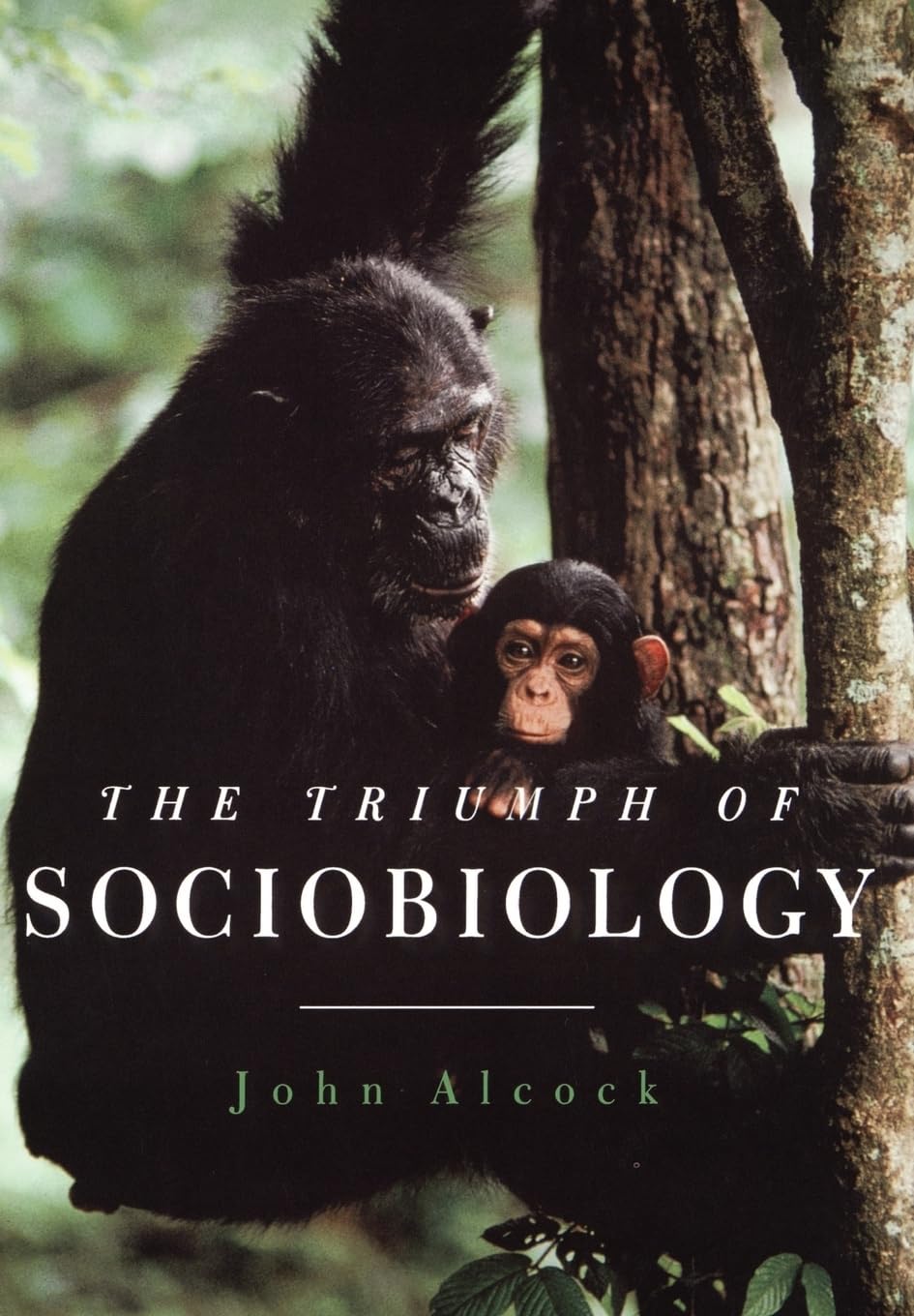
The Triumph of Sociobiology: John Alcock's Defence of Evolutionary Approaches to Human and Animal Social Behaviour
Inclusive of all applicable taxes. FREE shipping on all orders.
Available Offers
- 🚚Free Delivery — Free shipping on all orders
- 💵Cash on Delivery — Pay when your order arrives
- ↩️15-Day Easy Returns — Hassle-free return policy
- 🔒Cash on Delivery — Pay safely when your order arrives
Check Delivery
Product Description
Introduction
In the landscape of evolutionary science, few debates have been as heated and enduring as the one surrounding sociobiology. John Alcock's The Triumph of Sociobiology offers a lucid, compelling, and balanced examination of how this field has not only survived fierce ideological attacks but has emerged as a cornerstone of modern behavioral biology. For Indian readers—students, researchers, and curious minds alike—this book provides a rare opportunity to understand human social behavior through the lens of evolution, without the political baggage that often clouds the discussion.
Book Overview
Published by Oxford University Press, this hardcover edition is a masterful synthesis of science and reason. Alcock revisits the controversy ignited by E.O. Wilson's 1975 landmark work, Sociobiology: The New Synthesis, and demonstrates how sociobiology has triumphed over its critics. The book systematically dismantles misconceptions, showing that evolutionary approaches to human behavior are not only valid but essential for understanding why we act the way we do—from sexual jealousy to parental investment, from beauty standards to gender differences.
Key Highlights
- Rigorous yet accessible – Alcock writes for both specialists and general readers, making complex evolutionary concepts easy to grasp.
- Case-study driven – Real-world examples, including discussions on rape, parent-offspring conflict, and mate selection, bring theory to life.
- Balanced perspective – The author addresses ideological objections head-on, offering a fair hearing to critics while defending the scientific method.
- Timely relevance – Even decades after its original debates, the book remains a vital resource for understanding human nature in the Indian context.
Inside the Book
Alcock begins by tracing the origins of sociobiology and the firestorm of criticism it faced—accused of justifying racism, sexism, and social inequality. He then methodically presents the evidence: how natural selection shapes behavior in animals and humans alike. Each chapter tackles a specific topic, from the evolution of altruism to the biology of beauty. The writing is crisp, the arguments are tight, and the tone is refreshingly free of jargon. Readers will find themselves engaged in a detective story of scientific discovery.
Key Topics
- The history of the sociobiology controversy
- Evolutionary explanations for sexual jealousy and mate choice
- Parent-offspring conflict and family dynamics
- The biological basis of beauty and attractiveness
- Gender differences from an evolutionary perspective
- The sociobiology of rape and violence
- Critiques of sociobiology and their refutations
- How natural selection shapes human social behavior
Reader Benefits
This book empowers you to think critically about human behavior. It challenges popular myths and provides a scientific framework for understanding why people act in certain ways—whether in relationships, families, or societies. Indian readers, in particular, will find the discussions on kinship, arranged marriages, and social hierarchies enlightening. The book also helps in separating ideological rhetoric from empirical evidence, a skill increasingly valuable in today's information age.
Learning Outcomes
After reading this book, you will be able to: articulate the core principles of sociobiology and how they apply to humans; evaluate common criticisms of evolutionary psychology with evidence-based reasoning; understand the evolutionary roots of behaviors like jealousy, altruism, and aggression; apply sociobiological concepts to real-world social issues; and appreciate the scientific method as a tool for studying complex human phenomena.
Who Should Read
This book is ideal for undergraduate and postgraduate students in biology, psychology, anthropology, and sociology. It is equally valuable for teachers, researchers, and anyone interested in the science behind human nature. If you are a parent, educator, or policy maker seeking a deeper understanding of human behavior, this book will serve as an indispensable guide. It is also a must-read for those who enjoy intellectual debates and want to see how science triumphs over ideology.
About the Author
John Alcock is a renowned animal behaviorist and professor emeritus at Arizona State University. He has authored numerous textbooks and popular science books, including Animal Behavior: An Evolutionary Approach. His writing is celebrated for its clarity, wit, and unwavering commitment to scientific truth. Alcock's expertise in behavioral ecology makes him the perfect guide through the sociobiology debate.
About the Publisher
Oxford University Press is one of the oldest and most respected academic publishers in the world. With a legacy of excellence spanning over five centuries, OUP is synonymous with rigorous scholarship and high-quality publications. This hardcover edition reflects their commitment to producing durable, beautifully crafted books that stand the test of time.
Conclusion
The Triumph of Sociobiology is more than a book—it is a testament to the power of science to illuminate the darkest corners of human behavior. John Alcock's balanced, evidence-based approach will change the way you see yourself and others. For anyone in India with an interest in the biological roots of social life, this book is an essential addition to your library. Order your copy today from Bookshops.in and join the ranks of those who understand that evolution is not just about the past—it is about who we are right now.
Quick Summary
The Triumph of Sociobiology by John Alcock is a compelling and accessible account of how the evolutionary study of social behavior overcame fierce opposition to become a respected scientific field. Alcock, a distinguished animal behaviorist, takes readers through the stormy reception of E.O. Wilson's 1975 classic Sociobiology and demonstrates how subsequent research vindicated the core ideas. The book explains how natural selection shapes behaviors like altruism, aggression, mating, and parenting across species, including humans. It directly confronts common misconceptions—such as the charge of genetic determinism—and shows that sociobiology generates testable hypotheses that integrate with genetics, neuroscience, and anthropology. This book is ideal for Indian students and readers interested in biology, psychology, or the nature-nurture debate. By choosing Bookshops.in, you get a genuine Oxford University Press hardcover at a competitive price, delivered to your doorstep. Whether you are a university student, a teacher, or a curious reader, this book will deepen your understanding of the evolutionary roots of social life and why sociobiology has truly triumphed.
Book Highlights
Book Specifications
| ISBN-13 | 9780195143836 |
| ISBN-10 | 0195143833 |
| Publisher | Oxford Univ Pr on Demand |
| Language | English |
| Dimensions | 24.36 x 16.36 x 2.41 cm |
| Weight | 544 g |
| Category | Biology & Life Sciences › Zoology |
| Genre | Non-fiction |
| Original Language | English |
Frequently Asked Questions
What is The Triumph of Sociobiology about?
Who is John Alcock?
Is this book suitable for beginners?
Does the book cover human behavior?
How does this book relate to E.O. Wilson's Sociobiology?
What are the main criticisms of sociobiology addressed in the book?
Can this book be used as a textbook?
Is the book still relevant today?
Does the book include examples from Indian species?
What is the price of The Triumph of Sociobiology on Bookshops.in?
Is this book only for science students?
What makes this book different from other sociobiology texts?
Can I find this book in Indian bookstores?
Readers Also Search For
Customers Also Bought
Mathematics
Stereotype Spaces and Algebras: 73 (De Gruyter Expositions in Mathematics, 73)

Mathematics
Semigroups in Algebra, Geometry and Analysis: 20 (De Gruyter Expositions in Mathematics, 20)

Mathematics
Geometry from the Pacific Rim: Proceedings of the Pacific Rim Geometry Conference held at National University of Singapore, Republic of Singapore, ... 1994 (De Gruyter Proceedings in Mathematics)

Mathematics
First International Tainan-Moscow Algebra Workshop: Proceedings of the International Conference held at National Cheng Kung University Tainan, Taiwan, ... 1994 (De Gruyter Proceedings in Mathematics)

Mathematics
Differential Geometry - Proceedings of the VIII International Colloquium (English, Jesus A. Alvarez Lopez | Eduardo Garcia-Rio)

Mathematics
Mathematical Theory of Optimal Processes (Classics of Soviet Mathematics)
Related Products
View All
Science & Mathematics
Elements of Pelagos Biology: With Focus on the Mediterranean Sea
Science & Mathematics
Squid - Superconducting Quantum Interference Devices and Their Applications: Proceedings of the International Conference on Superconducting Quantum Devices, Berlin-west, October 4-8, 1976
Science & Mathematics
Thermodynamics and Pattern Formation in Biology
Science & Mathematics
The Nature of Mathematics and the Mathematics of Nature by S. Andersson – Mathematics & Science

Science & Mathematics
Linear Algebra | by Stephen Friedberg | Arnold Insel | Lawrence Spence | Pearson | by Stephen Friedberg | Arnold Insel | Lawrence Spence | Pearson | by Stephen Friedberg | Arnold Insel | Lawrence Spence | Pearson | by Stephen Friedberg | Arnold Insel | Lawrence Spence | Pearson | by Stephen Friedberg | Arnold Insel | Lawrence Spence | Pearson | by Stephen Friedberg | Arnold Insel | Lawrence Spence | Pearson | by Stephen Friedberg | Arnold Insel | Lawrence Spence | Pearson | by Stephen Friedberg

Science & Mathematics