
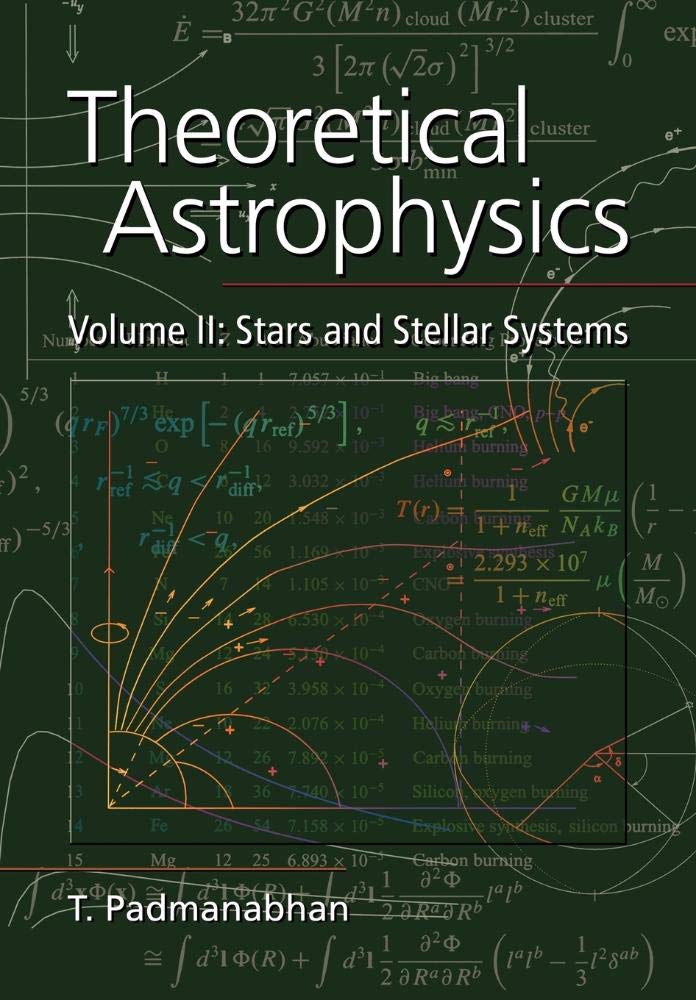
Theoretical Astrophysics: Stars and Stellar Systems – A Graduate Textbook on Stellar Physics by T. R. Padmanabhan
Inclusive of all applicable taxes. FREE shipping on all orders.
Available Offers
- 🚚Free Delivery — Free shipping on all orders
- 💵Cash on Delivery — Pay when your order arrives
- ↩️15-Day Easy Returns — Hassle-free return policy
- 🔒Cash on Delivery — Pay safely when your order arrives
Check Delivery
Product Description
Introduction
Theoretical Astrophysics: Volume 2, Stars and Stellar Systems by T. R. Padmanabhan is a masterful exploration of stellar physics, designed to bridge the gap between foundational concepts and advanced research. As the second volume in a celebrated three-part series published by Cambridge University Press, this hardbound edition serves as an essential resource for graduate students, researchers, and astrophysics enthusiasts in India and beyond. With its rigorous yet accessible approach, the book equips readers with a deep understanding of the physical processes that govern stars, from their birth to their ultimate fate as remnants.
Book Overview
This authoritative textbook stands as a comprehensive guide to stellar and stellar system physics. Padmanabhan carefully balances theoretical depth with observational insights, ensuring that readers not only grasp the mathematics but also appreciate the real-world phenomena of stars. The book is modular in design, allowing each chapter to be studied independently while maintaining a coherent narrative flow. It can be used alongside Volume I (which covers astrophysical processes) or as a standalone text, making it a versatile addition to any academic library.
Key Highlights
- Comprehensive Coverage: From stellar structure and evolution to the physics of compact objects, pulsars, and binary systems, this book leaves no stone unturned.
- Modular Structure: Each chapter is self-contained, enabling flexible learning paths for students and researchers.
- Observational Foundation: The book begins with a review of key observational results and nomenclature, grounding theoretical concepts in real astronomical data.
- Advanced Topics: Includes detailed discussions on stellar remnants, neutron stars, planetary systems, and the Sun, preparing readers for cutting-edge research.
- Pedagogical Approach: Clear derivations, worked examples, and problem sets reinforce learning and encourage independent thinking.
Inside the Book
The content is organized into well-structured chapters that progress from basic principles to complex phenomena. Early sections revisit stellar astronomy basics, including classification, luminosity, and spectral types. Subsequent chapters delve into the physics of stellar interiors, nuclear fusion, energy transport, and the equations of stellar structure. The book then explores stellar evolution across the Hertzsprung-Russell diagram, the formation of white dwarfs, neutron stars, and black holes, and the dynamics of binary systems. A dedicated section on the Sun and planetary systems provides a local perspective, tying stellar physics to our cosmic neighbourhood.
Key Topics
- Stellar Structure and Evolution: Equations of state, hydrostatic equilibrium, and evolutionary tracks.
- Stellar Remnants: White dwarfs, neutron stars, and pulsars—physics of degenerate matter and magnetic fields.
- Binary and Multiple Star Systems: Mass transfer, accretion processes, and X-ray binaries.
- The Sun and Planetary Systems: Solar physics, helioseismology, and formation of planets.
- Observational Techniques: Nomenclature, magnitude systems, and data interpretation.
Reader Benefits
This volume empowers readers with a solid conceptual framework and quantitative skills needed to tackle research problems in stellar astrophysics. The modular design allows students to focus on specific areas without losing context, while the advanced coverage prepares them for doctoral-level work. Indian students will appreciate the clear exposition and the inclusion of both classical and modern topics, making it ideal for courses in Indian universities and for self-study.
Learning Outcomes
- Understand the fundamental physical principles governing stars, including thermodynamics, nuclear reactions, and radiative transfer.
- Analyze stellar structure using mathematical models and compare them with observational data.
- Trace the evolutionary pathways of stars from formation to final remnants.
- Interpret the properties of binary systems and their role in astrophysical phenomena.
- Apply the physics of stellar remnants to understand pulsars, white dwarfs, and neutron stars.
Who Should Read
This book is tailored for graduate students in astrophysics, physics, and astronomy, as well as researchers seeking a comprehensive reference on stellar physics. It is also suitable for advanced undergraduate students with a strong background in physics and mathematics. Professionals in related fields, such as space science and planetary studies, will find the content invaluable for broadening their understanding of stellar systems.
About the Author
T. R. Padmanabhan was a distinguished Indian theoretical physicist and astrophysicist, renowned for his contributions to cosmology, gravity, and astrophysics. A professor at the Inter-University Centre for Astronomy and Astrophysics (IUCAA) in Pune, he authored several acclaimed textbooks and research papers. His ability to explain complex ideas with clarity and depth has made his works indispensable to students and researchers worldwide.
About the Publisher
Cambridge University Press is a globally respected academic publisher with a rich history of producing high-quality textbooks and research monographs. Known for rigorous editorial standards and scholarly excellence, Cambridge publications are trusted by educators and institutions across India and the world. This hardcover edition reflects the publisher's commitment to durable, long-lasting educational resources.
Conclusion
Theoretical Astrophysics: Volume 2, Stars and Stellar Systems is an indispensable resource for anyone serious about understanding the physics of stars. With its blend of theory, observation, and pedagogical clarity, it stands as a cornerstone text for Indian students and researchers. Whether you are preparing for competitive exams, pursuing a research career, or simply passionate about the cosmos, this book will deepen your knowledge and inspire your journey through the universe of stellar astrophysics.
Quick Summary
Theoretical Astrophysics: Volume 2, Stars and Stellar Systems by T. R. Padmanabhan is a definitive graduate-level textbook that offers a deep and rigorous exploration of stellar physics. The book systematically covers the structure, evolution, and dynamics of stars, from their formation in molecular clouds to their final stages as white dwarfs, neutron stars, or black holes. It also delves into stellar nucleosynthesis, energy transport, and the physics of stellar systems such as binaries and clusters. Written by one of India's most respected theoretical physicists, this volume is designed to build a strong conceptual foundation while also addressing advanced topics like asteroseismology and radiative transfer. Ideal for graduate students, researchers, and educators in astrophysics, the book features a modular chapter structure that allows for flexible study. Readers will gain the tools to understand and model stellar phenomena using physical principles. Purchasing from Bookshops.in ensures you receive an authentic hardcover edition published by Cambridge University Press, delivered reliably across India. Whether you are preparing for a career in astrophysics or deepening your knowledge, this textbook is an indispensable resource.
Book Highlights
Book Specifications
| ISBN-13 | 9780521566315 |
| ISBN-10 | 0521566312 |
| Publisher | Cambridge University Press |
| Language | English |
| Dimensions | 16.99 x 3.43 x 24.38 cm |
| Weight | 940 g |
| Country | India |
| Category | Medicine › General |
| Series | Theoretical Astrophysics |
| Genre | Non-fiction |
| Reading Age | Adult |
| Original Language | English |
Frequently Asked Questions
Is this book suitable for self-study?
Does this book cover stellar evolution completely?
What is the prerequisite knowledge required?
Is this book part of a series?
Who is the author?
What is the binding type?
Does the book include exercises?
Can I use this book for a graduate course?
Is the book available in India?
Does the book cover observational astronomy?
Is this book useful for researchers?
What topics are included in stellar systems?
How does this book compare to other stellar astrophysics textbooks?
Readers Also Search For
Customers Also Bought

Anatomy
Ultrastructure of the Digestive Tract: 4 (Electron Microscopy in Biology and Medicine)

Anatomy
Ultrastructure of the Connective Tissue Matrix: 3 (Electron Microscopy in Biology and Medicine)

Anatomy
Reproductive Genetics (Royal College of Obstetricians and Gynaecologists Study Group)

Anatomy
Human Gross Anatomy: An Outline Text by Robert J. Leonard – Medical Anatomy

Pharmacology
Mathematical Modeling and Simulation in Enteric Neurobiology

Anatomy
Nature’s Patterns and the Fractional Calculus: 2 (Fractional Calculus in Applied Sciences and Engineering, 2)
Related Products
View All
Medicine & Health Sciences
Handbook of Hospitality Strategic Management | by Olsen Michael | Taylor & Francis Ltd | by Olsen Michael | Taylor & Francis Ltd | by Olsen Michael | Taylor & Francis Ltd | by Olsen Michael | Taylor & Francis Ltd | by Olsen Michael | Taylor & Francis Ltd | by Olsen Michael | Taylor & Francis Ltd | by Olsen Michael | Taylor & Francis Ltd | by Olsen Michael | Taylor & Francis Ltd | by Olsen Michael | Taylor & Francis Ltd | by Olsen Michael | Taylor & Francis

Medicine & Health Sciences
Pediatrics on Call | by Charles A. Pohl | Kathleen Bradford | Clara Callahan | McGraw Hill / Medical | by Charles A. Pohl | Kathleen Bradford | Clara Callahan | McGraw Hill / Medical | by Charles A. Pohl | Kathleen Bradford | Clara Callahan | McGraw Hill / Medical | by Charles A. Pohl | Kathleen Bradford | Clara Callahan | McGraw Hill / Medical | by Charles A. Pohl | Kathleen Bradford | Clara Callahan | McGraw Hill / Medical | by Charles A. Pohl | Kathleen Bradford | Clara Callahan | McGraw Hill

Medicine & Health Sciences
The Physician's Guide to Depression and Bipolar Disorders | by Dwight L. Evans | Dennis S. Charney | Lydia Lewis | McGraw Hill / Medical | by Dwight L. Evans | Dennis S. Charney | Lydia Lewis | McGraw Hill / Medical | by Dwight L. Evans | Dennis S. Charney | Lydia Lewis | McGraw Hill / Medical | by Dwight L. Evans | Dennis S. Charney | Lydia Lewis | McGraw Hill / Medical | by Dwight L. Evans | Dennis S. Charney | Lydia Lewis | McGraw Hill / Medical | by Dwight L. Evans | Dennis S. Charney | Lydi
Medicine & Health Sciences
First Exposure to Internal Medicine | by Andrew R. Hoellein | Charles H. Griffith | McGraw Hill / Medical | by Andrew R. Hoellein | Charles H. Griffith | McGraw Hill / Medical | by Andrew R. Hoellein | Charles H. Griffith | McGraw Hill / Medical | by Andrew R. Hoellein | Charles H. Griffith | McGraw Hill / Medical | by Andrew R. Hoellein | Charles H. Griffith | McGraw Hill / Medical | by Andrew R. Hoellein | Charles H. Griffith | McGraw Hill / Medical | by Andrew R. Hoellein | Charles H. Griffit
Medicine & Health Sciences
First Exposure to Internal Medicine | by Charles H. Griffith | Andrew R. Hoellein | McGraw Hill / Medical | by Charles H. Griffith | Andrew R. Hoellein | McGraw Hill / Medical | by Charles H. Griffith | Andrew R. Hoellein | McGraw Hill / Medical | by Charles H. Griffith | Andrew R. Hoellein | McGraw Hill / Medical | by Charles H. Griffith | Andrew R. Hoellein | McGraw Hill / Medical | by Charles H. Griffith | Andrew R. Hoellein | McGraw Hill / Medical | by Charles H. Griffith | Andrew R. Hoellei

Medicine & Health Sciences