
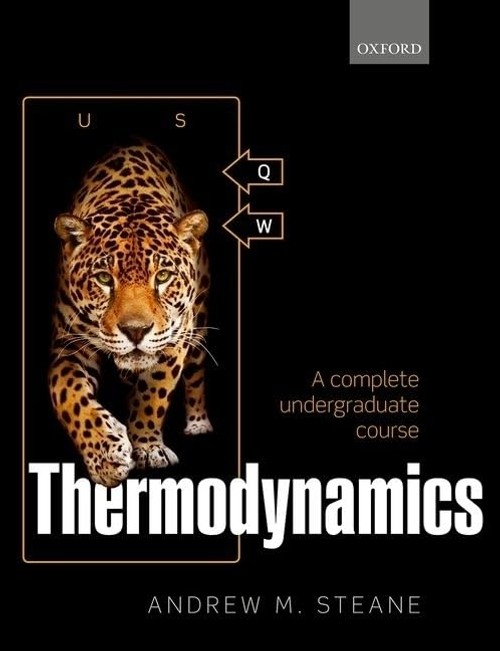
Thermodynamics: A Complete Undergraduate Course by Andrew M. Steane – An Essential Textbook for Physics, Chemistry, and
Inclusive of all applicable taxes. FREE shipping on all orders.
Available Offers
- 🚚Free Delivery — Free shipping on all orders
- 💵Cash on Delivery — Pay when your order arrives
- ↩️15-Day Easy Returns — Hassle-free return policy
- 🔒Cash on Delivery — Pay safely when your order arrives
Check Delivery
Product Description
Introduction
Thermodynamics is often seen as a dry, classical subject, but in reality it is a powerful and elegant framework that underpins much of modern physics and engineering. Thermodynamics: A complete undergraduate course by Andrew M. Steane offers a fresh and rigorous approach to the subject, designed specifically for undergraduate students in India and around the world. Published by Oxford University Press, this hardcover volume is an essential companion for anyone pursuing a degree in physics, chemistry, or engineering. It presents thermodynamics not as a collection of formulas, but as a coherent and logical system of ideas that helps us understand everything from heat engines to climate change.
Book Overview
This book is a self-contained course that takes the reader from the very basics of thermodynamics to advanced applications, all while maintaining a clear and logical flow. Andrew M. Steane, a renowned physicist, has crafted a text that assumes almost no prior knowledge of mathematics beyond school level, making it accessible to first-year undergraduates. The book carefully introduces the necessary mathematical methods, including partial derivatives and exact differentials, in a way that is easy to follow. It then builds up to central concepts such as entropy, free energy, and the laws of thermodynamics, explaining each with numerous worked examples and real-world applications. Unlike many other texts, this book deliberately keeps statistical mechanics at a distance to ensure the thermodynamic reasoning remains sharp and independent.
Key Highlights
- Self-contained and rigorous: The book starts from first principles and builds up to advanced topics, requiring minimal prerequisites.
- Clear mathematical exposition: All necessary mathematical tools are introduced within the text, with careful explanations and examples.
- Emphasis on thermodynamic reasoning: The focus is on the logic and style of thermodynamic thinking, not just on plugging numbers into equations.
- Wide range of applications: Covers Joule-Kelvin expansion, gas turbines, magnetic cooling, solids under high pressure, chemical equilibrium, radiative heat exchange, and even global warming.
- Modern and relevant: Connects classical thermodynamics to contemporary issues, making the subject feel alive and important.
- Hardcover edition: A durable, high-quality physical book perfect for students and libraries.
Inside the Book
The book is structured as a complete course, with each chapter building on the previous one. Early chapters introduce the concept of temperature, the zeroth law, and the basic ideas of heat and work. The first law of thermodynamics is presented with clarity, followed by a thorough discussion of the second law and the profound concept of entropy. Later chapters delve into free energy, thermodynamic potentials, and the Maxwell relations. The final chapters explore advanced topics such as phase transitions, chemical thermodynamics, and irreversible processes. Throughout the book, the author uses a conversational yet precise style, with numerous diagrams and tables to aid understanding. Worked examples and end-of-chapter problems help students test their grasp of the material.
Key Topics
- The Laws of Thermodynamics: Zeroth, first, second, and third laws explained in depth.
- Entropy and the Second Law: A careful and intuitive development of entropy, with many illustrative examples.
- Free Energy and Thermodynamic Potentials: Gibbs free energy, Helmholtz free energy, enthalpy, and their uses.
- Maxwell Relations and Applications: How to derive and use these powerful relationships.
- Phase Transitions: Clausius-Clapeyron equation, phase diagrams, and critical phenomena.
- Chemical Thermodynamics: Chemical equilibrium, reaction spontaneity, and the van't Hoff equation.
- Heat Engines and Refrigerators: Carnot cycle, Otto cycle, Brayton cycle, and real-world devices.
- Radiative Heat Transfer: Blackbody radiation, Stefan-Boltzmann law, and applications to global warming.
- Magnetic Cooling and Low Temperatures: Adiabatic demagnetization and achieving temperatures near absolute zero.
Reader Benefits
- Builds a strong conceptual foundation: The book ensures you truly understand the ideas, not just memorize formulas.
- Develops problem-solving skills: With numerous worked examples and exercises, you learn to apply thermodynamic reasoning to new situations.
- Prepares for advanced study: Ideal for students planning to pursue postgraduate work in physics, chemistry, or engineering.
- Connects theory to the real world: Applications to engines, refrigerators, materials under pressure, and even climate science make the subject relevant.
- Self-study friendly: The clear exposition and gradual buildup make it suitable for independent learners.
Learning Outcomes
By the end of this course, students will be able to: state and apply the laws of thermodynamics to a variety of systems; calculate changes in entropy, enthalpy, and free energy for physical and chemical processes; analyze the efficiency of heat engines and refrigerators; understand phase equilibria and phase transitions; apply thermodynamic reasoning to problems in materials science, chemistry, and environmental physics; and use Maxwell relations and thermodynamic potentials to derive useful relationships. The book also equips students with the confidence to read and understand advanced thermodynamics literature.
Who Should Read
- Undergraduate students of physics, chemistry, or engineering in their first, second, or third year.
- Self-learners who want a thorough and accessible introduction to thermodynamics.
- Teachers and lecturers looking for a clear, modern textbook for their courses.
- Professionals in related fields who need to refresh or deepen their understanding of thermodynamic principles.
About the Author
Andrew M. Steane is a professor of physics at the University of Oxford, where he has taught thermodynamics and statistical mechanics for many years. He is known for his clear and insightful teaching style, as well as his research in quantum information, atomic physics, and precision measurements. His previous books, including Relativity Made Relatively Easy, have been praised for their clarity and depth. In this volume, he brings the same pedagogical skill to thermodynamics, making it accessible without sacrificing rigour.
About the Publisher
Oxford University Press (OUP) is a world-renowned academic publisher with a long tradition of producing high-quality textbooks and reference works. OUP's science and mathematics titles are trusted by students and educators globally for their accuracy, clarity, and scholarly depth. This hardcover edition of Thermodynamics: A complete undergraduate course maintains the high standards expected from OUP, with a durable binding and clear typesetting that makes it a pleasure to read and study.
Conclusion
Thermodynamics: A complete undergraduate course is more than just a textbook—it is a guide to thinking like a thermodynamicist. Andrew M. Steane has succeeded in presenting this foundational subject in a way that is both rigorous and inviting. Whether you are a student embarking on your first thermodynamics course, a teacher seeking a reliable text, or a professional looking to deepen your understanding, this book is an excellent investment. It will not only help you master the subject but also inspire you with the elegance and power of thermodynamic reasoning. Order your copy today from Bookshops.in and start your journey into the heart of thermal physics.
Quick Summary
Thermodynamics: A complete undergraduate course by Andrew M. Steane is a comprehensive textbook that redefines how thermodynamics is taught to undergraduate students. Rather than treating it as a mere approximation for large systems, Steane presents thermodynamics as an elegant, self-contained framework that organises our understanding of thermal phenomena. The book is designed for first-year students in physics, chemistry, or engineering, and assumes minimal prior mathematical knowledge—introducing calculus and other tools gradually. Key concepts like entropy and free energy are explained in depth with numerous examples, and the book explores practical applications including the Joule-Kelvin expansion, gas turbines, magnetic cooling, and the behaviour of solids under high pressure. Readers will develop strong thermodynamic reasoning skills that are essential for advanced study and research. Published by Oxford University Press, this hardcover edition is built to last. Buying from Bookshops.in ensures you receive an authentic copy with reliable delivery across India, making it an excellent investment for serious students and educators alike.
Book Highlights
Book Specifications
| ISBN-13 | 9780198788560 |
| ISBN-10 | 0198788568 |
| Publisher | OUP Oxford |
| Language | English |
| Dimensions | 24.64 x 19.05 x 2.79 cm |
| Weight | 1 kg 130 g |
| Category | Science & Mathematics › Mechanics |
| Genre | Science & Mathematics |
| Original Language | English |
Frequently Asked Questions
What is the main focus of this thermodynamics book?
Who is the author of Thermodynamics: A complete undergraduate course?
Is this book suitable for first-year undergraduate students?
Does the book cover real-world applications?
What subjects does this textbook cater to?
Is prior knowledge of calculus required?
What is the ISBN-13 of this book?
Is this book available in paperback?
Can this book be used for self-study?
Does the book include exercises?
What makes this book different from other thermodynamics textbooks?
Is the book suitable for Indian university curricula?
Where can I buy this book in India?
Readers Also Search For
Customers Also Bought
Mathematics
Stereotype Spaces and Algebras: 73 (De Gruyter Expositions in Mathematics, 73)

Mathematics
Semigroups in Algebra, Geometry and Analysis: 20 (De Gruyter Expositions in Mathematics, 20)

Mathematics
Geometry from the Pacific Rim: Proceedings of the Pacific Rim Geometry Conference held at National University of Singapore, Republic of Singapore, ... 1994 (De Gruyter Proceedings in Mathematics)

Mathematics
First International Tainan-Moscow Algebra Workshop: Proceedings of the International Conference held at National Cheng Kung University Tainan, Taiwan, ... 1994 (De Gruyter Proceedings in Mathematics)
Mathematics
Differential Geometry - Proceedings of the VIII International Colloquium (English, Jesus A. Alvarez Lopez | Eduardo Garcia-Rio)
Mathematics
Mathematical Theory of Optimal Processes (Classics of Soviet Mathematics)
Related Products
View All
Science & Mathematics
Elements of Pelagos Biology: With Focus on the Mediterranean Sea

Science & Mathematics
Squid - Superconducting Quantum Interference Devices and Their Applications: Proceedings of the International Conference on Superconducting Quantum Devices, Berlin-west, October 4-8, 1976

Science & Mathematics
Thermodynamics and Pattern Formation in Biology
Science & Mathematics
The Nature of Mathematics and the Mathematics of Nature by S. Andersson – Mathematics & Science

Science & Mathematics
Linear Algebra | by Stephen Friedberg | Arnold Insel | Lawrence Spence | Pearson | by Stephen Friedberg | Arnold Insel | Lawrence Spence | Pearson | by Stephen Friedberg | Arnold Insel | Lawrence Spence | Pearson | by Stephen Friedberg | Arnold Insel | Lawrence Spence | Pearson | by Stephen Friedberg | Arnold Insel | Lawrence Spence | Pearson | by Stephen Friedberg | Arnold Insel | Lawrence Spence | Pearson | by Stephen Friedberg | Arnold Insel | Lawrence Spence | Pearson | by Stephen Friedberg
Science & Mathematics