
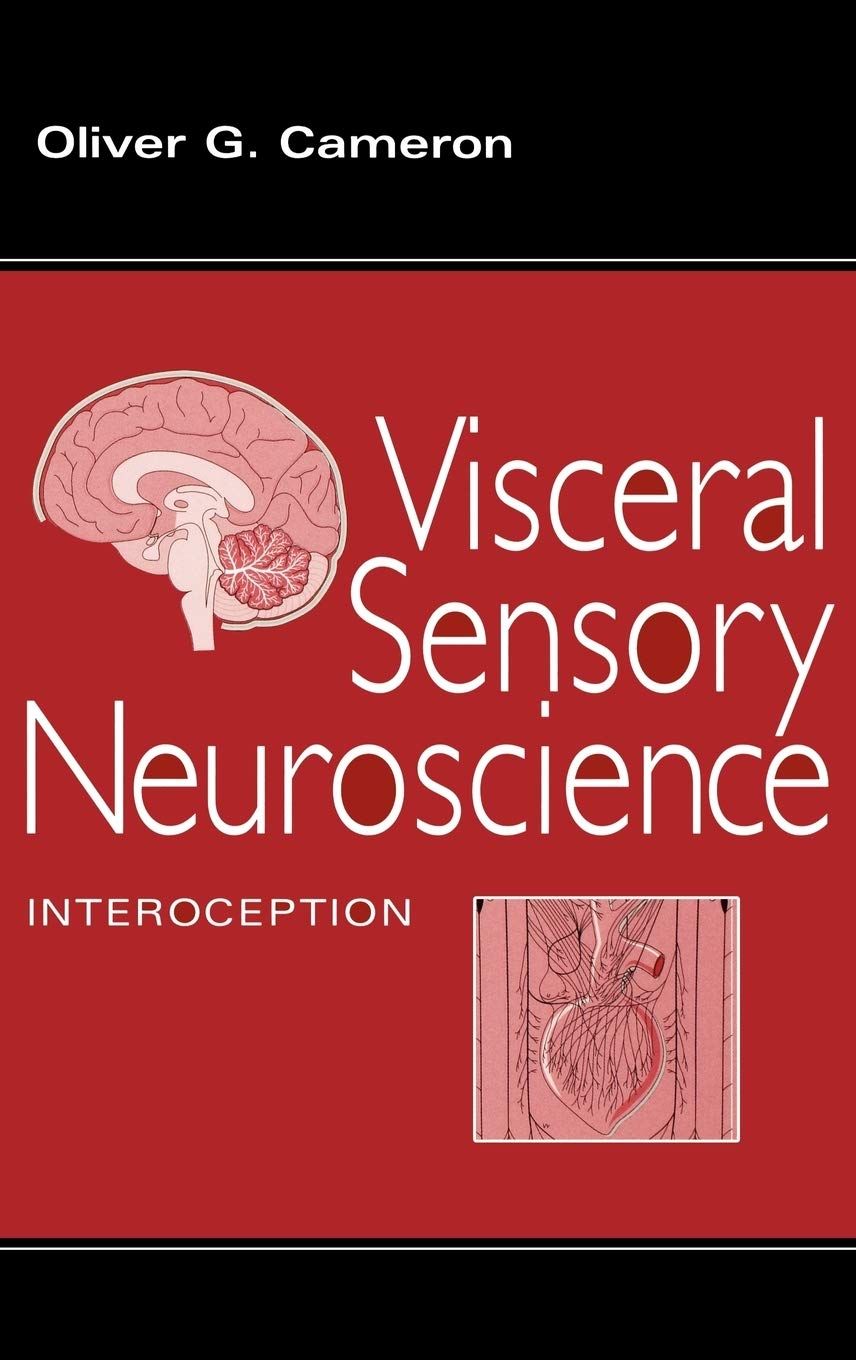
Visceral Sensory Neuroscience: Interoception – A Groundbreaking Work on Body-to-Brain Communication by Oliver G. Cameron
Inclusive of all applicable taxes. FREE shipping on all orders.
Available Offers
- 🚚Free Delivery — Free shipping on all orders
- 💵Cash on Delivery — Pay when your order arrives
- ↩️15-Day Easy Returns — Hassle-free return policy
- 🔒Cash on Delivery — Pay safely when your order arrives
Check Delivery
Product Description
Introduction
For decades, the conversation around the nervous system has largely focused on the brain's commands to the body. Yet, a quieter, more profound dialogue flows in the opposite direction—from our organs, muscles, and viscera back to the brain. This inward stream of information, known as interoception, shapes our emotions, drives our motivations, and underpins our sense of physical self. Visceral Sensory Neuroscience: Interoception by Oliver G. Cameron is a landmark work that brings this hidden world into sharp focus. For Indian students and researchers delving into the neurosciences, psychology, or medicine, this book offers an indispensable foundation for understanding how our bodies speak to our minds.
Book Overview
Published by Oxford University Press, this hardcover volume is the first comprehensive review of interoception—the sensing of internal bodily states. It bridges the gap between neurobiology and psychobiology, tracing the historical roots of the field from the James-Lange theory of emotion to modern Pavlovian and operant conditioning studies. The book systematically explores the afferent (body-to-brain) pathways that regulate visceral organ function, emotional processes, and psychosomatic disorders. With a rigorous yet accessible approach, it synthesises decades of research into a coherent narrative that is as valuable for the seasoned scientist as it is for the curious postgraduate student.
Key Highlights
- First of its kind: A comprehensive, single-volume treatment of interoception that has been long overdue in neuroscience literature.
- Historical depth: Traces the evolution of ideas from William James and Carl Lange through to contemporary neural imaging studies.
- Dual perspective: Integrates both neurobiological mechanisms and psychobiological phenomena, offering a holistic view of visceral perception.
- Clinical relevance: Directly addresses the role of interoception in psychosomatic disorders, anxiety, and cardiovascular-respiratory conditions.
- Rigorous scholarship: Backed by Oxford University Press, ensuring high editorial standards and authoritative content.
Inside the Book
The book is structured to guide the reader from foundational concepts to cutting-edge research. The opening section defines interoception and provides historical context, including the seminal James-Lange theory and its implications for emotion. It then delves into learning and motivation, showing how Pavlovian conditioning and operant control of visceral functions have shaped our understanding. The second half of the book presents detailed findings on the neural basis of visceral perception, with specific chapters dedicated to cardiovascular-respiratory systems, gastrointestinal signalling, and the interplay between visceral afferents and emotional states. Each chapter is rich with experimental data, anatomical diagrams, and conceptual frameworks that clarify complex neural pathways.
Key Topics
- Historical development of interoception research from James-Lange to modern neuroscience
- Afferent neural pathways from visceral organs to the central nervous system
- Role of interoception in emotional experience and motivational behaviour
- Pavlovian and operant conditioning of visceral responses
- Neural correlates of visceral perception in cardiovascular and respiratory systems
- Interoceptive dysfunction in psychosomatic and anxiety disorders
- Methodological approaches for studying visceral sensation in humans and animals
Reader Benefits
This book empowers readers with a deep, integrated understanding of how bodily signals influence cognition and emotion. It clarifies the mechanisms behind phenomena like the feeling of a racing heart during anxiety or the gut sensations that accompany decision-making. For clinicians, it offers insights into the biological underpinnings of conditions where mind and body intersect. For researchers, it provides a comprehensive reference that can inform experimental design and theoretical framing. Students will find the clear explanations and historical context invaluable for grasping a field that is often fragmented across disciplines.
Learning Outcomes
By engaging with this book, readers will be able to: trace the historical and theoretical foundations of interoception; identify the major neural pathways involved in visceral sensation; explain how interoceptive signals contribute to emotional experience and motivated behaviour; evaluate experimental paradigms used to study visceral perception; and critically assess the role of interoception in psychosomatic and affective disorders. These outcomes equip learners with a robust conceptual toolkit for advanced study or clinical practice in neuroscience, psychology, and related health sciences.
Who Should Read
- Neuroscience students and researchers specialising in sensory systems, autonomic function, or emotional neuroscience
- Clinical psychologists and psychiatrists interested in the biological bases of anxiety, depression, and somatic symptom disorders
- Medical professionals in fields such as cardiology, gastroenterology, and psychosomatic medicine
- Graduate students in cognitive science, behavioural neuroscience, or physiological psychology
- Anyone curious about the scientific understanding of gut feelings, intuition, and the mind-body connection
About the Author
Oliver G. Cameron is a distinguished neuroscientist and professor whose career has been dedicated to unravelling the mysteries of visceral perception. With decades of research experience, he has contributed seminal papers on interoception, autonomic regulation, and the neural basis of emotion. His work bridges laboratory science with clinical application, making him uniquely qualified to write this comprehensive volume. Cameron's clear, engaging writing style reflects his commitment to making complex neuroscience accessible without sacrificing depth.
About the Publisher
Oxford University Press (OUP) is one of the oldest and most respected academic publishers in the world. With a legacy spanning over five centuries, OUP is synonymous with scholarly excellence, rigorous peer review, and authoritative content. This book carries the hallmark of OUP's commitment to advancing knowledge in the sciences, ensuring that every page meets the highest standards of accuracy and clarity. For Indian readers, an OUP publication is a mark of trust and quality.
Conclusion
Visceral Sensory Neuroscience: Interoception is more than a textbook—it is a gateway to understanding the silent conversation between body and brain. In an era where the mind-body connection is increasingly recognised as central to health and well-being, Oliver G. Cameron's work provides the scientific bedrock that every serious student and professional needs. Whether you are exploring the neural roots of emotion or seeking insights into psychosomatic disorders, this book will illuminate your path. Add it to your library today and discover the science behind what your body is telling you.
Quick Summary
Visceral Sensory Neuroscience: Interoception by Oliver G. Cameron is a landmark work that offers the first comprehensive review of the body-to-brain afferent system, known as interoception. For over a century, scientists have known about the visceral-autonomic nervous system, but the role of bodily afferent information in central nervous system control, emotional-motivational processes, and psychosomatic disorders has only recently gained attention. This book bridges that gap by covering both neurobiological and psychobiological aspects. It begins with historical foundations, including the James-Lange theory of emotion, and explores learning and motivation rooted in Pavlovian conditioning. Readers will gain deep insights into how interoception influences organ function, emotional states, and mental health. The book is ideal for advanced students, researchers, and clinicians in neuroscience, psychology, and medicine. Published by Oxford University Press, this hardcover edition is a durable academic resource. By purchasing from Bookshops.in, Indian readers get authentic imported books with reliable delivery and customer support.
Book Highlights
Book Specifications
| ISBN-13 | 9780195136012 |
| ISBN-10 | 0195136012 |
| Publisher | Oxford Univ Pr |
| Language | English |
| Dimensions | 16.56 x 2.57 x 24.13 cm |
| Weight | 771 g |
| Category | Basic Sciences › Neuroscience |
| Genre | Non-fiction |
| Original Language | English |
Frequently Asked Questions
What is Visceral Sensory Neuroscience: Interoception about?
Who is the author of this book?
Which publisher released this book?
Is this book suitable for beginners in neuroscience?
Does the book cover the James-Lange theory?
What is the ISBN-13 of this book?
What format is this book available in at Bookshops.in?
Does the book discuss psychosomatic disorders?
What language is the book written in?
What is the price of this book in India?
Is this book part of a series?
Can I use this book for my research on interoception?
Where can I buy this book in India?
Readers Also Search For
Customers Also Bought

Anatomy
Ultrastructure of the Digestive Tract: 4 (Electron Microscopy in Biology and Medicine)

Anatomy
Ultrastructure of the Connective Tissue Matrix: 3 (Electron Microscopy in Biology and Medicine)

Anatomy
Reproductive Genetics (Royal College of Obstetricians and Gynaecologists Study Group)

Anatomy
Human Gross Anatomy: An Outline Text by Robert J. Leonard – Medical Anatomy

Pharmacology
Mathematical Modeling and Simulation in Enteric Neurobiology

Anatomy
Nature’s Patterns and the Fractional Calculus: 2 (Fractional Calculus in Applied Sciences and Engineering, 2)
Related Products
View All
Medicine & Health Sciences
Handbook of Hospitality Strategic Management | by Olsen Michael | Taylor & Francis Ltd | by Olsen Michael | Taylor & Francis Ltd | by Olsen Michael | Taylor & Francis Ltd | by Olsen Michael | Taylor & Francis Ltd | by Olsen Michael | Taylor & Francis Ltd | by Olsen Michael | Taylor & Francis Ltd | by Olsen Michael | Taylor & Francis Ltd | by Olsen Michael | Taylor & Francis Ltd | by Olsen Michael | Taylor & Francis Ltd | by Olsen Michael | Taylor & Francis

Medicine & Health Sciences
Pediatrics on Call | by Charles A. Pohl | Kathleen Bradford | Clara Callahan | McGraw Hill / Medical | by Charles A. Pohl | Kathleen Bradford | Clara Callahan | McGraw Hill / Medical | by Charles A. Pohl | Kathleen Bradford | Clara Callahan | McGraw Hill / Medical | by Charles A. Pohl | Kathleen Bradford | Clara Callahan | McGraw Hill / Medical | by Charles A. Pohl | Kathleen Bradford | Clara Callahan | McGraw Hill / Medical | by Charles A. Pohl | Kathleen Bradford | Clara Callahan | McGraw Hill

Medicine & Health Sciences
The Physician's Guide to Depression and Bipolar Disorders | by Dwight L. Evans | Dennis S. Charney | Lydia Lewis | McGraw Hill / Medical | by Dwight L. Evans | Dennis S. Charney | Lydia Lewis | McGraw Hill / Medical | by Dwight L. Evans | Dennis S. Charney | Lydia Lewis | McGraw Hill / Medical | by Dwight L. Evans | Dennis S. Charney | Lydia Lewis | McGraw Hill / Medical | by Dwight L. Evans | Dennis S. Charney | Lydia Lewis | McGraw Hill / Medical | by Dwight L. Evans | Dennis S. Charney | Lydi
Medicine & Health Sciences
First Exposure to Internal Medicine | by Andrew R. Hoellein | Charles H. Griffith | McGraw Hill / Medical | by Andrew R. Hoellein | Charles H. Griffith | McGraw Hill / Medical | by Andrew R. Hoellein | Charles H. Griffith | McGraw Hill / Medical | by Andrew R. Hoellein | Charles H. Griffith | McGraw Hill / Medical | by Andrew R. Hoellein | Charles H. Griffith | McGraw Hill / Medical | by Andrew R. Hoellein | Charles H. Griffith | McGraw Hill / Medical | by Andrew R. Hoellein | Charles H. Griffit
Medicine & Health Sciences
First Exposure to Internal Medicine | by Charles H. Griffith | Andrew R. Hoellein | McGraw Hill / Medical | by Charles H. Griffith | Andrew R. Hoellein | McGraw Hill / Medical | by Charles H. Griffith | Andrew R. Hoellein | McGraw Hill / Medical | by Charles H. Griffith | Andrew R. Hoellein | McGraw Hill / Medical | by Charles H. Griffith | Andrew R. Hoellein | McGraw Hill / Medical | by Charles H. Griffith | Andrew R. Hoellein | McGraw Hill / Medical | by Charles H. Griffith | Andrew R. Hoellei
Medicine & Health Sciences