
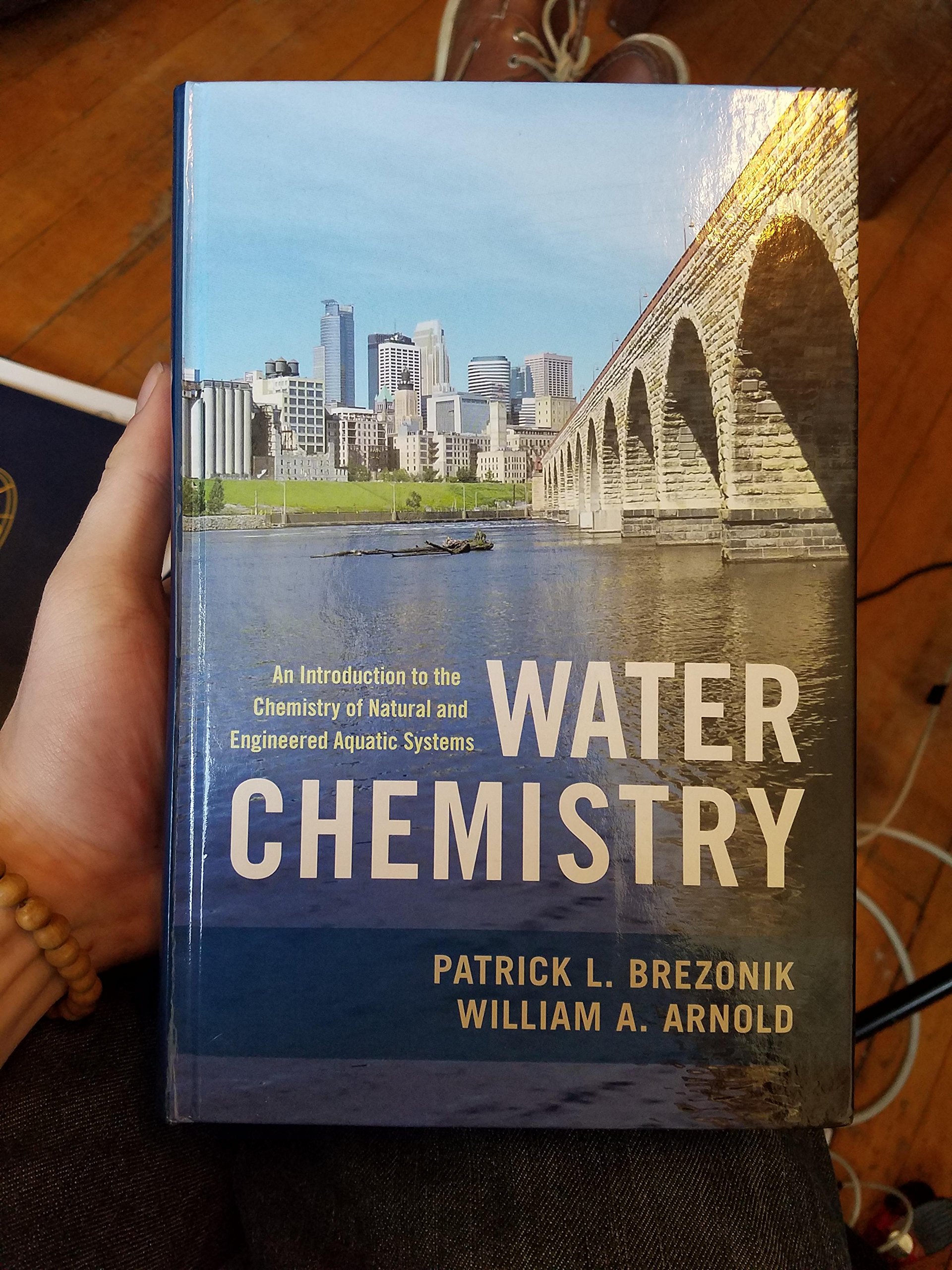
Water Chemistry: An Introduction to the Chemistry of Natural and Engineered Aquatic Systems by Patrick Brezonik – A Comp
Inclusive of all applicable taxes. FREE shipping on all orders.
Available Offers
- 🚚Free Delivery — Free shipping on all orders
- 💵Cash on Delivery — Pay when your order arrives
- ↩️15-Day Easy Returns — Hassle-free return policy
- 🔒Cash on Delivery — Pay safely when your order arrives
Check Delivery
Product Description
Introduction
Water is the essence of life, yet its chemical behavior in both natural and engineered systems is profoundly complex. For students, researchers, and professionals in environmental science, civil engineering, and chemistry, understanding the intricate processes that govern water chemistry is essential. Water Chemistry: An Introduction to the Chemistry of Natural and Engineered Aquatic Systems by Patrick Brezonik, published by Oxford University Press, offers a rigorous yet accessible foundation for mastering this critical subject. This hardcover edition is an indispensable resource for Indian learners seeking to bridge theoretical principles with practical applications in water quality management, treatment, and environmental protection.
Book Overview
This comprehensive textbook provides a systematic exploration of the chemical principles that control the composition and behavior of water in diverse environments—from pristine lakes and rivers to wastewater treatment plants and industrial water systems. The author emphasizes a balanced approach, integrating both equilibrium thermodynamics and kinetic processes to solve real-world problems. Unlike many texts that focus solely on inorganic chemistry, this book also delves into the fate and reactions of organic chemicals, making it highly relevant for contemporary environmental challenges. The content is structured to build from fundamental concepts about water itself to advanced problem-solving techniques using mathematical, graphical, and computational tools.
Key Highlights
- Comprehensive Coverage: Bridges natural aquatic systems (lakes, rivers, groundwater) with engineered systems (water treatment, distribution, and industrial processes).
- Problem-Solving Focus: Emphasizes quantitative equilibrium and kinetic problems through graphical and computational methods, not just theoretical discussion.
- Organic and Inorganic Integration: Addresses the chemistry of both inorganic constituents and organic pollutants, a crucial aspect for modern environmental science.
- Rigorous Yet Accessible: Suitable for advanced undergraduate and graduate students, with clear explanations of thermodynamics, activity, and kinetics.
- Indian Context Relevance: Provides foundational knowledge applicable to India’s water quality challenges, including river pollution, groundwater contamination, and drinking water treatment.
Inside the Book
The book begins with an introduction to the unique properties of water and its chemical composition in natural and engineered systems. It then builds a solid theoretical framework covering thermodynamics, chemical activity, and reaction kinetics. Each subsequent chapter applies these tools to specific topics: acid-base chemistry, metal ion complexation, mineral solubility and precipitation, and oxidation-reduction reactions. The text uses numerous worked examples, graphs, and computational exercises to illustrate how to solve complex problems. Later chapters extend these skills to topics like nutrient cycling, trace metal behavior, and the chemistry of organic contaminants in aquatic environments. The author carefully balances depth with clarity, ensuring that students can follow the logical progression from fundamentals to advanced applications.
Key Topics
- Water Properties and Composition: Molecular structure, hydrogen bonding, and the chemical constituents of natural waters.
- Chemical Thermodynamics and Activity: Gibbs free energy, equilibrium constants, activity coefficients, and ionic strength effects.
- Acid-Base Chemistry: pH buffers, alkalinity, acidity, and carbonate system equilibria in natural waters.
- Metal Complexation and Speciation: Ligand binding, stability constants, and the distribution of metal species.
- Mineral Solubility and Precipitation: Saturation indices, dissolution kinetics, and control of water hardness.
- Oxidation-Reduction Reactions: Redox potential, pE-pH diagrams, and biogeochemical cycling of elements.
- Kinetics of Aquatic Reactions: Rate laws, reaction mechanisms, and applications to pollutant degradation.
- Organic Chemical Fate: Hydrolysis, photolysis, sorption, and biodegradation in aquatic systems.
Reader Benefits
By engaging with this book, readers will gain a deep, actionable understanding of how chemical species behave in water. They will learn to predict and control water quality parameters, design treatment processes, and assess environmental impacts. The emphasis on quantitative problem-solving equips students with skills directly applicable to careers in environmental consulting, water utilities, regulatory agencies, and research. Indian students will find the book particularly useful for tackling issues such as fluoride and arsenic contamination, eutrophication of lakes, and industrial effluent treatment. The computational approach prepares learners for modern data analysis and modeling tasks in the field.
Learning Outcomes
- Master Fundamental Principles: Understand the thermodynamic and kinetic frameworks governing aquatic chemistry.
- Solve Equilibrium Problems: Use mathematical, graphical, and computational methods to analyze acid-base, complexation, solubility, and redox systems.
- Interpret Chemical Speciation: Predict the forms and concentrations of inorganic and organic species in natural and treated waters.
- Apply Kinetics to Real Systems: Evaluate reaction rates and pathways for chemical transformations in water.
- Integrate Theory with Practice: Connect chemical principles to water treatment, pollution control, and environmental management.
Who Should Read
This book is ideal for advanced undergraduate and graduate students in environmental engineering, civil engineering, chemistry, and earth sciences. It is also a valuable reference for practicing professionals—environmental scientists, water quality engineers, hydrologists, and regulatory specialists—who need a solid theoretical foundation to address complex water chemistry problems. Indian students preparing for competitive exams or pursuing research in water-related fields will find this text an essential addition to their library.
About the Author
Patrick Brezonik is a distinguished professor and researcher in environmental engineering and water chemistry. With decades of experience in academia and applied research, he has contributed extensively to the understanding of aquatic systems, including nutrient cycling, trace metal behavior, and water quality modeling. His teaching philosophy emphasizes rigorous quantitative analysis combined with real-world relevance, making his textbooks highly respected in the field.
About the Publisher
Oxford University Press is a globally renowned academic publisher known for producing authoritative and high-quality textbooks across all disciplines. Their commitment to scholarly excellence ensures that every title, including this one, meets the highest standards of accuracy, clarity, and pedagogical value. For Indian students, OUP publications are synonymous with trusted knowledge and academic rigor.
Conclusion
Water Chemistry: An Introduction to the Chemistry of Natural and Engineered Aquatic Systems is more than a textbook—it is a gateway to mastering one of the most critical scientific disciplines of our time. Whether you are a student aiming to excel in environmental studies or a professional seeking to deepen your expertise, this book provides the tools, theory, and practice needed to understand and manage water chemistry effectively. Order your hardcover copy from Bookshops.in today and take a definitive step toward becoming proficient in the chemistry of aquatic systems.
Quick Summary
Water Chemistry: An Introduction to the Chemistry of Natural and Engineered Aquatic Systems by Patrick Brezonik is a definitive textbook for understanding the chemical processes that shape water quality in both natural environments (lakes, rivers, groundwater) and engineered systems (water and wastewater treatment plants). The book begins with fundamental concepts about water itself and the chemical composition of aquatic systems, then builds a strong foundation in thermodynamics, activity, and kinetics. It emphasizes that both equilibrium and kinetic processes are critical in real-world aquatic systems. Unlike many texts that focus solely on inorganic constituents, this book also addresses the fate and reactions of organic chemicals. A hallmark of the book is its emphasis on solving quantitative equilibrium and kinetic problems using mathematical, graphical, and computational tools. Readers will gain practical skills in acid-base chemistry, carbonate systems, redox reactions, trace metal speciation, and organic contaminant behavior. This book is ideal for Indian undergraduate and postgraduate students in environmental science, civil engineering, chemistry, and related fields, as well as professionals in water quality management. By choosing Bookshops.in, Indian readers receive an authentic imported hardcover edition at a competitive price with prompt delivery.
Book Highlights
Book Specifications
| ISBN-13 | 9780199730728 |
| ISBN-10 | 0199730725 |
| Publisher | Oxford Univ Pr on Demand |
| Language | English |
| Dimensions | 4.57 x 16 x 23.62 cm |
| Weight | 1 kg 270 g |
| Country | India |
| Category | Civil Engineering › Ecology & Environment |
| Genre | Non-fiction |
| Reading Age | Adult |
| Original Language | English |
Frequently Asked Questions
What is Water Chemistry by Patrick Brezonik about?
Who is the author of this book?
Is this book suitable for Indian university courses?
What topics are covered in the book?
Does the book include computational methods?
What is the ISBN of this book?
Is this book available in hardcover?
Can I use this book for self-study?
How is this book different from other water chemistry texts?
What is the price of this book on Bookshops.in?
Does the book include exercises or problems?
What is the reading level of this book?
Is the book focused only on inorganic chemistry?
Why should I buy from Bookshops.in?
Readers Also Search For
Customers Also Bought
Mathematics
Stereotype Spaces and Algebras: 73 (De Gruyter Expositions in Mathematics, 73)

Mathematics
Semigroups in Algebra, Geometry and Analysis: 20 (De Gruyter Expositions in Mathematics, 20)

Mathematics
Geometry from the Pacific Rim: Proceedings of the Pacific Rim Geometry Conference held at National University of Singapore, Republic of Singapore, ... 1994 (De Gruyter Proceedings in Mathematics)

Mathematics
First International Tainan-Moscow Algebra Workshop: Proceedings of the International Conference held at National Cheng Kung University Tainan, Taiwan, ... 1994 (De Gruyter Proceedings in Mathematics)
Mathematics
Differential Geometry - Proceedings of the VIII International Colloquium (English, Jesus A. Alvarez Lopez | Eduardo Garcia-Rio)
Mathematics
Mathematical Theory of Optimal Processes (Classics of Soviet Mathematics)
Related Products
View All
Science & Mathematics
Squid - Superconducting Quantum Interference Devices and Their Applications: Proceedings of the International Conference on Superconducting Quantum Devices, Berlin-west, October 4-8, 1976
Science & Mathematics
Thermodynamics and Pattern Formation in Biology
Science & Mathematics
The Nature of Mathematics and the Mathematics of Nature by S. Andersson – Mathematics & Science

Science & Mathematics
Linear Algebra | by Stephen Friedberg | Arnold Insel | Lawrence Spence | Pearson | by Stephen Friedberg | Arnold Insel | Lawrence Spence | Pearson | by Stephen Friedberg | Arnold Insel | Lawrence Spence | Pearson | by Stephen Friedberg | Arnold Insel | Lawrence Spence | Pearson | by Stephen Friedberg | Arnold Insel | Lawrence Spence | Pearson | by Stephen Friedberg | Arnold Insel | Lawrence Spence | Pearson | by Stephen Friedberg | Arnold Insel | Lawrence Spence | Pearson | by Stephen Friedberg
Science & Mathematics
University Calculus | by Joel Hass | Christopher Heil | Maurice Weir | Pearson | by Joel Hass | Christopher Heil | Maurice Weir | Pearson | by Joel Hass | Christopher Heil | Maurice Weir | Pearson | by Joel Hass | Christopher Heil | Maurice Weir | Pearson | by Joel Hass | Christopher Heil | Maurice Weir | Pearson | by Joel Hass | Christopher Heil | Maurice Weir | Pearson | by Joel Hass | Christopher Heil | Maurice Weir | Pearson | by Joel Hass | Christopher Heil | Maurice Weir | Pearson | by Joe
Science & Mathematics