
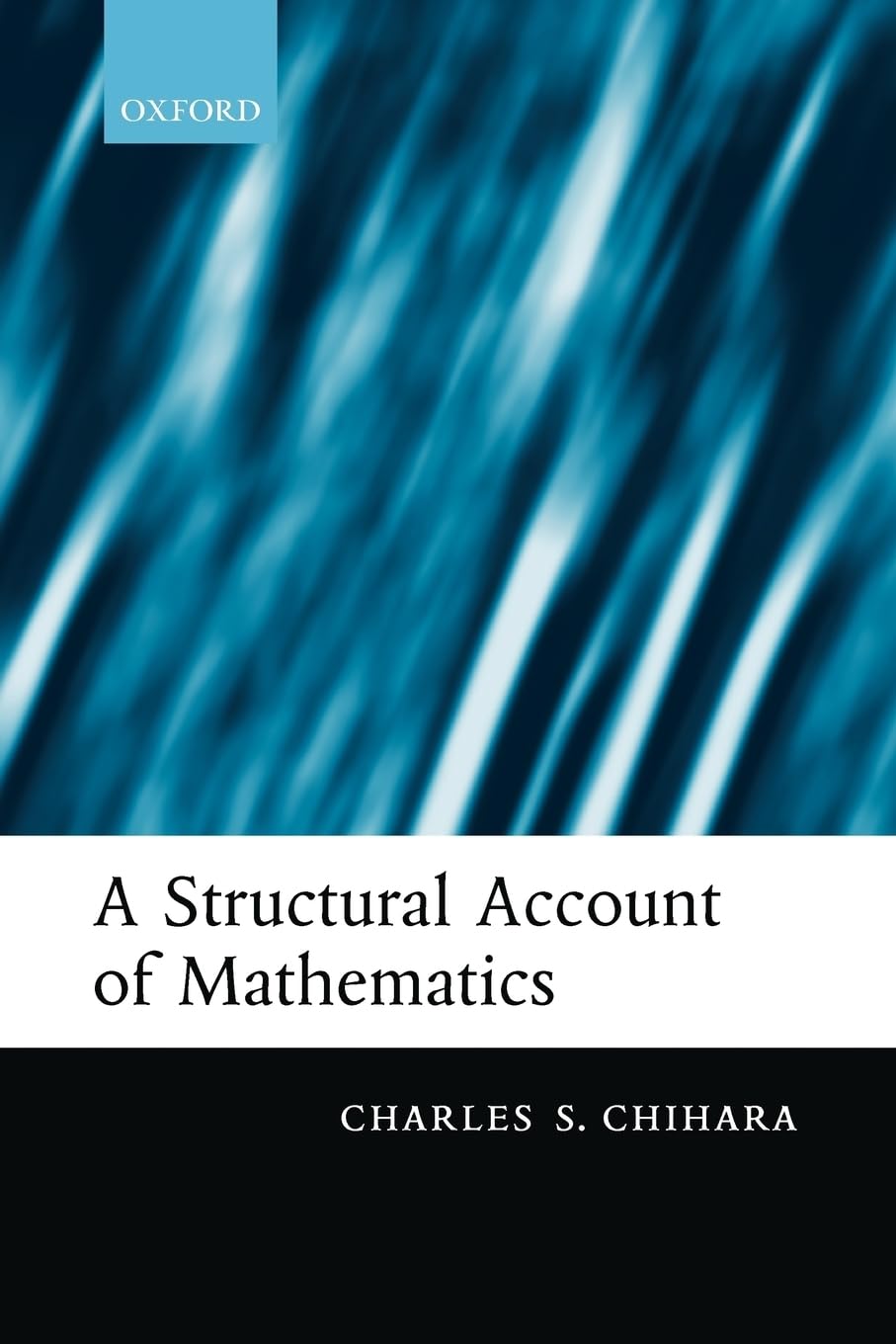
A Structural Account of Mathematics by Charles S. Chihara – A Philosophical Exploration of Mathematical Systems and Nomi
Inclusive of all applicable taxes. FREE shipping on all orders.
Available Offers
- 🚚Free Delivery — Free shipping on all orders
- 💵Cash on Delivery — Pay when your order arrives
- ↩️15-Day Easy Returns — Hassle-free return policy
- 🔒Cash on Delivery — Pay safely when your order arrives
Check Delivery
Product Description
Introduction
In the vast landscape of philosophical inquiry into mathematics, few works manage to challenge deep-seated assumptions while offering a coherent alternative. Charles S. Chihara's A Structural Account of Mathematics is precisely such a landmark text. Published by OUP Oxford, this hardcover edition presents a rigorous and original defence of a structuralist view of mathematics, one that does not rely on the existence of abstract mathematical objects. For Indian students, researchers, and academics grappling with the foundations of mathematics and its application in science, this book provides a refreshing perspective that bridges logic, ontology, and scientific practice.
Book Overview
This book is a sophisticated exploration of the nature of mathematical truth and its relationship to the physical world. Chihara builds upon his earlier constructibility theory to argue that mathematical systems can be understood without presupposing the existence of numbers, sets, or other abstract entities. He systematically dismantles the influential indispensability argument, famously championed by Willard Quine and Hilary Putnam, which claims that we must believe in mathematical objects because they are indispensable to our best scientific theories. Instead, Chihara shows how scientists can use mathematical systems in a nominalistic framework—where theorems need not be literally true but can be understood as tools for reasoning about the concrete world. The book is both a defence of structuralism and a fresh take on centuries-old puzzles about mathematical applicability.
Key Highlights
- Original Structuralist Thesis: Develops a novel structural account that does not commit to the existence of abstract mathematical objects.
- Critique of Indispensability: Offers several new ways to undermine the Quine-Putnam indispensability argument, a central topic in contemporary philosophy of mathematics.
- Constructibility Theory: Builds upon Chihara's earlier work, presenting a system of mathematics that operates without reference to mathematical objects.
- Application in Science: Analyzes how real-world scientific systems are compatible with a nominalistic, object-free mathematics.
- Rigorous Argumentation: Provides clear, step-by-step reasoning suitable for advanced students and professionals.
Inside the Book
The volume is structured to first lay out the philosophical problems that motivate structuralism, then to present the constructibility theory in detail, and finally to apply it to pressing issues such as mathematical applicability and indispensability. Chihara carefully examines how mathematicians and scientists actually use mathematical language, and he proposes that we can interpret mathematical statements as being about possible structures rather than actual objects. The book includes detailed discussions of set theory, logic, and the philosophy of science, making it a comprehensive resource for anyone interested in the foundations of mathematics. Each chapter builds logically on the previous, ensuring that readers develop a thorough understanding of the arguments.
Key Topics
- Structuralism in mathematics and its philosophical foundations
- The Quine-Putnam indispensability argument and its critiques
- Constructibility theory as a nominalistic alternative
- Mathematical applicability in scientific theories
- Ontological commitment and the existence of mathematical objects
- Logic, set theory, and the nature of mathematical truth
- Philosophy of science and the role of mathematics
Reader Benefits
- Deepen Philosophical Insight: Gain a sophisticated understanding of one of the most debated topics in philosophy of mathematics.
- Engage with Cutting-Edge Ideas: Explore a well-argued alternative to Platonism and formalism.
- Strengthen Analytical Skills: Follow rigorous logical arguments that sharpen critical thinking.
- Bridge Mathematics and Science: Understand how mathematical structures underpin scientific reasoning without metaphysical baggage.
- Academic Excellence: Prepare for advanced research or teaching in philosophy, mathematics, or theoretical science.
Learning Outcomes
By studying this book, readers will be able to critically evaluate the indispensability argument for mathematical objects, articulate a structuralist view of mathematics, apply constructibility theory to concrete examples, and explain how mathematical systems can be used in science without assuming the existence of abstract entities. They will also develop the ability to engage with contemporary debates in metaphysics and the philosophy of science with confidence.
Who Should Read
This book is ideal for graduate students and researchers in philosophy of mathematics, logic, and theoretical computer science. It is also highly valuable for mathematicians interested in the philosophical underpinnings of their discipline, as well as scientists and engineers who wish to reflect on the nature of the mathematical tools they use. Indian university students pursuing advanced degrees in philosophy, mathematics, or physics will find this a challenging yet rewarding read. Professors and academicians looking for a definitive text on structuralism will consider this an essential addition to their library.
About the Author
Charles S. Chihara is a distinguished philosopher of mathematics and a professor emeritus at the University of California, Berkeley. He is renowned for his work on nominalism, constructibility theory, and the philosophy of logic. His previous books, including Constructibility and Mathematical Existence, have been influential in shaping contemporary debates. Chihara's writing is known for its clarity, rigour, and willingness to challenge orthodox views, making him a leading voice in the field.
About the Publisher
OUP Oxford, the academic imprint of Oxford University Press, is one of the world's oldest and most respected publishers. Renowned for its commitment to scholarly excellence, OUP Oxford produces authoritative works across disciplines, including philosophy, mathematics, and science. This hardcover edition is crafted to meet the highest standards of academic publishing, ensuring durability and readability for years of study.
Conclusion
A Structural Account of Mathematics is not just a book; it is a paradigm-shifting contribution to how we understand the nature of mathematics itself. For Indian readers and students seeking to move beyond traditional metaphysical assumptions, Chihara's work offers a rigorous, accessible, and deeply original path. Whether you are a philosopher, mathematician, or curious scientist, this volume will challenge your thinking and expand your intellectual horizons. Add this essential hardcover to your collection and engage with one of the most significant philosophical projects of our time.
Quick Summary
'A Structural Account of Mathematics' by Charles S. Chihara is a groundbreaking work in the philosophy of mathematics that presents a structural view of the subject. The book argues that mathematics can be understood without assuming the existence of mathematical objects, using the constructibility theory developed by Chihara. It addresses long-standing philosophical puzzles about the nature of mathematics and its application in science. The author shows how mathematical systems used by scientists are compatible with a nominalistic outlook, meaning they do not require truth or objects. This book is ideal for Indian students and researchers in philosophy, mathematics, and the philosophy of science who want to explore foundational issues. Readers will learn how to think critically about mathematical ontology and the relationship between mathematics and the physical world. Buying from Bookshops.in ensures you receive an authentic hardcover edition at a competitive price, with reliable shipping across India.
Book Highlights
Book Specifications
| ISBN-13 | 9780199228072 |
| ISBN-10 | 0199228078 |
| Publisher | Clarendon Pr |
| Language | English |
| Dimensions | 15.49 x 2.26 x 23.11 cm |
| Weight | 612 g |
| Country | India |
| Category | Philosophy › Logic |
| Genre | Non-fiction |
| Original Language | English |
Frequently Asked Questions
What is the main thesis of 'A Structural Account of Mathematics'?
Who is Charles S. Chihara?
Is this book suitable for beginners in philosophy?
Does the book require knowledge of advanced mathematics?
How is this book different from other philosophy of mathematics texts?
Can I use this book for my Indian university course?
What is the constructibility theory?
Is this book part of a series?
Is the book available in hardcover?
What language is the book in?
What is the price in India?
Does the book address applied mathematics?
Why buy from Bookshops.in?
Readers Also Search For
Customers Also Bought

Islam
Spiritual Economies (English, Daromir Rudnyckyj)

Islam
Who Is Allah? (English, Bruce B. Lawrence)

Islam
Islam and Liberal Citizenship: The Search for an Overlapping Consensus by Andrew F. March

Islam
Fiqh Us-Sunnah: Funerals and Diggers by Al-Sayyid Sabiq – Islamic Funeral Guide

Christianity
Genetics (English, Thomas a. Shannon | Mark P. Aulisio | Françoise Baylis)

Hinduism
Karma and Creativity by Christopher Key Chapple – Indian Philosophy
Related Products
View All
Philosophy
Latin American Philosophy: Currents, Issues, Debates by Eduardo Mendieta

Philosophy
Al-Farabi's Short Commentary on Aristotle's Prior Analytics by Nicholas Rescher – Philosophy

Philosophy
Poetics of Imagining: Modern to Post-modern by Richard Kearney

Philosophy
The Metaphysics of Extrinsic Properties: 11 (Metaphysical Research, 11)

Philosophy
Dialogues on Metaphysics and on Religion by Nicolas Malebranche – Philosophy
Philosophy