
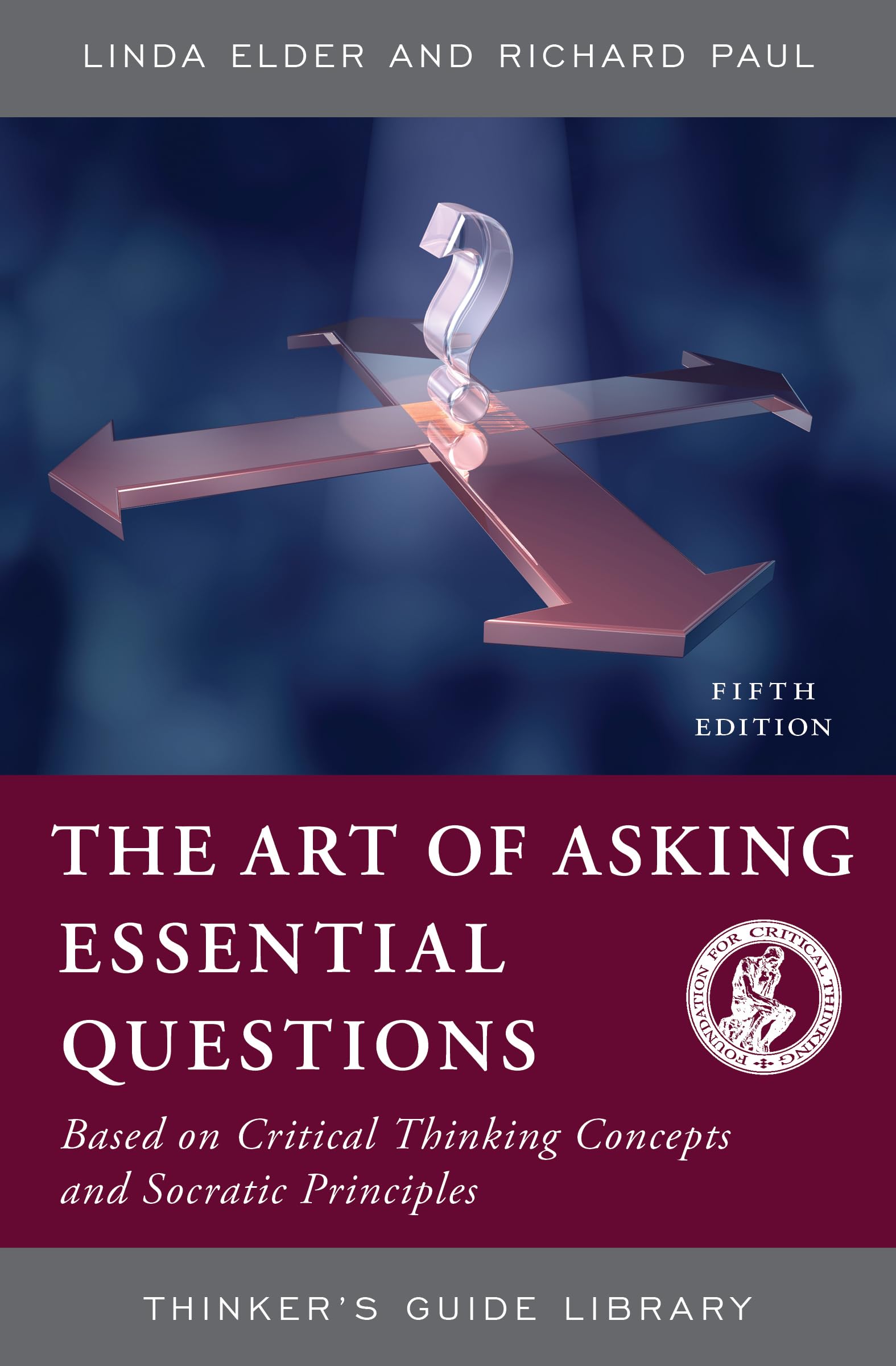
The Art of Asking Essential Questions: Based on Critical Thinking Concepts and Socratic Principles by Linda Elder – A Co
Inclusive of all applicable taxes. FREE shipping on all orders.
Available Offers
- 🚚Free Delivery — Free shipping on all orders
- 💵Cash on Delivery — Pay when your order arrives
- ↩️15-Day Easy Returns — Hassle-free return policy
- 🔒Cash on Delivery — Pay safely when your order arrives
Check Delivery
Product Description
Introduction
In a world overflowing with information, the ability to ask the right questions has become more critical than ever. The Art of Asking Essential Questions: Based on Critical Thinking Concepts and Socratic Principles by Linda Elder is a masterful guide that unveils the transformative power of questioning. This book is not just about asking any question—it is about crafting precise, probing, and purposeful questions that lead to deeper understanding, clearer thinking, and better decision-making. Whether you are a student, educator, professional, or lifelong learner, this book will equip you with the intellectual tools to navigate complexity with confidence and clarity.
Book Overview
Part of the acclaimed Thinker’s Guide Library published by the Foundation for Critical Thinking, this hardcover edition explores the often-overlooked skill of questioning as the cornerstone of all learning and success. Linda Elder, a leading authority on critical thinking, draws on Socratic principles to demonstrate how essential questions can help us uncover hidden assumptions, challenge misleading information, and develop fair-minded, reasoned perspectives. The book systematically breaks down the anatomy of effective questions, distinguishing between analytic and evaluative types, and shows how to use them to foster intellectual growth and avoid the pitfalls of egocentric and sociocentric thinking.
Key Highlights
- Foundational Framework: Learn the core elements of a well-structured question and how to apply them across disciplines.
- Practical Techniques: Step-by-step methods to formulate questions that reveal deeper insights and drive meaningful inquiry.
- Critical Thinking Integration: Seamlessly blends questioning strategies with critical thinking concepts for holistic intellectual development.
- Real-World Applications: Examples from education, business, personal life, and social contexts illustrate the universal relevance of essential questions.
- Socratic Wisdom: Revives ancient Socratic methods in a modern, accessible format that encourages dialogue and reflection.
Inside the Book
The book is structured as a concise yet comprehensive guide. It begins by defining the nature and purpose of essential questions, then moves into the mechanics of question design. Readers will explore the difference between questions that seek information and those that demand analysis, evaluation, or creative synthesis. Each chapter includes illustrative examples, reflective exercises, and practical tips to help readers internalize the concepts. The book also addresses common barriers to effective questioning, such as cognitive biases and social pressures, and offers strategies to overcome them. By the end, readers will have a robust toolkit for using questions as instruments of intellectual empowerment.
Key Topics
- The role of questions in critical thinking and rational discourse
- Analytic vs. evaluative questions and when to use each
- Uncovering assumptions, biases, and hidden agendas through questioning
- Avoiding egocentric and sociocentric thinking traps
- Questioning as a tool for problem-solving and decision-making
- The Socratic method in contemporary contexts
- Developing a questioning mindset for lifelong learning
Reader Benefits
Readers of The Art of Asking Essential Questions will gain the ability to think more clearly, communicate more persuasively, and learn more deeply. They will learn to cut through noise and misinformation, ask questions that challenge the status quo, and foster intellectual humility. The book helps students excel in academics by improving their analytical writing and class participation, while professionals can enhance their leadership, negotiation, and strategic thinking skills. For anyone seeking to become a more independent and fair-minded thinker, this guide is an invaluable companion.
Learning Outcomes
- Master the art of formulating precise and purposeful questions
- Distinguish between different types of questions and their applications
- Identify and challenge personal and societal biases through questioning
- Apply Socratic principles to foster dialogue and critical inquiry
- Enhance problem-solving abilities by focusing on essential issues
- Develop intellectual virtues such as curiosity, humility, and perseverance
Who Should Read
This book is ideal for students and teachers in schools, colleges, and universities who want to deepen their understanding of critical thinking. It is equally valuable for professionals in any field—managers, lawyers, doctors, engineers, journalists, and policymakers—who rely on sound reasoning. Parents, coaches, and anyone involved in mentoring will find practical strategies to nurture inquisitive minds. In short, this book is for every Indian reader who believes that asking the right question is the first step toward wisdom and success.
About the Author
Linda Elder is an educational psychologist and a foremost authority on critical thinking. She is the President of the Foundation for Critical Thinking and has co-authored numerous books and articles on the subject, including the widely used Thinker’s Guide series. Her work focuses on making critical thinking accessible and applicable across all levels of education and professional life. Dr. Elder’s insights are rooted in decades of research and teaching, making her a trusted voice in the field.
About the Publisher
The Foundation for Critical Thinking is a non-profit organization dedicated to promoting fair-minded critical thinking in education, business, and society. Through its Thinker’s Guide Library, the foundation provides practical, research-based resources that empower individuals to think more clearly, rationally, and ethically. Their publications are used by educators and institutions worldwide to cultivate essential intellectual skills and virtues.
Conclusion
The Art of Asking Essential Questions is more than a book—it is a manual for intellectual empowerment. In an age where information is abundant but wisdom is scarce, this guide offers a timeless skill set that will serve you for a lifetime. Whether you are preparing for exams, leading a team, or simply trying to make sense of the world, the ability to ask essential questions will be your most trusted ally. Add this hardcover edition to your library today and begin your journey toward sharper thinking and deeper understanding.
Quick Summary
The Art of Asking Essential Questions by Linda Elder is a compact yet powerful guide that teaches readers the art of asking questions that lead to deeper understanding and better decisions. Rooted in critical thinking concepts and Socratic principles, this book explains how effective questions can uncover hidden assumptions, challenge misinformation, and reveal biases. It distinguishes between analytic questions that break down ideas and evaluative questions that judge their worth. The book also warns against egocentric and sociocentric thinking that can cloud judgment. Ideal for Indian students, teachers, and professionals, it provides practical tools to enhance reasoning in academics, career, and daily life. By mastering essential questioning, readers can think more clearly, communicate more effectively, and make wiser choices. Part of the Thinker's Guide Library published by the Foundation for Critical Thinking, this hardcover edition is a valuable addition to any personal or institutional library. Buy from Bookshops.in for a genuine copy with reliable delivery across India.
Book Highlights
Book Specifications
| ISBN-13 | 9780944583166 |
| ISBN-10 | 0944583164 |
| Publisher | Foundation for Critical Thinking |
| Language | English |
| Dimensions | 13.34 x 0.28 x 20.32 cm |
| Weight | 68 g |
| Category | Philosophy › Logic |
| Series | Thinker's Guide Library |
| Genre | Nonfiction |
| Reading Age | 15 and up |
| Original Language | English |
Frequently Asked Questions
What is The Art of Asking Essential Questions about?
Who is the author of this book?
Is this book suitable for beginners in critical thinking?
How does this book help with exams like UPSC or MBA?
Does the book include practical exercises?
Can teachers use this book in classrooms?
Is this book only for academic use?
What is the difference between analytic and evaluative questions?
Does the book cover cognitive biases?
How long does it take to read this book?
Is this book available in hardcover?
How is this book different from other critical thinking books?
Why should I buy this book from Bookshops.in?
Readers Also Search For
Customers Also Bought
Islam
Spiritual Economies (English, Daromir Rudnyckyj)

Islam
Who Is Allah? (English, Bruce B. Lawrence)
Islam
Islam and Liberal Citizenship: The Search for an Overlapping Consensus by Andrew F. March

Islam
Fiqh Us-Sunnah: Funerals and Diggers by Al-Sayyid Sabiq – Islamic Funeral Guide

Christianity
Genetics (English, Thomas a. Shannon | Mark P. Aulisio | Françoise Baylis)

Hinduism
Karma and Creativity by Christopher Key Chapple – Indian Philosophy
Related Products
View All
Philosophy
Latin American Philosophy: Currents, Issues, Debates by Eduardo Mendieta

Philosophy
Al-Farabi's Short Commentary on Aristotle's Prior Analytics by Nicholas Rescher – Philosophy
Philosophy
Poetics of Imagining: Modern to Post-modern by Richard Kearney
Philosophy
The Metaphysics of Extrinsic Properties: 11 (Metaphysical Research, 11)
Philosophy
Dialogues on Metaphysics and on Religion by Nicolas Malebranche – Philosophy
Philosophy