
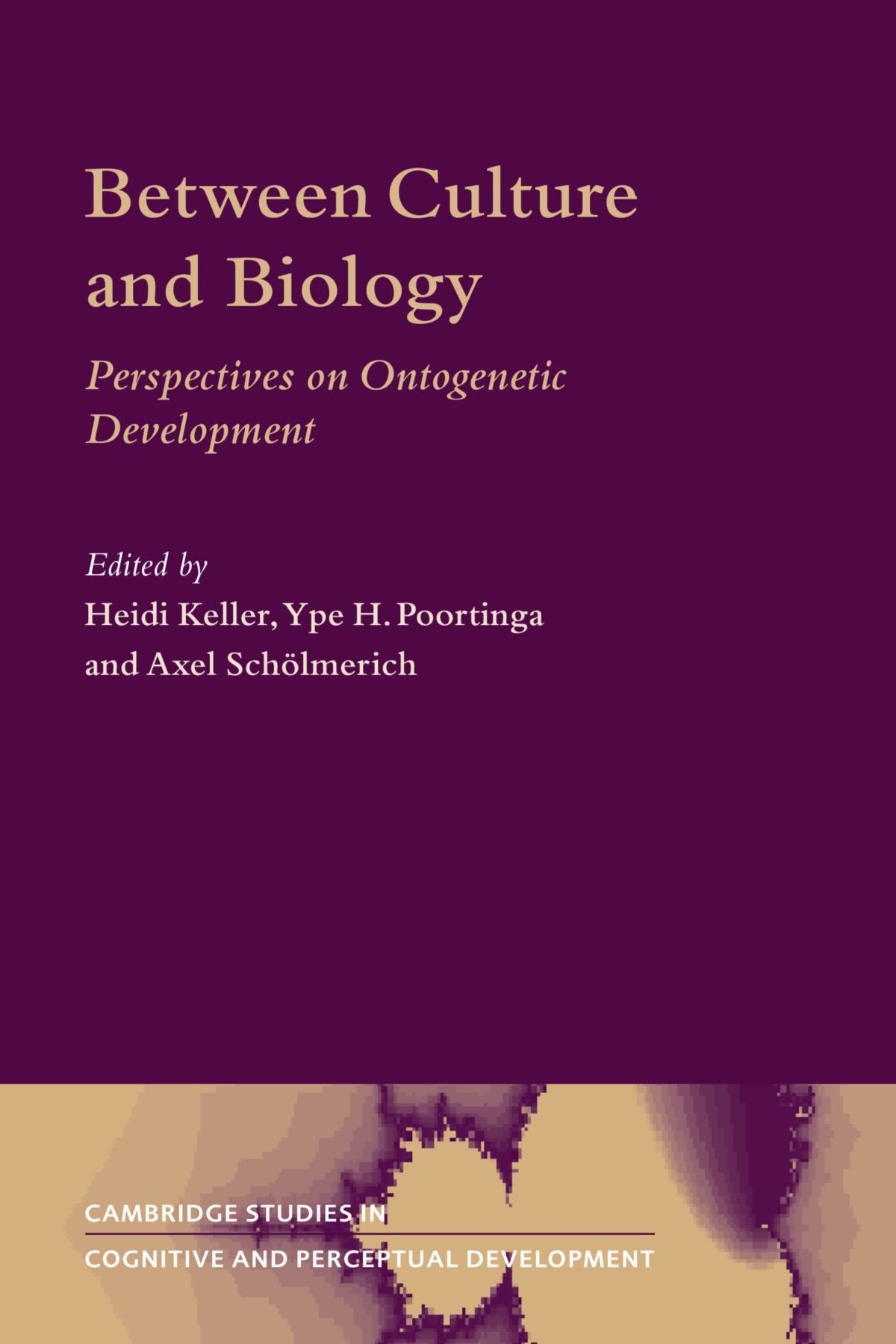
Between Culture and Biology: An Integrated Perspective on Human Development by Heidi Keller
Inclusive of all applicable taxes. FREE shipping on all orders.
Available Offers
- 🚚Free Delivery — Free shipping on all orders
- 💵Cash on Delivery — Pay when your order arrives
- ↩️15-Day Easy Returns — Hassle-free return policy
- 🔒Cash on Delivery — Pay safely when your order arrives
Check Delivery
Product Description
Introduction
In the vast landscape of developmental science, few works have dared to bridge the chasm between biological determinism and cultural relativism with the intellectual rigor found in Scpd: Between Culture and Biology. Authored by the eminent scholar Heidi Keller and published by Cambridge University Press, this hardcover volume offers a groundbreaking synthesis that challenges students and researchers alike to rethink the very foundations of human development. For Indian readers, where diverse cultural traditions intersect with modern scientific inquiry, this book provides a uniquely nuanced perspective on how our genes and our social worlds co-create who we become.
Book Overview
This compelling work moves decisively beyond the tired nature-versus-nurture debate. Instead, it presents an integrated framework where biological processes and cultural contexts are seen as mutually constitutive forces shaping ontogenetic development. Drawing on empirical research from multiple disciplines, Keller argues that human behaviour cannot be reduced to either innate predispositions or environmental influences alone. The book systematically explores how cultural ideas and practices both reflect and constrain biological potentials, offering a dynamic model of development that is as relevant to a child growing up in a bustling Indian city as to one in a remote village. Each chapter builds a case for a truly interdisciplinary approach, weaving together insights from psychology, anthropology, neuroscience, and evolutionary biology.
Key Highlights
- Integrated Framework: A novel theoretical model that treats biology and culture as inseparable, co-evolving systems rather than opposing forces.
- Cross-Cultural Evidence: Rich examples from diverse societies, including non-Western contexts, making it especially valuable for Indian scholars.
- Developmental Constraints: A clear analysis of how biological limits and cultural opportunities interact to shape developmental trajectories.
- Methodological Innovation: Discussion of research methods that capture the interplay between genes, environment, and cultural practices.
- Critical Reappraisal: A thoughtful critique of traditional developmental theories that have often ignored cultural variation.
Inside the Book
Readers will find a meticulously structured text that progresses from foundational concepts to complex applications. Early chapters lay out the historical and philosophical background of the nature/nurture dichotomy, before dismantling it piece by piece. Subsequent sections delve into specific domains such as attachment, socialisation, cognitive development, and moral reasoning, always through the lens of cultural-biological synergy. Keller uses case studies, empirical data, and theoretical arguments to illustrate how parenting practices, educational systems, and societal norms are both shaped by and shape our biological makeup. The writing is accessible yet scholarly, making it suitable for advanced undergraduates, postgraduate students, and academics seeking a fresh perspective.
Key Topics
- The cultural construction of developmental milestones
- Biological plasticity and its limits across different ecologies
- Parent-child relationships as sites of cultural and biological negotiation
- Evolutionary perspectives on human social behaviour
- Implications for education, health, and social policy in culturally diverse societies
- Comparative studies of development in individualistic and collectivist cultures
- The role of language and symbolism in mediating biology and culture
Reader Benefits
This book empowers readers to move beyond simplistic dichotomies and embrace complexity. Students will gain a robust conceptual toolkit for analysing human development in its full context. Researchers will find fresh hypotheses and methodological guidance for studying culture-biology interactions. Educators and practitioners working with diverse populations in India will appreciate the culturally sensitive framework that acknowledges both universal biological processes and local particularities. The book also fosters critical thinking by challenging readers to question their own assumptions about what is 'natural' versus 'cultural' in human behaviour.
Learning Outcomes
- Understand why the nature/nurture debate is a false dichotomy and how to replace it with an integrated model.
- Identify the biological mechanisms that enable cultural learning and the cultural practices that shape biological development.
- Analyse developmental phenomena from multiple disciplinary perspectives simultaneously.
- Evaluate research designs that can capture bidirectional influences between biology and culture.
- Apply these insights to real-world issues in education, child rearing, and mental health in the Indian context.
Who Should Read
This book is essential reading for postgraduate students and faculty in psychology, anthropology, sociology, and education. It will also be invaluable for paediatricians, child psychologists, social workers, and policymakers involved in early childhood development programmes. Indian readers with an interest in understanding how cultural diversity—from joint family systems to urban nuclear households—interacts with biological universals will find this work deeply illuminating. Anyone curious about what it truly means to be human, shaped by both our evolutionary heritage and our cultural worlds, will benefit from Keller's masterful synthesis.
About the Author
Heidi Keller is a distinguished professor of psychology and an internationally recognised authority on cross-cultural human development. With decades of research experience spanning multiple continents, she has pioneered studies on parenting, attachment, and socialisation in diverse cultural settings. Her work has been instrumental in challenging Western-centric models of development and advocating for a more inclusive, globally informed science. Keller's scholarship is characterised by its theoretical depth, empirical rigour, and deep respect for cultural variation.
About the Publisher
Cambridge University Press is one of the world's oldest and most prestigious academic publishers, with a legacy of disseminating cutting-edge research since 1534. Known for its rigorous peer-review process and commitment to scholarly excellence, Cambridge University Press brings authoritative works like this one to a global readership. This hardcover edition is produced to the highest standards, ensuring durability and readability for years of reference.
Conclusion
Scpd: Between Culture and Biology is not merely a book—it is a paradigm shift. For Indian students and academics navigating the rich tapestry of our nation's cultural diversity, this volume offers an indispensable guide to understanding development as a truly integrated process. By rejecting simplistic binaries and embracing complexity, Heidi Keller provides a vision of human growth that honours both our shared biology and our unique cultural expressions. Add this essential hardcover to your library and join the conversation that is redefining developmental science.
Quick Summary
Between Culture and Biology by Heidi Keller is a groundbreaking work that dismantles the traditional nature versus nurture dichotomy, offering an integrated framework for understanding human development. The book brings together biological, psychological, and cultural perspectives, arguing that these forces are deeply intertwined and must be studied together. It explores how biological bases of behavior interact with cultural contexts to shape ontogenetic development, and examines the constraints and opportunities that arise from this interplay. Written by a leading expert in developmental psychology, this volume is ideal for Indian students and researchers seeking a holistic view of human growth. Readers will learn how cultural ideas and practices reflect biological and psychological constraints, and how developmental theory can be enriched by cross-cultural insights. Published by Cambridge University Press, this hardcover edition is a valuable addition to any academic library. By purchasing from Bookshops.in, Indian customers get authentic imported books at competitive prices with reliable delivery. Whether you are a psychology student, an anthropologist, or an educator, this book will deepen your understanding of what makes us human.
Book Highlights
Book Specifications
| ISBN-13 | 9780521794527 |
| ISBN-10 | 0521794528 |
| Publisher | Cambridge University Press |
| Language | English |
| Dimensions | 15.24 x 2.87 x 22.86 cm |
| Weight | 650 g |
| Category | Psychology › Developmental Psychology |
| Genre | Non-fiction |
| Original Language | English |
Frequently Asked Questions
What is the main theme of Between Culture and Biology?
Who is the author of this book?
Is this book suitable for Indian students?
Which publisher released this book?
What is the ISBN-13 of this book?
Is this book a hardcover edition?
What is the price of this book?
Does this book include digital formats?
What language is the book written in?
What is the rating of this book?
Which category does this book belong to?
Can this book be used as a textbook?
How does this book differ from other developmental psychology texts?
Readers Also Search For
Customers Also Bought
Psychology
Koinonia: From Hate, Through Dialogue, to Culture in the Large Group by Patrick B. Demare
Psychology
Mindfulness-Based Interventions for Trauma and Its Consequences (Concise Guides on Trauma Care, 4)

Psychology
Handbook for Teaching Statistics and Research Methods by Mark E. Ware

Psychology
Psychoanalysis and the Nuclear Threat: Clinical and Theoretical Studies

Psychology
Humor and Psyche: Psychoanalytic Perspectives by James W. Barron

Relationships
The Experience and Expression of Uncertainty in Close Relationships by Jennifer A. Theiss
Related Products
View AllPsychology
Mindfulness-Based Interventions for Trauma and Its Consequences (Concise Guides on Trauma Care, 4)
Psychology
Handbook for Teaching Statistics and Research Methods by Mark E. Ware
Psychology
Psychoanalysis and the Nuclear Threat: Clinical and Theoretical Studies
Psychology
Humor and Psyche: Psychoanalytic Perspectives by James W. Barron

Psychology
Proceedings of the First International Conference on Genetic Algorithms and Their Applications
Psychology