
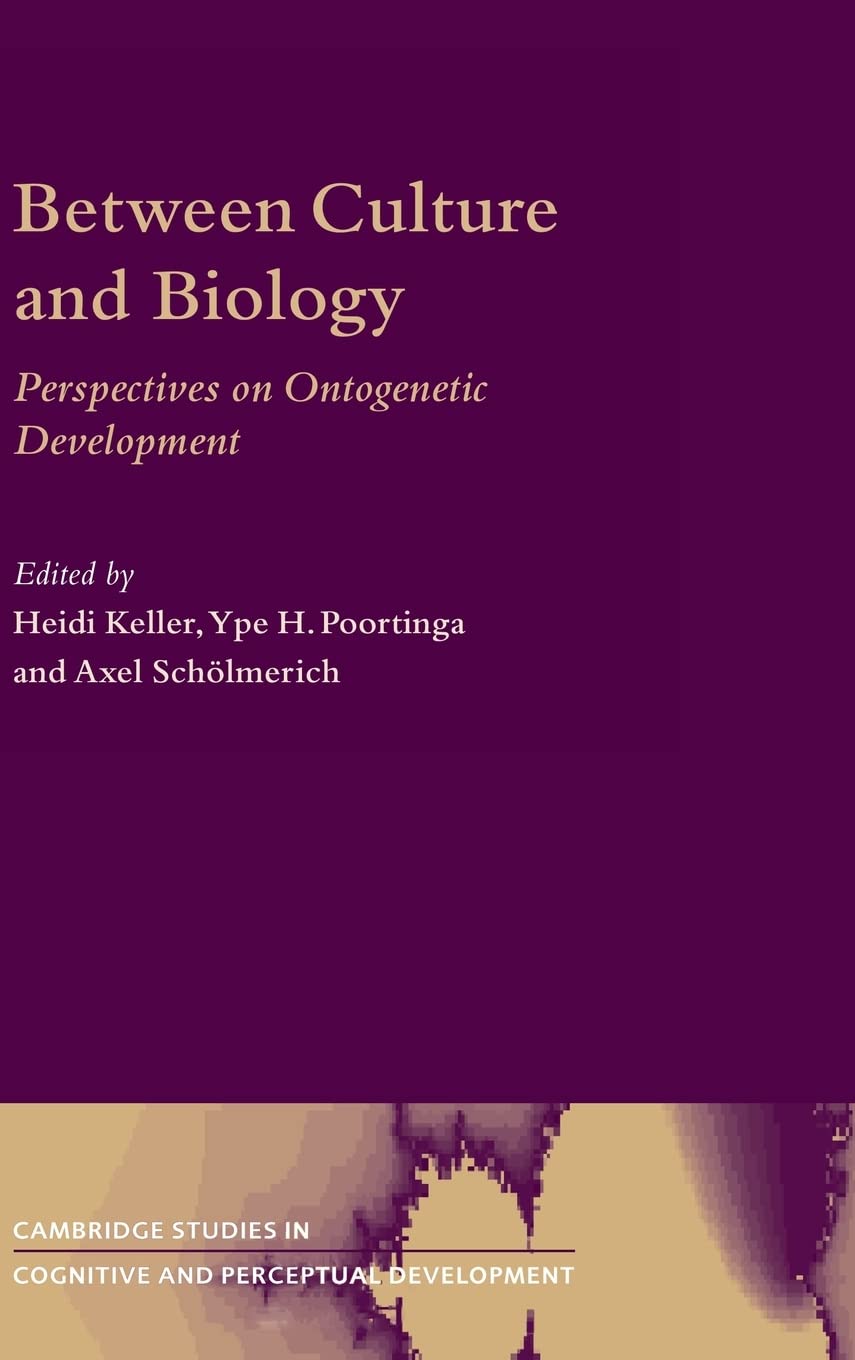
Between Culture and Biology: Perspectives on Ontogenetic Development by Heidi Keller – An Integrated Approach to Human G
Inclusive of all applicable taxes. FREE shipping on all orders.
Available Offers
- 🚚Free Delivery — Free shipping on all orders
- 💵Cash on Delivery — Pay when your order arrives
- ↩️15-Day Easy Returns — Hassle-free return policy
- 🔒Cash on Delivery — Pay safely when your order arrives
Check Delivery
Product Description
Introduction
In the vast landscape of developmental psychology, few questions are as enduring as the debate between nature and nurture. Between Culture and Biology: Perspectives on Ontogenetic Development by Heidi Keller offers a refreshing departure from this tired dichotomy. Published by the prestigious Cambridge University Press, this hardbound volume is an essential read for Indian students, researchers, and educators who seek a deeper, integrated understanding of how human beings grow, learn, and adapt. Keller brings together leading voices from biology, psychology, and cultural studies to present a cohesive framework that respects both our biological heritage and the rich diversity of cultural contexts—a perspective particularly relevant in India’s multicultural society.
Book Overview
This scholarly work challenges readers to move beyond simplistic either-or explanations of development. Instead, it argues that ontogenetic development—the process of an individual’s growth from conception to maturity—is shaped by a dynamic interplay between biological constraints and cultural opportunities. The book systematically explores how cultural practices, beliefs, and social environments interact with genetic predispositions and neurological maturation. Keller and her contributors draw on cross-cultural research, including examples from non-Western societies, to illustrate how development cannot be fully understood without considering both the universal biological substrate and the particular cultural milieu. The result is a nuanced, multi-layered analysis that respects complexity while offering clarity.
Key Highlights
- Integrated Framework: Breaks free from the nature-versus-nurture debate to propose a truly integrated biosocial approach.
- Expert Contributors: Features chapters from leading international scholars in developmental science, anthropology, and neuroscience.
- Cross-Cultural Emphasis: Includes rich examples from diverse cultural settings, making it highly relevant for Indian readers.
- Rigorous Scholarship: Maintains intellectual depth without sacrificing accessibility for advanced students and professionals.
- Authoritative Publisher: Published by Cambridge University Press, ensuring high editorial and academic standards.
Inside the Book
The book is organized into thematic sections that guide the reader through foundational concepts, empirical research, and theoretical implications. Early chapters establish the biological underpinnings of development, including genetic expression and neural plasticity. Subsequent chapters delve into cultural dimensions, such as parenting styles, educational practices, and socialisation rituals across different societies. The later sections synthesise these strands, offering models for how biological and cultural factors co-construct developmental pathways. Each chapter includes critical discussions, case studies, and references that invite further exploration. The writing is clear and engaging, making complex ideas accessible without oversimplification.
Key Topics
- Nature, nurture, and the biosocial interface in development
- Cultural variation in infant care and attachment
- Biological constraints and cultural opportunities in cognitive development
- Neural plasticity and the role of experience
- Parenting across cultures: universal and context-specific aspects
- Moral development and cultural values
- Language acquisition as a biocultural phenomenon
- Developmental psychopathology from a cultural perspective
- Methodological challenges in cross-cultural developmental research
Reader Benefits
This book empowers readers to think critically about human development in a globalised world. For Indian students, it provides a framework to understand how local cultural practices—such as joint family systems, multilingual environments, and community-based child rearing—shape developmental outcomes. Researchers will appreciate the theoretical rigor and the call for more inclusive, culturally sensitive methodologies. Educators can use this text to enrich their teaching of developmental psychology, anthropology, and education. The book also helps professionals in child welfare, counselling, and policy-making appreciate the need for culturally informed interventions.
Learning Outcomes
By engaging with this book, readers will be able to: analyse the limitations of the nature-nurture dichotomy; evaluate how biological and cultural factors jointly influence development; apply cross-cultural perspectives to real-world developmental issues; critically assess research designs in developmental science; articulate the significance of context in shaping behaviour and cognition; and synthesise knowledge from multiple disciplines to form a holistic understanding of ontogenesis.
Who Should Read
- Postgraduate and advanced undergraduate students in psychology, anthropology, sociology, and education
- Researchers and academics specialising in developmental science, cross-cultural studies, and human biology
- Practitioners in child development, mental health, and social work
- Educators and curriculum designers interested in culturally responsive pedagogy
- Policy-makers and NGO professionals working on child welfare and early intervention programmes
- Anyone curious about the complex interplay between biology and culture in shaping who we become
About the Author
Heidi Keller is a renowned developmental psychologist and professor emeritus at Osnabrück University, Germany. Her research has focused on cultural influences on child development, particularly in comparing Western and non-Western contexts. With decades of fieldwork in diverse communities, including in India and Africa, Keller is a leading advocate for integrating cultural perspectives into mainstream developmental theory. She has authored numerous influential papers and books, and her work has shaped contemporary understanding of parenting, attachment, and socialisation across cultures.
About the Publisher
Cambridge University Press is one of the world’s oldest and most respected academic publishers, with a history dating back to 1534. Known for its rigorous peer-review process and commitment to scholarly excellence, Cambridge University Press publishes works that set the standard in their fields. This book is part of their prestigious series in developmental psychology and cultural studies, ensuring that readers receive authoritative, well-edited content that stands the test of time.
Conclusion
Between Culture and Biology: Perspectives on Ontogenetic Development is more than a textbook—it is a paradigm shift. For Indian readers seeking to understand how children grow and learn in a culturally diverse world, this book offers invaluable insights. It respects the complexity of human development while providing a clear, integrated framework. Whether you are a student, researcher, or practitioner, this volume will deepen your appreciation of the beautiful interplay between our biological roots and our cultural worlds. Add this essential hardcover to your library today and join the conversation that is reshaping developmental science.
Quick Summary
Between Culture and Biology: Perspectives on Ontogenetic Development by Heidi Keller is a groundbreaking academic work that moves beyond the traditional nature/nurture debate to offer an integrated understanding of human development. The book brings together biological, psychological and cultural perspectives, arguing that these domains are deeply interconnected. It examines how cultural contexts and biological constraints both provide opportunities and limitations for growth. Written by a leading expert and published by Cambridge University Press, this volume is ideal for advanced undergraduate and postgraduate students in psychology, anthropology, education and sociology. Indian readers will benefit from its cross-cultural approach, which challenges Western-centric models and highlights diversity. Readers will learn to think critically about developmental theory and appreciate the complex interplay between biology and culture. By purchasing from Bookshops.in, you get a high-quality physical copy delivered to your doorstep, supporting local bookstores and ensuring authentic content.
Book Highlights
Book Specifications
| ISBN-13 | 9780521791205 |
| ISBN-10 | 0521791200 |
| Publisher | Cambridge University Press |
| Language | English |
| Dimensions | 15.88 x 3.18 x 23.5 cm |
| Weight | 830 g |
| Country | India |
| Category | Psychology › Developmental Psychology |
| Genre | Non-fiction |
| Original Language | English |
Frequently Asked Questions
What is this book about?
Who is the author?
Is this book suitable for Indian students?
What is ontogenetic development?
Does the book support nature or nurture?
Who is the publisher?
What is the price?
Is it a hardcover or paperback?
What is the ISBN?
Can I use this for my thesis?
Does it include case studies?
Is it available in other languages?
Where can I buy it?
Readers Also Search For
Customers Also Bought
Psychology
Koinonia: From Hate, Through Dialogue, to Culture in the Large Group by Patrick B. Demare
Psychology
Mindfulness-Based Interventions for Trauma and Its Consequences (Concise Guides on Trauma Care, 4)

Psychology
Handbook for Teaching Statistics and Research Methods by Mark E. Ware

Psychology
Psychoanalysis and the Nuclear Threat: Clinical and Theoretical Studies

Psychology
Humor and Psyche: Psychoanalytic Perspectives by James W. Barron

Relationships
The Experience and Expression of Uncertainty in Close Relationships by Jennifer A. Theiss
Related Products
View AllPsychology
Mindfulness-Based Interventions for Trauma and Its Consequences (Concise Guides on Trauma Care, 4)
Psychology
Handbook for Teaching Statistics and Research Methods by Mark E. Ware
Psychology
Psychoanalysis and the Nuclear Threat: Clinical and Theoretical Studies
Psychology
Humor and Psyche: Psychoanalytic Perspectives by James W. Barron

Psychology
Proceedings of the First International Conference on Genetic Algorithms and Their Applications
Psychology