
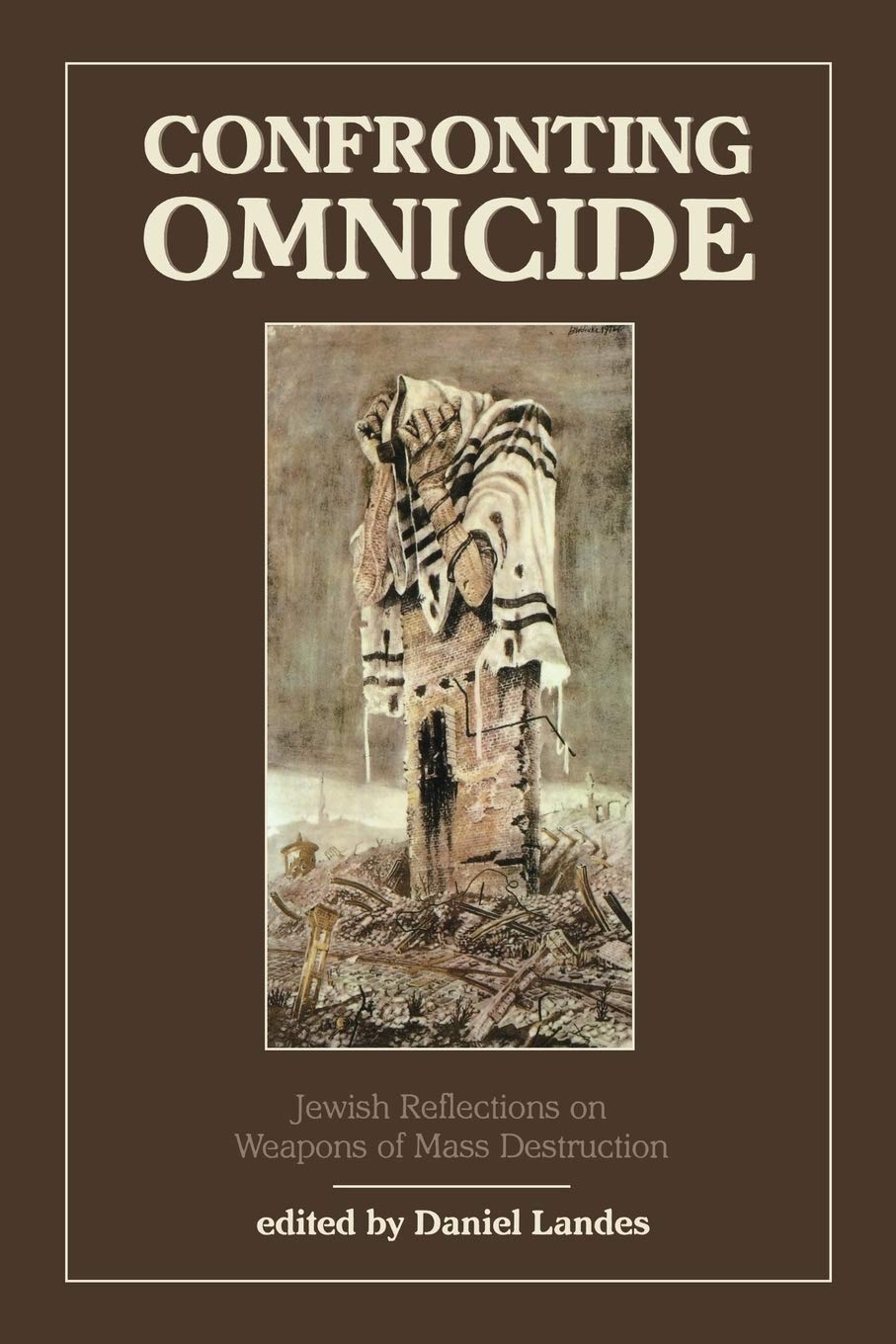
Confronting Omnicide: Jewish Reflections on Weapons of Mass Destruction by Daniel Landes – A Simon Wiesenthal Center Pro
Inclusive of all applicable taxes. FREE shipping on all orders.
Available Offers
- 🚚Free Delivery — Free shipping on all orders
- 💵Cash on Delivery — Pay when your order arrives
- ↩️15-Day Easy Returns — Hassle-free return policy
- 🔒Cash on Delivery — Pay safely when your order arrives
Check Delivery
Product Description
Introduction
In a world where the spectre of nuclear, biological, and chemical warfare looms large, Confronting Omnicide: Jewish Reflections on Weapons of Mass Destruction offers a profound and urgently needed moral compass. This hardcover volume, curated by Daniel Landes as part of the Simon Wiesenthal Center Project, brings together leading Jewish thinkers, theologians, and ethicists to grapple with the existential threat of omnicide—the annihilation of all life. For Indian readers, students, and scholars engaged in debates on global security, ethics, and religious responsibility, this book provides a unique lens rooted in millennia of Jewish wisdom, yet universally resonant. It is not merely an academic text but a call to conscience, urging humanity to confront the ultimate consequences of its technological and political choices.
Book Overview
Published by Jason Aronson, Confronting Omnicide is a landmark anthology that examines the moral, theological, and practical dimensions of weapons capable of destroying entire civilizations. The book emerges from the prestigious Simon Wiesenthal Center, an organisation dedicated to preserving the memory of the Holocaust and combating hatred and genocide. Drawing on Jewish traditions of justice, peace, and human dignity, the essays within explore how ancient texts and modern ethical frameworks can guide humanity away from self-annihilation. Each chapter is a rigorous yet accessible exploration of topics ranging from nuclear deterrence to the concept of 'tikkun olam' (repairing the world), making this an indispensable resource for anyone concerned about the future of life on Earth.
Key Highlights
- Authoritative Contributors: Features essays by renowned rabbis, philosophers, and scholars, including figures like Irving Greenberg, David Hartman, and Elie Wiesel, offering diverse perspectives within Jewish thought.
- Timely and Relevant: Addresses contemporary threats such as nuclear proliferation, chemical warfare, and environmental collapse, linking them to classical Jewish teachings on responsibility and survival.
- Interdisciplinary Approach: Combines theology, history, political science, and ethics, making it suitable for both religious and secular audiences.
- Original and Unpublished Material: Contains exclusive reflections not available elsewhere, developed specifically for the Simon Wiesenthal Center Project.
- Premium Hardcover Edition: Durable binding and high-quality paper, perfect for libraries, academic institutions, and personal collections in India.
Inside the Book
The volume is structured into thematic sections that guide the reader from foundational Jewish concepts to pressing modern dilemmas. The opening chapters establish the biblical and rabbinic roots of peace and the prohibition of wanton destruction, drawing on texts from Genesis to the Talmud. Later sections delve into the ethics of nuclear weapons, the moral limits of warfare, and the role of memory—especially the Holocaust—in shaping a Jewish response to omnicide. The book also includes case studies on the Iran nuclear deal, the ethics of preemptive strikes, and the responsibility of scientists and policymakers. A concluding essay synthesises these insights into a compelling call for global action, grounded in the Jewish imperative to choose life.
Key Topics
- Jewish ethics of war and peace in the nuclear age
- The concept of 'omnicide' and its theological implications
- Holocaust memory as a lens for understanding genocide prevention
- The role of 'tikkun olam' in addressing global threats
- Nuclear deterrence versus disarmament: a Jewish perspective
- Biological and chemical weapons: moral and halakhic considerations
- Environmental destruction as a form of slow omnicide
- Interfaith dialogue and collective responsibility for survival
Reader Benefits
By engaging with this book, readers gain a deeper understanding of how ancient religious traditions can inform contemporary debates on existential risk. Indian students and scholars will find parallels with Hindu, Buddhist, and Jain philosophies of non-violence and cosmic responsibility, enriching cross-cultural dialogue. The book also provides practical ethical frameworks for activists, policymakers, and educators working on disarmament and peacebuilding. Moreover, it offers a powerful counter-narrative to fatalism, demonstrating that human agency and moral choice remain vital even in the face of overwhelming danger. The hardcover format ensures that this is a lasting reference, ideal for repeated study and reflection.
Learning Outcomes
- Articulate the Jewish ethical principles relevant to weapons of mass destruction
- Analyse the theological and historical roots of the concept of omnicide
- Evaluate contemporary security policies through a moral and religious lens
- Understand the role of collective memory in shaping responses to genocide and annihilation
- Develop informed arguments for disarmament and global cooperation based on Jewish sources
- Apply the concept of 'tikkun olam' to modern environmental and technological crises
Who Should Read
This book is essential for university students and faculty in religious studies, political science, international relations, and ethics. It is also highly recommended for members of Jewish communities in India and abroad, interfaith leaders, peace activists, and policymakers concerned with nuclear non-proliferation. Additionally, general readers interested in the intersection of faith and global survival will find the essays both intellectually stimulating and spiritually uplifting. The accessible yet scholarly tone makes it suitable for advanced high school students and lifelong learners alike.
About the Author
Daniel Landes is a distinguished rabbi, educator, and scholar who has served as the Director of the Pardes Institute of Jewish Studies in Jerusalem and as a senior fellow at the Shalom Hartman Institute. He is a prolific writer and lecturer on Jewish ethics, modern Jewish thought, and the legacy of the Holocaust. Landes has been deeply involved with the Simon Wiesenthal Center, contributing to its mission of remembrance and moral education. His editorial vision for Confronting Omnicide reflects a lifelong commitment to making Jewish wisdom accessible and actionable in addressing the most pressing challenges of our time.
About the Publisher
Jason Aronson, an imprint of Rowman & Littlefield, is a renowned publisher of scholarly and trade books in Jewish studies, psychology, and spirituality. With a catalogue spanning over four decades, Jason Aronson has brought to readers foundational works by leading rabbis, historians, and philosophers. The publisher is celebrated for its commitment to rigorous scholarship combined with accessible prose, making complex ideas available to a broad audience. This hardcover edition upholds the publisher's tradition of quality, featuring a sturdy binding, clear typeface, and archival-grade paper—ideal for the Indian climate and long-term use in personal and institutional libraries.
Conclusion
Confronting Omnicide: Jewish Reflections on Weapons of Mass Destruction is more than a book—it is a moral intervention in a world teetering on the brink. By weaving together ancient wisdom and modern analysis, Daniel Landes and his contributors offer a path from despair to hope, from passivity to action. For Indian readers who value deep ethical inquiry and global responsibility, this volume is an invaluable addition to any library. It challenges us to think, to feel, and to act before it is too late. Order your copy today from Bookshops.in and join the conversation that could shape the future of humanity.
Quick Summary
Confronting Omnicide: Jewish Reflections on Weapons of Mass Destruction, edited by Daniel Landes, is a landmark volume produced under the aegis of the Simon Wiesenthal Center. This book gathers essays from leading Jewish theologians, rabbis, and ethicists to grapple with the moral, spiritual, and existential crisis posed by nuclear and other weapons of mass destruction. The term 'omnicide'—the annihilation of all humanity—frames the discussion, linking the memory of the Holocaust to contemporary threats. Readers will encounter deep dives into Jewish ethical traditions, prophetic calls for peace, and critical analyses of deterrence and disarmament. The book is essential for students of theology, ethics, international relations, and peace studies, as well as for religious leaders and activists. It offers a unique religious lens on global security issues that is rarely found in mainstream discourse. By purchasing from Bookshops.in, Indian readers gain access to this rare, hardcover edition with reliable delivery and customer service, supporting a local bookstore that values thoughtful, scholarly works.
Book Highlights
Book Specifications
| ISBN-13 | 9780876688519 |
| ISBN-10 | 0876688512 |
| Publisher | Jason Aronson Inc |
| Language | English |
| Dimensions | 15.24 x 1.75 x 22.86 cm |
| Weight | 635 g |
| Category | Religious Studies › Theology & Philosophy of Religion |
| Genre | Nonfiction |
| Reading Age | Adult |
| Original Language | English |
Frequently Asked Questions
What is the main theme of Confronting Omnicide?
Who edited Confronting Omnicide?
Is this book suitable for non-Jewish readers?
What does 'omnicide' mean?
Does the book offer practical solutions?
What is the Simon Wiesenthal Center's role?
What is the language of the book?
Is this book a hardcover?
What is the ISBN of Confronting Omnicide?
Who is the publisher?
What is the price of the book?
Can I buy this book from Bookshops.in?
Is this book part of a series?
Readers Also Search For
Customers Also Bought
Islam
Spiritual Economies (English, Daromir Rudnyckyj)

Islam
Who Is Allah? (English, Bruce B. Lawrence)
Islam
Islam and Liberal Citizenship: The Search for an Overlapping Consensus by Andrew F. March
Islam
Fiqh Us-Sunnah: Funerals and Diggers by Al-Sayyid Sabiq – Islamic Funeral Guide

Christianity
Genetics (English, Thomas a. Shannon | Mark P. Aulisio | Françoise Baylis)

Hinduism
Karma and Creativity by Christopher Key Chapple – Indian Philosophy
Related Products
View All
Religion & Spirituality
Spiritual Competency in Psychotherapy | by Philip Brownell | Springer Publishing Company | by Philip Brownell | Springer Publishing Company | by Philip Brownell | Springer Publishing Company | by Philip Brownell | Springer Publishing Company | by Philip Brownell | Springer Publishing Company | by Philip Brownell | Springer Publishing Company | by Philip Brownell | Springer Publishing Company | by Philip Brownell | Springer Publishing Company | by Philip Brownell | Springer Publishing Company | b
Religion & Spirituality
Religion as a Conversation Starter | by Ina Merdjanova | Continuum | by Ina Merdjanova | Continuum | by Ina Merdjanova | Continuum | by Ina Merdjanova | Continuum | by Ina Merdjanova | Continuum | by Ina Merdjanova | Continuum | by Ina Merdjanova | Continuum | by Ina Merdjanova | Continuum | by Ina Merdjanova | Continuum | by Ina Merdjanova | Continuum | by Ina Merdjanova | Continuum | by Ina Merdjanova | Continuum | by Ina Merdjanova | Continuum | by Ina Merdjanova | Continuum | by Ina Merdjano
Religion & Spirituality
The Other Jewish Question: Identifying the Jew and Making Sense of Modernity
Religion & Spirituality
The Oxford Guide to People & Places of the Bible | by Bruce M. Metzger | Michael D. Coogan | Oxford University Press | by Bruce M. Metzger | Michael D. Coogan | Oxford University Press | by Bruce M. Metzger | Michael D. Coogan | Oxford University Press | by Bruce M. Metzger | Michael D. Coogan | Oxford University Press | by Bruce M. Metzger | Michael D. Coogan | Oxford University Press | by Bruce M. Metzger | Michael D. Coogan | Oxford University Press | by Bruce M. Metzger | Michael D. Coogan |

Religion & Spirituality
Anti-Judaism in Early Christianity | by Stephen G. Wilson | Wilfrid Laurier University Press | by Stephen G. Wilson | Wilfrid Laurier University Press | by Stephen G. Wilson | Wilfrid Laurier University Press | by Stephen G. Wilson | Wilfrid Laurier University Press | by Stephen G. Wilson | Wilfrid Laurier University Press | by Stephen G. Wilson | Wilfrid Laurier University Press | by Stephen G. Wilson | Wilfrid Laurier University Press | by Stephen G. Wilson | Wilfrid Laurier University Press |
Religion & Spirituality