
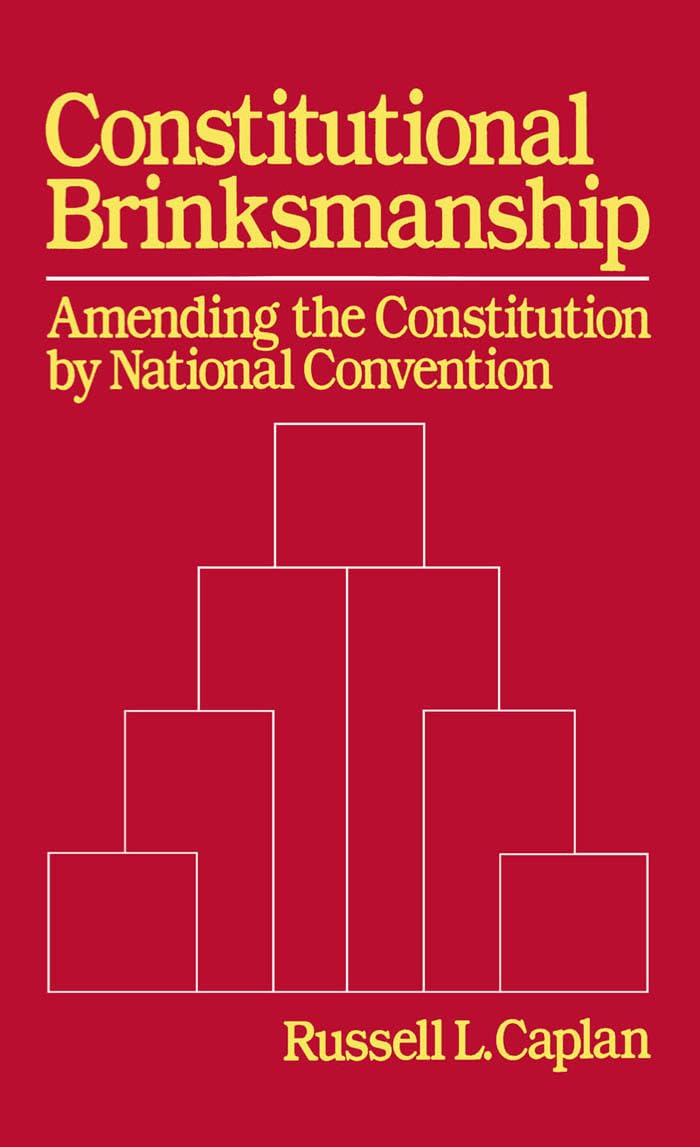
Constitutional Brinksmanship: Amending the Constitution by National Convention by Russell L. Caplan – A Scholarly Analys
Inclusive of all applicable taxes. FREE shipping on all orders.
Available Offers
- 🚚Free Delivery — Free shipping on all orders
- 💵Cash on Delivery — Pay when your order arrives
- ↩️15-Day Easy Returns — Hassle-free return policy
- 🔒Cash on Delivery — Pay safely when your order arrives
Check Delivery
Product Description
Introduction
In the landscape of constitutional law, few processes are as dramatic or as little understood as the movement to amend the U.S. Constitution through a national convention. Russell L. Caplan’s Constitutional Brinksmanship: Amending the Constitution by National Convention offers a gripping and authoritative exploration of this high-stakes constitutional mechanism. Published by Oxford University Press, this hardcover volume is an essential resource for law students, constitutional scholars, and anyone fascinated by the delicate balance between state and federal power. Written with clarity and scholarly rigour, the book reveals how state-driven efforts for a constitutional convention have recurred like clockwork every twenty years since the founding of the American republic. Caplan deftly unpacks the politics of brinksmanship between Congress and the states, shedding light on the enduring tension between constitutional tradition and the push for reform. For Indian readers and students of comparative constitutional law, this book provides a unique window into a lesser-known but profoundly influential aspect of American governance.
Book Overview
Constitutional Brinksmanship is a meticulously researched study that traces the history and politics of the Article V convention process — the alternative method for amending the U.S. Constitution. Caplan demonstrates that far from being a theoretical footnote, state applications for a constitutional convention have been a recurring feature of American political life. The book examines the strategic manoeuvring that occurs when states seek to bypass Congress and force a convention, and how Congress has responded with its own countermeasures. This interplay of pressure and resistance is what Caplan calls constitutional brinksmanship — a game of high-stakes negotiation that has shaped the nation’s constitutional development. The book is both a historical narrative and a legal analysis, making it accessible to general readers while satisfying the demands of specialists.
Key Highlights
What sets this book apart is its ability to make a complex constitutional process both engaging and comprehensible. Caplan’s writing is crisp and insightful, drawing on original sources and case studies. The book highlights the cyclical nature of convention movements, showing how they have emerged in response to major national crises — from the early republic’s debates over federal power to modern-era concerns about balanced budgets and term limits. Each chapter builds a compelling case that the convention option is not a dead letter but a live constitutional possibility. The author also examines the political and legal battles surrounding convention calls, including the roles of interest groups, state legislatures, and congressional leaders. For Indian readers, the parallels with India’s own constitutional amendment processes and federal tensions offer rich comparative insights.
Inside the Book
The book is structured to guide the reader through the historical evolution of the convention movement. Caplan begins with the Founding Fathers’ intentions behind Article V, then moves chronologically through the major convention drives of the 19th and 20th centuries. He devotes careful attention to the 1960s and 1980s campaigns, which came closest to triggering a convention. The analysis includes the legal debates over whether a convention could be limited to a single subject, and the political strategies used by both proponents and opponents. The final chapters consider the implications of a potential convention in the contemporary era, including its impact on federalism and constitutional interpretation. Throughout, Caplan balances narrative with rigorous legal reasoning, making the book an invaluable reference for scholars and practitioners alike.
Key Topics
- The origins and purpose of Article V of the U.S. Constitution
- Historical patterns of state applications for a constitutional convention
- The politics of brinksmanship between state legislatures and Congress
- Legal controversies over convention scope and procedure
- Case studies of major convention movements (e.g., balanced budget, term limits)
- Comparative perspectives on constitutional amendment processes
- The role of interest groups and public opinion in convention drives
- Implications for federalism and state-federal relations
Reader Benefits
This book offers a rare opportunity to understand a constitutional mechanism that is often misunderstood or ignored. Readers will gain a deeper appreciation for the strategic dimensions of constitutional change. The book is particularly useful for law students preparing for exams in constitutional law or legal history, as it provides concrete examples of how constitutional provisions are interpreted and contested in practice. For scholars, Caplan’s meticulous documentation and original analysis make this a foundational text. General readers with an interest in American politics or comparative constitutionalism will find the narrative engaging and thought-provoking. The hardcover edition from Oxford University Press is built to last, making it a worthy addition to any academic or personal library.
Learning Outcomes
By reading Constitutional Brinksmanship, you will be able to: trace the historical development of the convention movement from the 18th century to the present; analyse the political and legal strategies used by states and Congress in convention battles; evaluate the constitutional arguments for and against a limited convention; understand the broader implications of convention movements for federalism and democratic governance; and apply comparative insights to constitutional systems outside the United States, particularly India. The book equips you with the tools to critically assess contemporary debates about constitutional reform, whether in the U.S. or elsewhere.
Who Should Read
This book is ideally suited for law students, legal academics, and practitioners specialising in constitutional law. It is also highly recommended for postgraduate students of political science, public policy, and American studies. Indian readers who follow comparative constitutional law or have an interest in federal systems will find the book especially valuable, as it illuminates dynamics that resonate with India’s own constitutional experience. Journalists, policymakers, and anyone engaged in debates about constitutional reform will benefit from Caplan’s clear and comprehensive analysis. Finally, the book is accessible enough for curious general readers who want to understand a fascinating but overlooked aspect of American governance.
About the Author
Russell L. Caplan is a distinguished legal scholar with deep expertise in constitutional law and legal history. His research has focused on the intersection of constitutional text, political practice, and institutional design. Caplan’s work is known for its rigorous analysis and clear exposition of complex legal issues. In Constitutional Brinksmanship, he brings decades of scholarship to bear on a topic that has profound implications for how constitutions evolve. His ability to combine historical narrative with legal analysis makes him a trusted guide through the intricacies of the convention process.
About the Publisher
Oxford University Press is one of the world’s most respected academic publishers, with a distinguished history of producing authoritative works in law, politics, and the humanities. This hardcover edition reflects OUP’s commitment to quality scholarship and durable production. For Indian readers, Oxford University Press titles are widely available through Bookshops.in, ensuring easy access to this essential work of constitutional study.
Conclusion
Constitutional Brinksmanship: Amending the Constitution by National Convention is a masterful study of a constitutional process that has shaped American history and continues to hold relevance today. Russell L. Caplan’s insightful analysis, combined with Oxford University Press’s impeccable standards, makes this book a must-have for anyone serious about understanding constitutional change. Whether you are a law student, a scholar, or a curious reader, this book will deepen your understanding of how constitutions are — and can be — amended through the delicate art of brinksmanship. Order your hardcover copy today from Bookshops.in and add this essential volume to your collection.
Quick Summary
Constitutional Brinksmanship: Amending the Constitution by National Convention by Russell L. Caplan is a definitive scholarly work that explores the recurring phenomenon of state-driven movements to call a national convention under Article V of the US Constitution. The book traces nearly two centuries of political brinkmanship between Congress and state legislatures, revealing how these drives have shaped the balance of power between federal and state authority. Caplan examines major convention efforts, including the balanced budget amendment campaign, and provides a nuanced analysis of the constitutional, political, and strategic dimensions of each. This book is essential for law students, constitutional scholars, and anyone interested in the mechanics of constitutional change and federalism. Readers will gain a deep understanding of Article V's convention clause, the historical patterns of state activism, and the ongoing debates about constitutional reform. By purchasing from Bookshops.in, Indian readers receive a premium hardcover edition with fast delivery and excellent customer service, making it a valuable addition to any law library.
Book Highlights
Book Specifications
| ISBN-13 | 9780195055733 |
| ISBN-10 | 019505573X |
| Publisher | OUP Oxford |
| Language | English |
| Dimensions | 14.76 x 2.41 x 21.84 cm |
| Weight | 476 g |
| Category | Political Science › Government |
| Genre | Nonfiction |
| Original Language | English |
Frequently Asked Questions
What is Constitutional Brinksmanship about?
Who is the author Russell L. Caplan?
Is this book suitable for Indian readers?
What is Article V of the US Constitution?
Does the book cover recent convention drives?
Is this a textbook or a reference work?
What is the ISBN?
Is the book written in English?
What is the price in India?
What is the book's rating?
Does the book discuss Indian constitutional law?
Where can I buy this book in India?
Readers Also Search For
Customers Also Bought

Constitutional Law
Indigenous law and the state
Constitutional Law
Great Cases in Constitutional Law (English, Robert P. George)
Constitutional Law
Guilty Pleas in International Criminal Law (English, Nancy Amoury Combs)
Constitutional Law
The Growth of the Law by Benjamin N. Cardozo – Jurisprudence
Constitutional Law
Court of Injustice: Law Without Recognition in U.S. Immigration by J. C. Salyer
Constitutional Law
Youth: Learning Through Cases
Related Products
View All
Law
Mediasport | by Lawrence Wenner | Routledge | by Lawrence Wenner | Routledge | by Lawrence Wenner | Routledge | by Lawrence Wenner | Routledge | by Lawrence Wenner | Routledge | by Lawrence Wenner | Routledge | by Lawrence Wenner | Routledge | by Lawrence Wenner | Routledge | by Lawrence Wenner | Routledge | by Lawrence Wenner | Routledge | by Lawrence Wenner | Routledge | by Lawrence Wenner | Routledge | by Lawrence Wenner | Routledge | by Lawrence Wenner | Routledge | by Lawrence Wenner | Rout
Law
Human Rights Diplomacy | by Rein Mullerson | Routledge | by Rein Mullerson | Routledge | by Rein Mullerson | Routledge | by Rein Mullerson | Routledge | by Rein Mullerson | Routledge | by Rein Mullerson | Routledge | by Rein Mullerson | Routledge | by Rein Mullerson | Routledge | by Rein Mullerson | Routledge | by Rein Mullerson | Routledge | by Rein Mullerson | Routledge | by Rein Mullerson | Routledge | by Rein Mullerson | Routledge | by Rein Mullerson | Routledge | by Rein Mullerson | Routled
Law
Rome the Law-Giver | by Declareuil J. | Routledge | by Declareuil J. | Routledge | by Declareuil J. | Routledge | by Declareuil J. | Routledge | by Declareuil J. | Routledge | by Declareuil J. | Routledge | by Declareuil J. | Routledge | by Declareuil J. | Routledge | by Declareuil J. | Routledge | by Declareuil J. | Routledge | by Declareuil J. | Routledge | by Declareuil J. | Routledge | by Declareuil J. | Routledge | by Declareuil J. | Routledge | by Declareuil J. | Routledge | by Declareuil
Law
Human Rights and Gender Politics | by Anne-Marie Hilsdon | Martha MacIntyre | Vera MacKie | Routledge | by Anne-Marie Hilsdon | Martha MacIntyre | Vera MacKie | Routledge | by Anne-Marie Hilsdon | Martha MacIntyre | Vera MacKie | Routledge | by Anne-Marie Hilsdon | Martha MacIntyre | Vera MacKie | Routledge | by Anne-Marie Hilsdon | Martha MacIntyre | Vera MacKie | Routledge | by Anne-Marie Hilsdon | Martha MacIntyre | Vera MacKie | Routledge | by Anne-Marie Hilsdon | Martha MacIntyre | Vera Mac
Law
Politics of Human Rights in Southeast Asia | by Philip J. Eldridge | Routledge | by Philip J. Eldridge | Routledge | by Philip J. Eldridge | Routledge | by Philip J. Eldridge | Routledge | by Philip J. Eldridge | Routledge | by Philip J. Eldridge | Routledge | by Philip J. Eldridge | Routledge | by Philip J. Eldridge | Routledge | by Philip J. Eldridge | Routledge | by Philip J. Eldridge | Routledge | by Philip J. Eldridge | Routledge | by Philip J. Eldridge | Routledge | by Philip J. Eldridge |
Law