
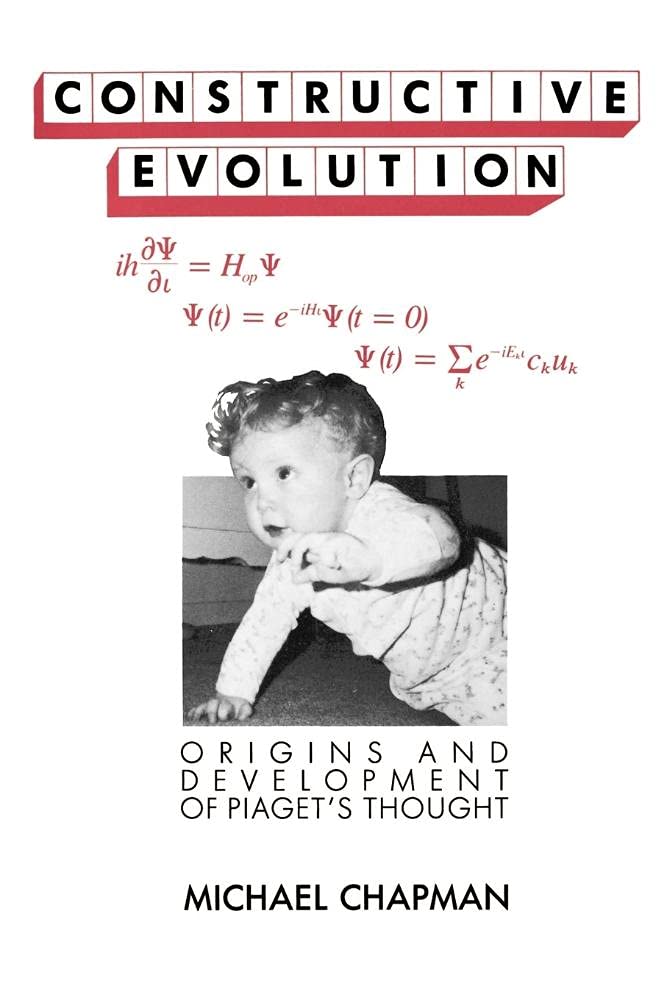
Constructive Evolution: Origins and Development of Piaget's Thought by Michael Chapman – A Comprehensive Study of Piaget
Inclusive of all applicable taxes. FREE shipping on all orders.
Available Offers
- 🚚Free Delivery — Free shipping on all orders
- 💵Cash on Delivery — Pay when your order arrives
- ↩️15-Day Easy Returns — Hassle-free return policy
- 🔒Cash on Delivery — Pay safely when your order arrives
Check Delivery
Product Description
Introduction
Few thinkers have shaped our understanding of how children learn and think as profoundly as Jean Piaget. Yet, the origins of his groundbreaking ideas often remain shrouded in mystery. Constructive Evolution: Origins and Development of Piaget's Thought by Michael Chapman offers a rare intellectual biography that traces the very roots of Piaget’s theories. For Indian students, educators, and psychology enthusiasts, this hardcover edition from Cambridge University Press provides a scholarly yet accessible journey into the mind of a genius. It is not merely a summary of Piaget’s work but a deep exploration of how his own thinking evolved over a lifetime.
Book Overview
In this meticulously researched volume, Michael Chapman applies Piaget’s own method—studying the origins and development of knowledge—to the Swiss psychologist himself. The book reveals how Piaget’s adolescent philosophical speculations about the relationship between science and value later crystallized into his famous stage theory of cognitive development. Chapman argues that many psychologists have misunderstood Piaget by viewing his work only through the lens of their discipline. By reconstructing Piaget’s intellectual biography, the author clarifies the original questions Piaget posed and the answers he developed through decades of research with children. This is not a dry textbook but a narrative of ideas in motion.
Key Highlights
- Intellectual Biography: A rare look at Piaget’s personal intellectual journey from his teenage years to his mature theories.
- Original Research: Chapman draws on Piaget’s early writings, letters, and lesser-known works to build a coherent picture.
- Clarifies Misunderstandings: Addresses common misinterpretations of Piaget’s work by modern psychologists and educators.
- Connects Philosophy and Psychology: Shows how deep philosophical questions about knowledge and values shaped empirical research.
- Authoritative Source: Published by Cambridge University Press, ensuring academic rigor and reliability.
Inside the Book
Chapman takes the reader through Piaget’s early life in Neuchâtel, his fascination with mollusks and biology, and his shift toward philosophy. The book examines Piaget’s concept of “genetic epistemology”—the idea that knowledge grows through a constructive process similar to biological development. Key chapters explore how Piaget’s notions of assimilation, accommodation, and equilibration emerged not as abstract terms but as solutions to real philosophical problems. The narrative follows Piaget’s work from his first studies of children’s language and reasoning to his later formalization of stages. Chapman also discusses the social and academic context in which Piaget wrote, including his dialogues with contemporaries like Lev Vygotsky.
Key Topics
- Origins of Piaget’s genetic epistemology
- Relation between science and values in intellectual development
- Construction of logical structures in childhood
- Role of action and experience in knowledge formation
- Critiques and reappraisals of Piaget’s stage theory
- Piaget’s early philosophical writings and their influence
- Development of concepts like conservation, object permanence, and egocentrism
Reader Benefits
This book offers Indian readers a deeper appreciation of one of psychology’s most influential figures. It helps students move beyond memorizing Piaget’s stages to understanding why he thought the way he did. Educators will gain fresh insights into how children construct knowledge, which can inform teaching practices. For researchers, Chapman’s careful scholarship provides a solid foundation for further study. The book also bridges the gap between philosophy and psychology, making it valuable for those interested in the history of ideas. By reading this work, you will see Piaget not as a distant theorist but as a thinker wrestling with timeless questions about how we come to know the world.
Learning Outcomes
After reading this book, you will be able to: explain the philosophical roots of Piaget’s theory; trace the evolution of his key concepts from his early to late works; identify common misinterpretations of Piaget in academic literature; connect his ideas to broader questions in epistemology and developmental science; and critically evaluate the strengths and limitations of his constructivist approach. The book equips you with a historical and conceptual framework that enriches your understanding of cognitive development, whether you are a student preparing for exams or a professional seeking deeper knowledge.
Who Should Read
This book is ideal for undergraduate and postgraduate students of psychology, education, and philosophy in Indian universities. It will also appeal to teachers, curriculum designers, and child development professionals who want to understand the theoretical foundations of their work. Anyone with a curiosity about how great thinkers develop their ideas—and how children develop their minds—will find this book rewarding. If you have ever wondered why Piaget’s theory remains so influential despite decades of criticism, this volume provides the answers.
About the Author
Michael Chapman was a respected developmental psychologist and historian of psychology. He specialized in the study of Piaget’s work and published extensively on genetic epistemology and cognitive development. His careful scholarship and ability to synthesize complex ideas made him a leading voice in the field. This book represents the culmination of his efforts to understand Piaget on Piaget’s own terms, offering readers a faithful and insightful portrait of the thinker and his ideas.
About the Publisher
Cambridge University Press is one of the oldest and most prestigious academic publishers in the world. Founded in 1534, it has a long tradition of publishing works of enduring scholarly value. This hardcover edition reflects the Press’s commitment to quality, with clear typography, durable binding, and careful editing. For Indian readers, Cambridge University Press ensures that the book meets international academic standards while being accessible to a global audience.
Conclusion
Constructive Evolution: Origins and Development of Piaget's Thought is more than a book about a psychologist—it is a journey into the making of a revolutionary idea. Michael Chapman’s lucid writing and deep research make this an essential addition to any serious student’s library. Whether you are studying for your psychology degree or simply wish to understand how children learn, this book will illuminate the path. Order your copy today from Bookshops.in and explore the fascinating evolution of one of the twentieth century’s most influential minds.
Quick Summary
Constructive Evolution: Origins and Development of Piaget's Thought by Michael Chapman is a scholarly exploration of how Jean Piaget's core ideas emerged and evolved. The book traces Piaget's intellectual journey from his adolescent philosophical musings on science and value to his groundbreaking experimental work on children's cognitive development. Chapman argues that Piaget's use of developmental psychology to address questions about the evolution of knowledge has been misunderstood by many psychologists. This work provides a clear, contextual understanding of Piaget's genetic epistemology and its foundations. Ideal for Indian psychology students, researchers, and educators, the book offers deep insights into the origins of constructivist theory. Published by Cambridge University Press, this hardcover edition is a valuable addition to any academic library. Readers will gain a richer appreciation of Piaget's contributions and the philosophical underpinnings of his stage theory. By purchasing from Bookshops.in, you receive a genuine, high-quality print edition with reliable delivery across India.
Book Highlights
Book Specifications
| ISBN-13 | 9780521367127 |
| ISBN-10 | 0521367123 |
| Publisher | Cambridge University Press |
| Language | English |
| Dimensions | 15.21 x 3 x 22.91 cm |
| Weight | 765 g |
| Country | India |
| Category | Psychology › Developmental Psychology |
| Genre | Non-fiction |
| Original Language | English |
Frequently Asked Questions
What is 'Constructive Evolution' about?
Who is the author of this book?
Is this book suitable for Indian students?
What is genetic epistemology?
Does the book cover Piaget's stage theory?
Is this book a biography of Piaget?
What language is the book in?
Can I use this book for my PhD research?
What is the price of this book?
Is the book available in hardcover?
Does the book include references?
Why should I buy from Bookshops.in?
Readers Also Search For
Customers Also Bought
Psychology
Koinonia: From Hate, Through Dialogue, to Culture in the Large Group by Patrick B. Demare

Psychology
Mindfulness-Based Interventions for Trauma and Its Consequences (Concise Guides on Trauma Care, 4)

Psychology
Handbook for Teaching Statistics and Research Methods by Mark E. Ware

Psychology
Psychoanalysis and the Nuclear Threat: Clinical and Theoretical Studies
Psychology
Humor and Psyche: Psychoanalytic Perspectives by James W. Barron

Relationships
The Experience and Expression of Uncertainty in Close Relationships by Jennifer A. Theiss
Related Products
View AllPsychology
Mindfulness-Based Interventions for Trauma and Its Consequences (Concise Guides on Trauma Care, 4)
Psychology
Handbook for Teaching Statistics and Research Methods by Mark E. Ware
Psychology
Psychoanalysis and the Nuclear Threat: Clinical and Theoretical Studies
Psychology
Humor and Psyche: Psychoanalytic Perspectives by James W. Barron

Psychology
Proceedings of the First International Conference on Genetic Algorithms and Their Applications
Psychology