
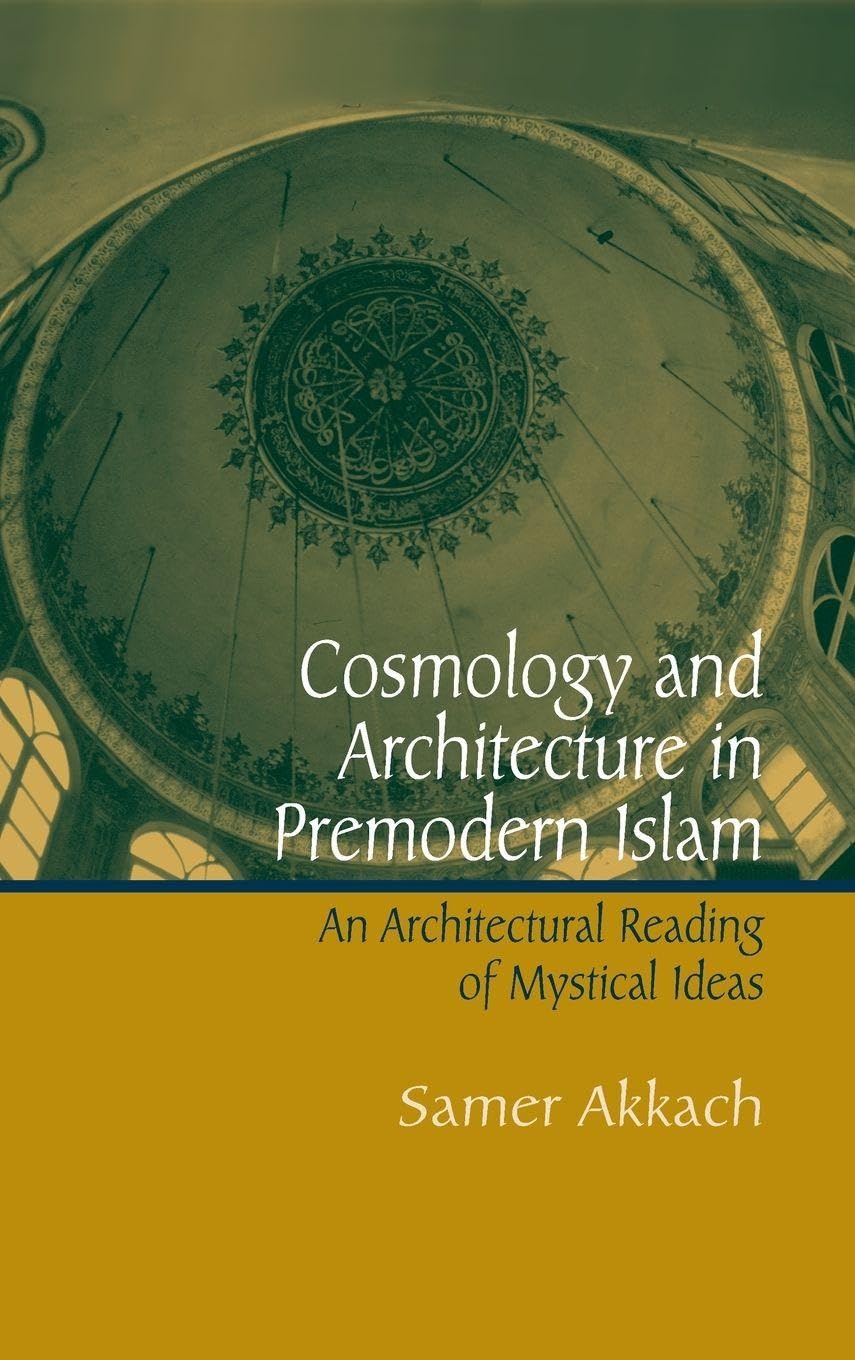
Cosmology and Architecture in Premodern Islam: An Architectural Reading of Mystical Ideas by Samer Akkach – Exploring Su
Inclusive of all applicable taxes. FREE shipping on all orders.
Available Offers
- 🚚Free Delivery — Free shipping on all orders
- 💵Cash on Delivery — Pay when your order arrives
- ↩️15-Day Easy Returns — Hassle-free return policy
- 🔒Cash on Delivery — Pay safely when your order arrives
Check Delivery
Product Description
Introduction
In the rich tapestry of Islamic intellectual history, few works have attempted to bridge the seemingly disparate worlds of mystical philosophy and built form. Cosmology and Architecture in Premodern Islam: An Architectural Reading of Mystical Ideas by Samer Akkach offers a groundbreaking exploration of how premodern Islamic architecture was deeply intertwined with cosmological beliefs and Sufi mysticism. This hardcover volume, published by the State University of New York Press, is an essential addition to the libraries of scholars, students, and enthusiasts of Islamic art, architecture, and philosophy.
Book Overview
This interdisciplinary study delves into the spatial ordering of premodern Islamic architecture, revealing how buildings, cities, and gardens were not merely functional but served as physical embodiments of transcendental and sublime ideas. Akkach draws extensively on mystical texts, particularly the works of the great Sufi master Ibn Arabi, to demonstrate that space in the Islamic world was shaped by religious conceptions of time, cosmos, and the human body. The book argues that a consistent spatial sensibility, anchored in medieval geocentrism, underpinned everything from the layout of mosques to the design of homes. Within this geometrically defined universe, nothing stood in isolation; every element was carefully positioned in an intricate hierarchy that reflected divine order.
Key Highlights
- Original Translations: Features many new translations of mystical and architectural texts, including several from previously unpublished sources.
- Rich Illustrations: Includes several diagrams and illustrations that help visualize the complex relationships between cosmology and built space.
- Focus on Ibn Arabi: Offers a detailed analysis of the works of Ibn Arabi, one of Islam's most influential mystics, and his impact on spatial thinking.
- Interdisciplinary Approach: Seamlessly connects architecture, cosmology, mysticism, and religious studies.
- Geocentric Worldview: Explores how the medieval geocentric model of the universe influenced architectural design and spatial organization.
Inside the Book
The book is structured to take the reader on a journey from abstract cosmological principles to concrete architectural forms. Akkach begins by establishing the intellectual and religious context of premodern Islam, then moves into a detailed examination of how space was conceptualized and ordered. He maps the intricate hierarchy of the cosmos, showing how the earthly realm was seen as a reflection of celestial realities. The text then applies these ideas to specific architectural examples, from the Kaaba in Mecca to the courtyards of madrasas and palaces. Each chapter builds on the last, culminating in a unified vision of how mysticism and architecture co-created a world of meaning.
Key Topics
- Premodern Islamic architecture and its cosmological foundations
- The role of Sufi mysticism in shaping spatial sensibilities
- Ibn Arabi's concept of the universe and its architectural implications
- Medieval geocentrism and its influence on design
- The relationship between the human body, geography, and built forms
- Sacred geometry and symbolic ordering of space
Reader Benefits
- Deepen Your Understanding: Gain a nuanced perspective on Islamic architecture beyond mere aesthetics or function.
- Explore Mystical Thought: Access complex mystical ideas through the lens of tangible, physical spaces.
- Enhance Research: Benefit from original translations and unpublished sources that are invaluable for academic work.
- Connect Disciplines: See how architecture, philosophy, and religion intersect in a premodern context.
Learning Outcomes
- Understand the concept of spatial sensibility in premodern Islamic culture.
- Analyze how cosmological beliefs influenced architectural design and urban planning.
- Interpret mystical texts as sources for understanding built environments.
- Identify key principles of sacred geometry and hierarchy in Islamic architecture.
- Critically evaluate the relationship between religion, science, and art in historical contexts.
Who Should Read
- Students and scholars of Islamic architecture, art history, and religious studies
- Architects and designers interested in the philosophical roots of spatial design
- Readers of Sufi mysticism and Islamic philosophy
- Anyone curious about how premodern cultures understood the cosmos and expressed it through building
About the Author
Samer Akkach is an associate professor at the University of Adelaide, Australia, where he teaches architectural history and theory. His research focuses on the intersections of Islamic mysticism, cosmology, and the built environment. He is known for his meticulous scholarship and ability to translate complex mystical ideas into accessible architectural analysis. Akkach has published widely in international journals and is a leading voice in the field of Islamic spatial studies.
About the Publisher
State University of New York Press is a renowned academic publisher known for its rigorous scholarly publications in the humanities and social sciences. With a strong focus on interdisciplinary studies, SUNY Press has been at the forefront of publishing works that explore the intersections of religion, philosophy, art, and culture. This volume is part of their distinguished series on Islamic studies and architecture.
Conclusion
Cosmology and Architecture in Premodern Islam is more than a book about buildings—it is a profound meditation on how a civilization understood its place in the universe. Samer Akkach's masterful synthesis of mystical ideas and architectural forms offers readers a rare glimpse into a world where the divine and the material were inseparable. Whether you are a student, a scholar, or a curious reader, this book will transform the way you see Islamic architecture and the spiritual dimensions of space. Order your copy today from Bookshops.in and embark on an intellectual journey that bridges heaven and earth.
Quick Summary
Cosmology and Architecture in Premodern Islam: An Architectural Reading of Mystical Ideas by Samer Akkach is a groundbreaking interdisciplinary study that reveals how Sufi mysticism and medieval cosmology shaped the spatial order of Islamic architecture. Drawing heavily on the works of the great Sufi master Ibn Arabi, Akkach demonstrates that premodern mosques, gardens, and cities were not merely functional but were designed as microcosms reflecting a geocentric universe. The book features numerous new translations from unpublished Arabic and Persian sources, along with illustrations that bring these concepts to life. Readers will learn how a consistent 'spatial sensibility' — rooted in religious beliefs about the cosmos, geography, the human body, and constructed forms — underpinned Islamic design from Spain to India. This book is ideal for advanced students and scholars of Islamic art, architecture, religious studies, and the history of science. For Indian readers, it offers a deeper appreciation of the spiritual dimensions of Islamic heritage, particularly relevant to the study of Mughal and Deccan architecture. By purchasing from Bookshops.in, you support a premium Indian bookstore committed to delivering authentic academic works with care.
Book Highlights
Book Specifications
| ISBN-13 | 9780791464113 |
| ISBN-10 | 0791464113 |
| Publisher | State University of New York Press |
| Language | English |
| Dimensions | 15.88 x 2.54 x 22.86 cm |
| Weight | 590 g |
| Country | India |
| Category | Religious Studies › History of Religion |
| Genre | Non-fiction |
| Original Language | English |
Frequently Asked Questions
What is the main theme of 'Cosmology and Architecture in Premodern Islam'?
Who is the author Samer Akkach?
Is this book suitable for beginners in Islamic studies?
Does the book include illustrations?
What role does Ibn Arabi play in this book?
How does this book connect architecture and cosmology?
Are there translations of original texts in the book?
What is the ISBN-13 for this book?
Is this book available in hardcover?
What is the price of this book in India?
What rating does this book have?
Can I use this book for my PhD research?
Where can I buy this book in India?
Readers Also Search For
Customers Also Bought
Islam
Spiritual Economies (English, Daromir Rudnyckyj)

Islam
Who Is Allah? (English, Bruce B. Lawrence)
Islam
Islam and Liberal Citizenship: The Search for an Overlapping Consensus by Andrew F. March
Islam
Fiqh Us-Sunnah: Funerals and Diggers by Al-Sayyid Sabiq – Islamic Funeral Guide

Christianity
Genetics (English, Thomas a. Shannon | Mark P. Aulisio | Françoise Baylis)

Hinduism
Karma and Creativity by Christopher Key Chapple – Indian Philosophy
Related Products
View All
Religion & Spirituality
Spiritual Competency in Psychotherapy | by Philip Brownell | Springer Publishing Company | by Philip Brownell | Springer Publishing Company | by Philip Brownell | Springer Publishing Company | by Philip Brownell | Springer Publishing Company | by Philip Brownell | Springer Publishing Company | by Philip Brownell | Springer Publishing Company | by Philip Brownell | Springer Publishing Company | by Philip Brownell | Springer Publishing Company | by Philip Brownell | Springer Publishing Company | b
Religion & Spirituality
Religion as a Conversation Starter | by Ina Merdjanova | Continuum | by Ina Merdjanova | Continuum | by Ina Merdjanova | Continuum | by Ina Merdjanova | Continuum | by Ina Merdjanova | Continuum | by Ina Merdjanova | Continuum | by Ina Merdjanova | Continuum | by Ina Merdjanova | Continuum | by Ina Merdjanova | Continuum | by Ina Merdjanova | Continuum | by Ina Merdjanova | Continuum | by Ina Merdjanova | Continuum | by Ina Merdjanova | Continuum | by Ina Merdjanova | Continuum | by Ina Merdjano
Religion & Spirituality
The Other Jewish Question: Identifying the Jew and Making Sense of Modernity
Religion & Spirituality
The Oxford Guide to People & Places of the Bible | by Bruce M. Metzger | Michael D. Coogan | Oxford University Press | by Bruce M. Metzger | Michael D. Coogan | Oxford University Press | by Bruce M. Metzger | Michael D. Coogan | Oxford University Press | by Bruce M. Metzger | Michael D. Coogan | Oxford University Press | by Bruce M. Metzger | Michael D. Coogan | Oxford University Press | by Bruce M. Metzger | Michael D. Coogan | Oxford University Press | by Bruce M. Metzger | Michael D. Coogan |

Religion & Spirituality
Anti-Judaism in Early Christianity | by Stephen G. Wilson | Wilfrid Laurier University Press | by Stephen G. Wilson | Wilfrid Laurier University Press | by Stephen G. Wilson | Wilfrid Laurier University Press | by Stephen G. Wilson | Wilfrid Laurier University Press | by Stephen G. Wilson | Wilfrid Laurier University Press | by Stephen G. Wilson | Wilfrid Laurier University Press | by Stephen G. Wilson | Wilfrid Laurier University Press | by Stephen G. Wilson | Wilfrid Laurier University Press |
Religion & Spirituality