
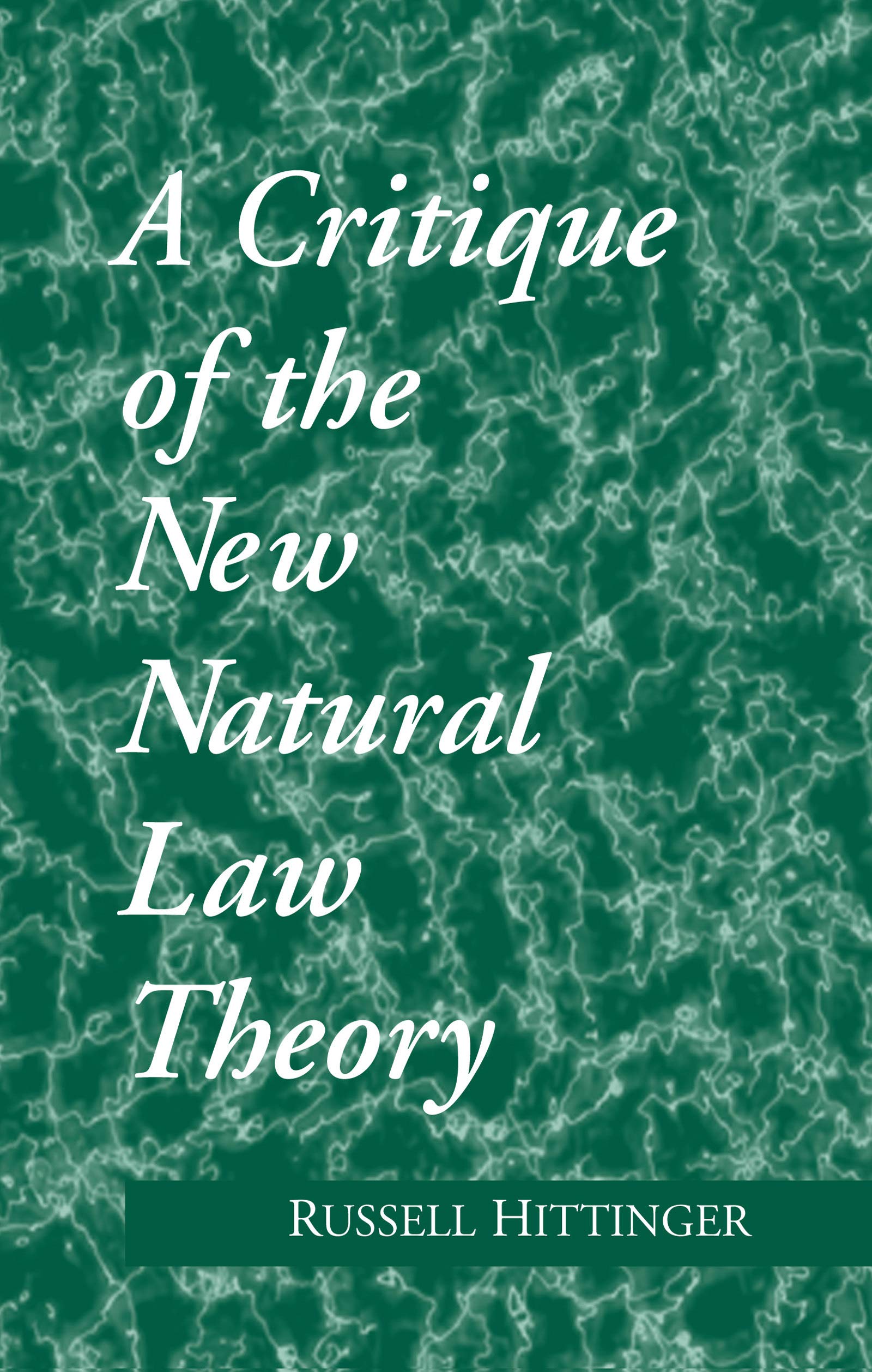
Critique of the New Natural Law Theory: A Scholarly Examination by Russell Hittinger – Moral Philosophy and Natural Law
Inclusive of all applicable taxes. FREE shipping on all orders.
Available Offers
- 🚚Free Delivery — Free shipping on all orders
- 💵Cash on Delivery — Pay when your order arrives
- ↩️15-Day Easy Returns — Hassle-free return policy
- 🔒Cash on Delivery — Pay safely when your order arrives
Check Delivery
Product Description
Introduction
In the landscape of modern moral philosophy, few debates are as rigorous and consequential as the one surrounding natural law theory. Russell Hittinger's Critique of the New Natural Law Theory stands as a landmark scholarly work that dissects the ambitious revival of natural law ethics by Germain Grisez and John Finnis. This hardcover volume from the University of Notre Dame Press offers Indian students, legal scholars, and moral theologians a penetrating analysis of whether the so-called 'new natural law theory' can withstand philosophical scrutiny. Hittinger does not merely summarize; he challenges, questions, and pushes the reader to think deeply about the foundations of morality, law, and human flourishing.
Book Overview
This book systematically examines the attempt by Grisez and Finnis to reconstruct natural law theory in a way that bypasses the criticisms leveled against it since the Enlightenment. Hittinger begins by situating their project within the broader context of contemporary moral philosophy, engaging with thinkers like Alasdair MacIntyre, Alan Donogan, Elizabeth Anscombe, and Stanley Hauerwas—all of whom sought to recover elements of premodern ethics. The core of the work is a rigorous evaluation of the internal coherence of the new natural law theory, its claims to universality, and its ability to address religious, anthropological, and metaphysical questions. Hittinger argues that while the theory offers valuable insights, it ultimately falls short in providing a comprehensive foundation for moral theology and legal philosophy. This is essential reading for anyone grappling with the intersection of faith, reason, and law in the Indian context.
Key Highlights
- Critical engagement with the foundational texts of Germain Grisez and John Finnis, the architects of the new natural law theory.
- Comparative analysis with the works of MacIntyre, Donogan, Anscombe, and Hauerwas, showing how the new theory fits into the broader revival of virtue ethics and natural law.
- Focus on metaphysical and theological adequacy—Hittinger examines whether the theory can truly ground moral obligations without relying on a robust metaphysical framework.
- Original and accessible argumentation that makes complex philosophical ideas understandable for advanced undergraduate and postgraduate readers.
Inside the Book
The book is structured to guide readers through the intricate web of arguments. Hittinger first lays out the historical and philosophical background, explaining why natural law fell out of favour and why thinkers like Grisez and Finnis sought to revive it. He then dedicates chapters to dissecting the core tenets of the new theory: the 'basic goods' (such as life, knowledge, and friendship), the 'first principle of practical reason,' and the claim that morality can be derived without appeal to a divine commander. Each chapter is a careful balance of exposition and critique, with Hittinger pointing out inconsistencies, gaps, and unresolved tensions. The final sections explore the implications for moral theology, showing how the theory struggles to incorporate doctrines like grace, sin, and redemption. The writing is dense but rewarding, making it an ideal text for seminar discussions and research.
Key Topics
- The historical trajectory of natural law from Aquinas to the Enlightenment and its modern revival.
- Grisez's and Finnis's theory of basic goods and the 'first principle of practical reason.'
- The relationship between practical reason, morality, and metaphysics.
- Critiques of the new natural law from within the Catholic moral tradition.
- The role of God and divine law in a supposedly autonomous natural law ethics.
- Comparisons with alternative approaches to natural law, including those of MacIntyre and Hauerwas.
Reader Benefits
- Deepen your understanding of one of the most influential moral theories of the late 20th century.
- Learn to critically evaluate philosophical arguments for internal consistency and practical applicability.
- Gain insight into how natural law theory can (or cannot) be reconciled with modern pluralistic societies.
- Enhance your research for dissertations, papers, or teaching in law, philosophy, theology, or ethics.
Learning Outcomes
By reading this book, you will be able to: articulate the central claims of the new natural law theory; identify its strengths and weaknesses as a moral framework; compare it with other contemporary ethical theories; evaluate the role of metaphysics and theology in moral reasoning; and apply these insights to debates in Indian legal and ethical contexts, such as the relationship between law and morality, the foundations of human rights, and the place of religious reasoning in public discourse.
Who Should Read
- Students of philosophy, theology, and law at Indian universities, especially those enrolled in courses on ethics, jurisprudence, or moral theology.
- Legal scholars and practitioners interested in the philosophical underpinnings of natural law and its relevance to Indian constitutional and legal traditions.
- Theologians and religious thinkers seeking a rigorous critique of a major contemporary Catholic moral theory.
- General readers with a serious interest in moral philosophy and the history of ideas.
About the Author
Russell Hittinger is a distinguished American philosopher and theologian. He is the Warren Professor of Catholic Studies at the University of Tulsa and a senior fellow at the Witherspoon Institute. His expertise lies in the history of moral and political philosophy, with a particular focus on natural law, the thought of Thomas Aquinas, and the relationship between church and state. Hittinger has authored numerous articles and books, and his work is widely cited in debates on natural law and Catholic social teaching. In Critique of the New Natural Law Theory, he brings a sharp analytical mind and deep scholarly erudition to bear on a topic that continues to shape ethical and legal discourse.
About the Publisher
The University of Notre Dame Press, based in South Bend, Indiana, is one of the most respected academic publishers in the United States, with a strong focus on philosophy, theology, law, and Catholic studies. Their catalogue includes seminal works by leading thinkers, and they are committed to publishing books that advance scholarship and intellectual debate. This hardcover edition is produced to the highest standards of quality, making it a durable addition to any library.
Conclusion
Critique of the New Natural Law Theory is not just a book for specialists—it is an invitation to think critically about the foundations of morality and law. For Indian readers, where debates about secularism, religious pluralism, and the role of tradition in modern life are ever-present, Hittinger's analysis offers tools for rigorous reflection. Whether you are a student grappling with natural law for the first time or a seasoned scholar looking for a fresh perspective, this volume will challenge and enrich your understanding. Order your copy from Bookshops.in today and add a vital work to your collection.
Quick Summary
Critique of the New Natural Law Theory by Russell Hittinger is a scholarly work that offers a comprehensive and critical examination of the natural law theory as revived by Germain Grisez and John Finnis. The book situates this new theory within the broader context of moral philosophy, engaging with thinkers like Alasdair MacIntyre, Alan Donogan, Elizabeth Anscombe, and Stanley Hauerwas who seek to recover elements of premodern ethics. Hittinger meticulously analyzes the claims of Grisez and Finnis, focusing on whether their framework successfully avoids the standard objections that have been raised against natural law since the Enlightenment. He evaluates the internal coherence and consistency of their theory, making this an essential read for students and scholars of moral theology, ethics, and jurisprudence. This hardcover edition from University of Notre Dame Press is a valuable resource for Indian readers pursuing advanced studies in philosophy, law, or theology. By purchasing from Bookshops.in, you get a genuine, high-quality physical book delivered to your doorstep in India.
Book Highlights
Book Specifications
| ISBN-13 | 9780268007669 |
| ISBN-10 | 0268007667 |
| Publisher | University of Notre Dame Press |
| Language | English |
| Dimensions | 13.97 x 1.4 x 21.59 cm |
| Weight | 283 g |
| Category | Philosophy › Ethics |
| Genre | Non-fiction |
| Original Language | English |
Frequently Asked Questions
What is the main focus of this book?
Who is the author?
Is this book suitable for beginners?
Does the book cover other philosophers?
What is the ISBN?
Is this a hardcover book?
Which publisher released this book?
What language is the book in?
Why is this book important for Indian readers?
Does the book address modern objections to natural law?
What are the basic goods according to Finnis?
Is the book purely philosophical or theological?
Can this book help in legal studies?
Where can I buy this book in India?
Readers Also Search For
Customers Also Bought
Islam
Spiritual Economies (English, Daromir Rudnyckyj)

Islam
Who Is Allah? (English, Bruce B. Lawrence)
Islam
Islam and Liberal Citizenship: The Search for an Overlapping Consensus by Andrew F. March
Islam
Fiqh Us-Sunnah: Funerals and Diggers by Al-Sayyid Sabiq – Islamic Funeral Guide

Christianity
Genetics (English, Thomas a. Shannon | Mark P. Aulisio | Françoise Baylis)

Hinduism
Karma and Creativity by Christopher Key Chapple – Indian Philosophy
Related Products
View All
Philosophy
Latin American Philosophy: Currents, Issues, Debates by Eduardo Mendieta

Philosophy
Al-Farabi's Short Commentary on Aristotle's Prior Analytics by Nicholas Rescher – Philosophy
Philosophy
Poetics of Imagining: Modern to Post-modern by Richard Kearney
Philosophy
The Metaphysics of Extrinsic Properties: 11 (Metaphysical Research, 11)
Philosophy
Dialogues on Metaphysics and on Religion by Nicolas Malebranche – Philosophy
Philosophy