
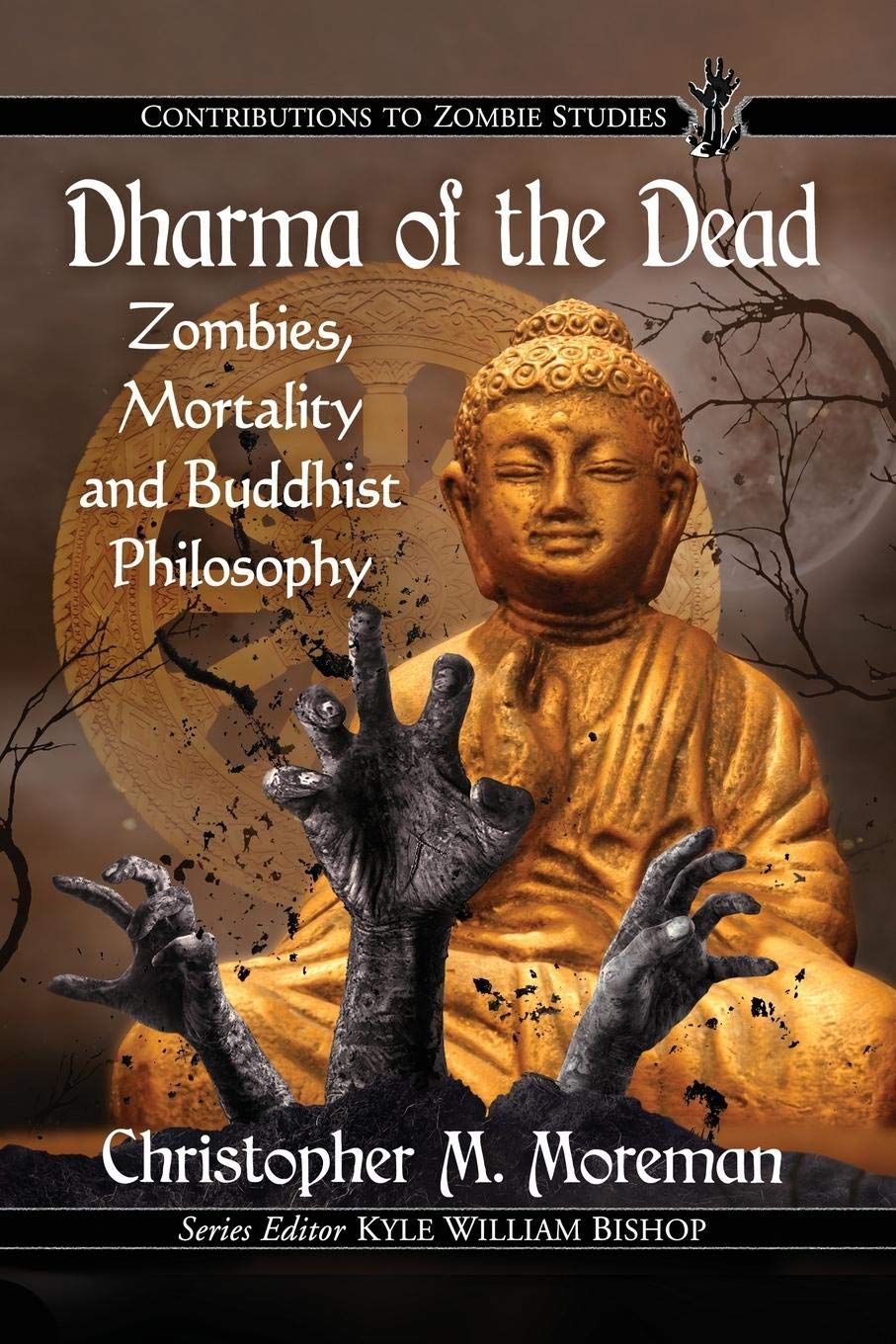
Dharma of the Dead: Zombies, Mortality and Buddhist Philosophy by Christopher M. Moreman – A Scholarly Exploration of De
Inclusive of all applicable taxes. FREE shipping on all orders.
Available Offers
- 🚚Free Delivery — Free shipping on all orders
- 💵Cash on Delivery — Pay when your order arrives
- ↩️15-Day Easy Returns — Hassle-free return policy
- 🔒Cash on Delivery — Pay safely when your order arrives
Check Delivery
Product Description
Introduction
In an age where the undead shuffle through our screens and stories, Dharma of the Dead: Zombies, Mortality and Buddhist Philosophy by Christopher M. Moreman offers a bold and thought-provoking journey into the heart of what it means to be human. This hardcover edition, published by McFarland & Company, bridges the gap between pop culture and ancient wisdom, inviting Indian readers and students to explore mortality through the lens of Buddhist thought. Blending the eerie allure of zombies with the profound teachings of the dharma, this book is a unique addition to any library seeking depth beyond the ordinary.
Book Overview
Moreman delves into the cultural phenomenon of zombies, not as mere monsters, but as powerful symbols of our collective fear of death. In a world that often denies mortality, the zombie becomes a mirror reflecting our existential dilemmas. The book examines how zombie apocalyptic narratives force characters—and readers—to confront the search for meaning in a secular, globalized society. By contrasting Buddhist perspectives on impermanence and suffering with Western social critiques, Moreman crafts a compelling argument that the undead can serve as objects of meditation, helping us face our own finitude with clarity and compassion.
Key Highlights
- Unique Fusion: The first book to systematically apply Buddhist philosophy to the zombie genre, offering fresh insights into both.
- Cultural Relevance: Analyzes the rise of zombie fiction in America’s death-denying culture, making it relatable to global audiences.
- Academic Rigour: Backed by scholarly research, yet written in an accessible style for students and curious readers alike.
- Existential Depth: Moves beyond gore to explore themes of identity, attachment, and the search for purpose in chaotic times.
Inside the Book
This volume is structured to guide readers through a layered exploration. It begins by tracing the zombie’s evolution from Haitian folklore to modern apocalyptic epics, then shifts to core Buddhist concepts such as anicca (impermanence), dukkha (suffering), and anatta (non-self). Each chapter uses zombie narratives as case studies to illustrate how these teachings can transform our relationship with death. The book also engages with works by other thinkers who have critiqued society through horror, offering a rich dialogue between traditions.
Key Topics
- Zombies as modern memento mori—reminders of death
- Buddhist meditation on mortality and the fear of annihilation
- The crisis of meaning in post-religious, globalized societies
- Comparative analysis of Buddhist and Western views on the self
- Ethical implications of survival in apocalyptic scenarios
Reader Benefits
By engaging with this book, readers will gain a deeper understanding of how popular culture can be a vehicle for spiritual insight. It helps demystify Buddhist philosophy, making it accessible through familiar horror tropes. The book encourages introspection about one’s own mortality, reducing anxiety by framing death as a natural part of existence. Students of philosophy, religious studies, and film studies will find a rich source of interdisciplinary material that challenges conventional thinking.
Learning Outcomes
- Understand the symbolic role of zombies in reflecting societal anxieties about death
- Apply core Buddhist principles to analyze contemporary narratives
- Critically evaluate the concept of the self in light of impermanence
- Develop a more mindful approach to mortality and existential questions
- Recognize the intersections between popular culture and ancient wisdom traditions
Who Should Read
This book is ideal for Indian students of philosophy, psychology, and cultural studies who seek innovative perspectives on age-old questions. It will also appeal to fans of zombie fiction who want to look beyond the surface, as well as practitioners of Buddhism interested in how their tradition engages with modern myths. Academics exploring death studies or comparative religion will find it a valuable resource for classroom discussion or personal research.
About the Author
Christopher M. Moreman is a professor and scholar of religious studies, specializing in death, dying, and the intersection of popular culture with spiritual traditions. He has written extensively on horror, the occult, and comparative religion, bringing a thoughtful, critical eye to topics often dismissed as mere entertainment. His work invites readers to see the sacred in the strange.
About the Publisher
McFarland & Company is a respected independent publisher known for its academic and reference works in fields such as popular culture, film, and religious studies. With a commitment to scholarly excellence and accessible writing, McFarland brings niche subjects to a broad audience, making complex ideas available to curious minds everywhere.
Conclusion
Dharma of the Dead is more than a book about zombies—it is a manual for living with awareness in a world haunted by the spectre of death. Whether you are a student, a seeker, or a fan of the undead, this hardcover will challenge you to think differently about what it means to be alive. Order your copy today from Bookshops.in and step into a conversation that bridges the gap between the grave and the guru.
Quick Summary
Dharma of the Dead: Zombies, Mortality and Buddhist Philosophy by Christopher M. Moreman is a groundbreaking work that examines the zombie as a modern memento mori—an object that reminds us of our own mortality. In a culture that often denies death, the zombie apocalypse narrative forces characters and readers alike to confront existential questions. Moreman uses Buddhist philosophy to explore how the undead can serve as a meditation on impermanence, suffering, and the search for meaning. The book contrasts Buddhist perspectives with Western religious and secular views, offering a rich critique of contemporary society. Written for scholars, students, and curious readers, this interdisciplinary study bridges pop culture and serious philosophy. Readers will learn to see zombie stories in a new light and gain tools for reflecting on their own mortality. Published by McFarland & Company in hardcover, this edition is perfect for Indian readers interested in Buddhism, death studies, or cultural criticism. By purchasing from Bookshops.in, you support a premium Indian bookstore that provides authentic imports and reliable service.
Book Highlights
Book Specifications
| ISBN-13 | 9781476672496 |
| ISBN-10 | 1476672490 |
| Publisher | McFarland & Co Inc |
| Language | English |
| Dimensions | 15.24 x 1.24 x 22.86 cm |
| Weight | 295 g |
| Category | Religious Studies › Theology & Philosophy of Religion |
| Genre | Philosophy |
| Original Language | English |
Frequently Asked Questions
What is Dharma of the Dead about?
Who is the author?
Is this book suitable for beginners in Buddhism?
Does the book cover Indian Buddhist traditions?
What makes this book unique?
Is this a religious book?
What is a memento mori?
Does the book discuss specific zombie movies or books?
Is this book available in hardcover?
What is the price in India?
Why should I buy from Bookshops.in?
Is this book relevant to Indian readers?
Readers Also Search For
Customers Also Bought
Islam
Spiritual Economies (English, Daromir Rudnyckyj)

Islam
Who Is Allah? (English, Bruce B. Lawrence)
Islam
Islam and Liberal Citizenship: The Search for an Overlapping Consensus by Andrew F. March

Islam
Fiqh Us-Sunnah: Funerals and Diggers by Al-Sayyid Sabiq – Islamic Funeral Guide

Christianity
Genetics (English, Thomas a. Shannon | Mark P. Aulisio | Françoise Baylis)

Hinduism
Karma and Creativity by Christopher Key Chapple – Indian Philosophy
Related Products
View All
Religion & Spirituality
Spiritual Competency in Psychotherapy | by Philip Brownell | Springer Publishing Company | by Philip Brownell | Springer Publishing Company | by Philip Brownell | Springer Publishing Company | by Philip Brownell | Springer Publishing Company | by Philip Brownell | Springer Publishing Company | by Philip Brownell | Springer Publishing Company | by Philip Brownell | Springer Publishing Company | by Philip Brownell | Springer Publishing Company | by Philip Brownell | Springer Publishing Company | b
Religion & Spirituality
Religion as a Conversation Starter | by Ina Merdjanova | Continuum | by Ina Merdjanova | Continuum | by Ina Merdjanova | Continuum | by Ina Merdjanova | Continuum | by Ina Merdjanova | Continuum | by Ina Merdjanova | Continuum | by Ina Merdjanova | Continuum | by Ina Merdjanova | Continuum | by Ina Merdjanova | Continuum | by Ina Merdjanova | Continuum | by Ina Merdjanova | Continuum | by Ina Merdjanova | Continuum | by Ina Merdjanova | Continuum | by Ina Merdjanova | Continuum | by Ina Merdjano

Religion & Spirituality
The Other Jewish Question: Identifying the Jew and Making Sense of Modernity
Religion & Spirituality
The Oxford Guide to People & Places of the Bible | by Bruce M. Metzger | Michael D. Coogan | Oxford University Press | by Bruce M. Metzger | Michael D. Coogan | Oxford University Press | by Bruce M. Metzger | Michael D. Coogan | Oxford University Press | by Bruce M. Metzger | Michael D. Coogan | Oxford University Press | by Bruce M. Metzger | Michael D. Coogan | Oxford University Press | by Bruce M. Metzger | Michael D. Coogan | Oxford University Press | by Bruce M. Metzger | Michael D. Coogan |

Religion & Spirituality
Anti-Judaism in Early Christianity | by Stephen G. Wilson | Wilfrid Laurier University Press | by Stephen G. Wilson | Wilfrid Laurier University Press | by Stephen G. Wilson | Wilfrid Laurier University Press | by Stephen G. Wilson | Wilfrid Laurier University Press | by Stephen G. Wilson | Wilfrid Laurier University Press | by Stephen G. Wilson | Wilfrid Laurier University Press | by Stephen G. Wilson | Wilfrid Laurier University Press | by Stephen G. Wilson | Wilfrid Laurier University Press |
Religion & Spirituality