
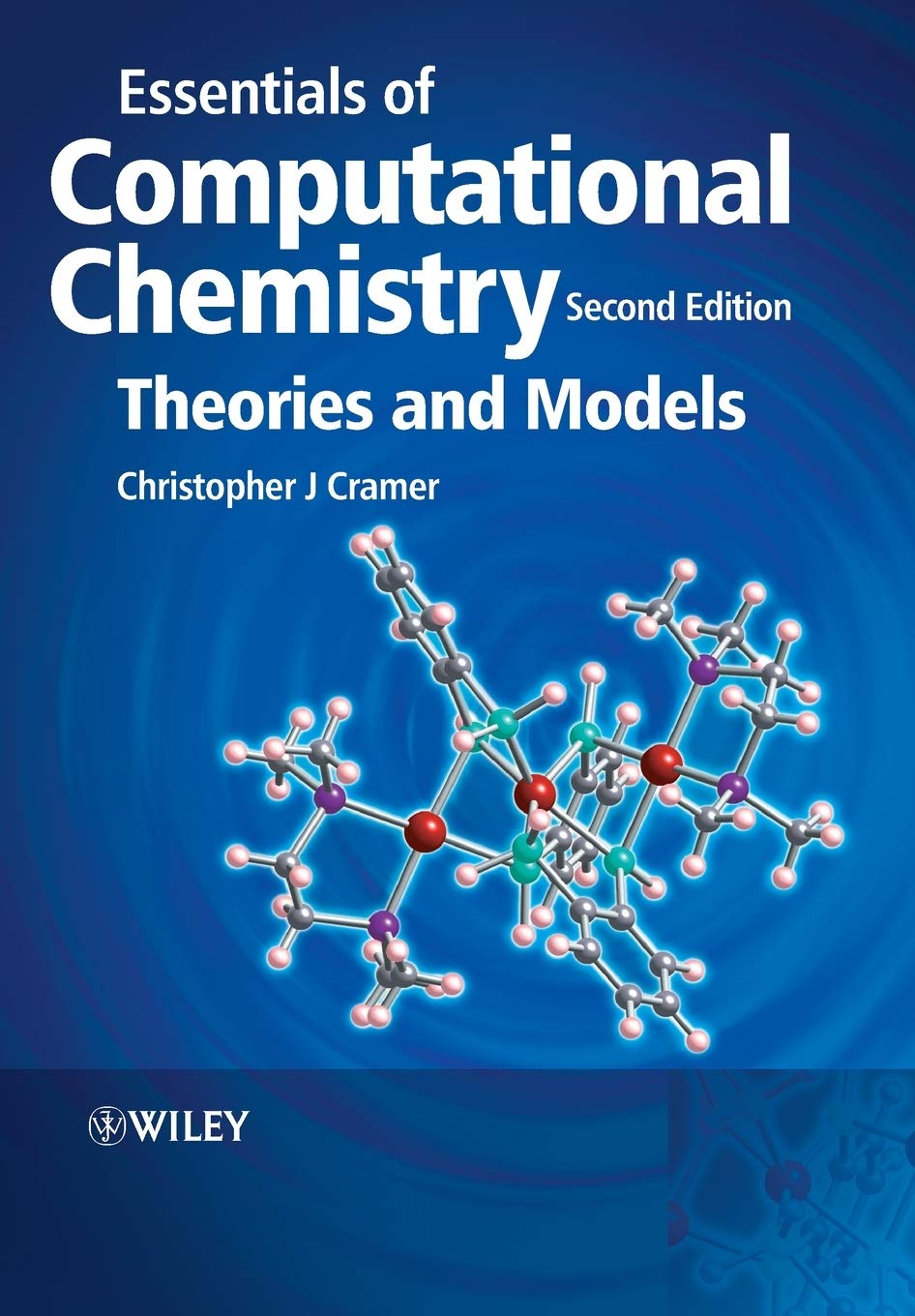
Essentials of Computational Chemistry: Theories and Models by Christopher J. Cramer – A Must-Have for Chemistry Students
Inclusive of all applicable taxes. FREE shipping on all orders.
Available Offers
- 🚚Free Delivery — Free shipping on all orders
- 💵Cash on Delivery — Pay when your order arrives
- ↩️15-Day Easy Returns — Hassle-free return policy
- 🔒Cash on Delivery — Pay safely when your order arrives
Check Delivery
Product Description
Introduction
In the rapidly evolving landscape of modern science, computational chemistry has emerged as an indispensable bridge between theoretical principles and practical experimentation. Essentials of Computational Chemistry - Theories and Models 2e by Christopher J. Cramer, published by Wiley, stands as a definitive guide for students and researchers seeking a solid foundation in this interdisciplinary field. Tailored for the Indian academic context, this hardcover edition offers a rigorous yet accessible exploration of the theories and models that power molecular simulations, quantum chemistry, and molecular mechanics. Whether you are a postgraduate student in chemistry, a research scholar in computational sciences, or a faculty member looking to deepen your understanding, this book provides the conceptual clarity and practical insights needed to excel.
Book Overview
This second edition of Essentials of Computational Chemistry is a comprehensive resource that systematically presents the core methodologies used in computational chemistry. Unlike texts that drown readers in abstract mathematics, Cramer focuses on conveying fundamental concepts through rich examples drawn from organic, inorganic, and biochemistry. The book strikes a careful balance—providing enough theoretical depth to understand the 'why' behind each method, while keeping mathematical derivations concise. It covers everything from basic quantum mechanics to advanced molecular dynamics, making it suitable for both beginners and experienced practitioners. The hardcover binding ensures durability for frequent reference, and the clear, structured writing style makes complex topics approachable for Indian students who may be new to computational approaches.
Key Highlights
- Concept-First Approach: Emphasises understanding of theories and models over exhaustive mathematical formalism, ideal for Indian students transitioning from traditional to computational chemistry.
- Extensive Cross-Disciplinary Examples: Features applications from organic reaction mechanisms, inorganic coordination complexes, and biochemical systems, demonstrating real-world relevance.
- Updated Content in Second Edition: Incorporates recent advances in density functional theory (DFT), solvation models, and QM/MM methods, keeping pace with cutting-edge research.
- Pedagogically Rich: Includes chapter summaries, key concept boxes, and problem sets to reinforce learning and self-assessment.
- Authoritative Publisher: Published by Wiley, a globally trusted name in scientific literature, ensuring high editorial and production standards.
Inside the Book
The book is organised into logically flowing chapters that build from foundational principles to advanced applications. The initial sections introduce the necessity of computational models and the basics of quantum mechanics, including the Schrödinger equation and molecular orbital theory. Subsequent chapters delve into semi-empirical methods, ab initio approaches, and density functional theory, with clear comparisons of their strengths and limitations. A significant portion is devoted to molecular mechanics, force fields, and molecular dynamics simulations, which are critical for studying large biomolecules. The text also covers solvation models, transition state theory, and the interpretation of computational results, equipping readers with the skills to design and analyse their own computational experiments. Each chapter is enriched with worked examples and case studies that illuminate how these methods solve real chemical problems.
Key Topics
- Fundamentals of quantum mechanics and the electronic structure of atoms and molecules
- Hartree-Fock theory and post-Hartree-Fock methods (MP2, CC, CI)
- Density functional theory (DFT) and its functionals
- Semi-empirical methods (AM1, PM3, PM6)
- Molecular mechanics and force field parameterisation
- Molecular dynamics simulations and Monte Carlo methods
- Solvation models: implicit and explicit solvent approaches
- QM/MM hybrid methods for large systems
- Thermochemistry, reaction mechanisms, and transition state analysis
- Computational spectroscopy and property prediction
Reader Benefits
By engaging with this book, readers will gain a robust conceptual framework that demystifies computational chemistry. They will learn to evaluate the suitability of different computational methods for specific chemical problems, interpret output data with confidence, and design meaningful computational studies. The practical examples help bridge the gap between theory and laboratory observation, making it easier to integrate computational tools into research projects. Indian students, in particular, will appreciate the clear explanations that do not assume prior programming expertise, and the focus on chemical intuition rather than algorithmic complexity. This book also serves as an excellent reference for thesis writing and exam preparation in advanced chemistry courses.
Learning Outcomes
- Understand the fundamental principles underlying quantum chemical and molecular mechanical methods.
- Differentiate between ab initio, semi-empirical, and DFT approaches and select appropriate methods for given systems.
- Perform basic computational analyses of molecular structures, energies, and reaction pathways.
- Interpret computational results in the context of experimental observations.
- Critically evaluate published computational studies in research literature.
- Apply computational chemistry to problems in organic, inorganic, and biochemistry.
Who Should Read
This book is ideally suited for postgraduate students (M.Sc. and Ph.D.) in chemistry, biochemistry, and chemical engineering at Indian universities. It is also highly recommended for undergraduate students in their final year who are pursuing computational chemistry electives. Faculty members and researchers transitioning into computational work will find it an invaluable self-study resource. Professionals in pharmaceuticals, materials science, and environmental chemistry who wish to incorporate computational modelling into their workflows will benefit from its practical orientation. The book assumes only a basic understanding of physical chemistry and mathematics, making it accessible to a wide audience.
About the Author
Christopher J. Cramer is a Distinguished McKnight University Professor at the University of Minnesota, where he holds appointments in the Department of Chemistry and the Department of Chemical Engineering and Materials Science. His research focuses on the development and application of computational methods to problems in organic and bioorganic chemistry, with a particular emphasis on solvation effects, reaction mechanisms, and molecular recognition. With over 400 peer-reviewed publications, Cramer is a leading authority in the field. His teaching philosophy centres on making computational chemistry accessible to all chemists, a vision that is brilliantly realised in this textbook.
About the Publisher
Wiley is a global leader in scientific and technical publishing, with a legacy spanning over 200 years. Known for its rigorous editorial standards and commitment to advancing knowledge, Wiley publishes textbooks and reference works that are trusted by students and professionals worldwide. This hardcover edition of Essentials of Computational Chemistry reflects Wiley's dedication to producing high-quality, durable educational resources that support academic excellence in India and beyond.
Conclusion
For anyone serious about mastering computational chemistry, Essentials of Computational Chemistry - Theories and Models 2e is an indispensable addition to their library. Christopher J. Cramer's lucid explanations, combined with Wiley's authoritative publishing, make this book a reliable companion for academic study and research. It empowers Indian students and scientists to harness the power of computational tools, driving innovation in chemistry and allied fields. Order your hardcover copy from Bookshops.in today and take a decisive step toward computational proficiency.
Quick Summary
Essentials of Computational Chemistry: Theories and Models by Christopher J. Cramer is a comprehensive textbook that demystifies the principles and applications of computational chemistry. Designed for graduate students and researchers, it covers both classical force field methods and modern quantum mechanical approaches such as density functional theory and ab initio calculations. The book uses illustrative examples from organic, inorganic, and biochemistry to show how computational methods solve real chemical problems. Readers will learn to choose appropriate methods, interpret results, and apply them to molecular structure, reactivity, spectroscopy, and thermochemistry. This edition is published by Wiley and is available in hardcover on Bookshops.in. Buying from Bookshops.in ensures you receive an authentic, high-quality print edition with fast delivery across India. Whether you are a student preparing for exams or a researcher advancing your work, this book provides the essential knowledge and practical insights you need.
Book Highlights
Book Specifications
| ISBN-13 | 9780470091821 |
| ISBN-10 | 0470091827 |
| Publisher | John Wiley & Sons Inc |
| Language | English |
| Dimensions | 16.81 x 3.58 x 24.43 cm |
| Weight | 1 kg 50 g |
| Category | Science & Mathematics › Chemistry |
| Genre | Science & Mathematics |
| Reading Age | 18+ |
| Original Language | English |
Frequently Asked Questions
Is this book suitable for beginners in computational chemistry?
Does the book cover quantum chemistry methods?
Are there practical examples from biochemistry?
What software is discussed in the book?
Is this book used in Indian universities?
Does the book include exercises?
Is the book hardcover or paperback?
Does it cover molecular dynamics?
Can I use this book for self-study?
What is the price on Bookshops.in?
Does the book include solvation models?
Is there a focus on organic chemistry?
Who is the author?
How is this book different from other computational chemistry books?
Readers Also Search For
Customers Also Bought
Mathematics
Stereotype Spaces and Algebras: 73 (De Gruyter Expositions in Mathematics, 73)

Mathematics
Semigroups in Algebra, Geometry and Analysis: 20 (De Gruyter Expositions in Mathematics, 20)
Mathematics
Geometry from the Pacific Rim: Proceedings of the Pacific Rim Geometry Conference held at National University of Singapore, Republic of Singapore, ... 1994 (De Gruyter Proceedings in Mathematics)

Mathematics
First International Tainan-Moscow Algebra Workshop: Proceedings of the International Conference held at National Cheng Kung University Tainan, Taiwan, ... 1994 (De Gruyter Proceedings in Mathematics)

Mathematics
Differential Geometry - Proceedings of the VIII International Colloquium (English, Jesus A. Alvarez Lopez | Eduardo Garcia-Rio)
Mathematics
Mathematical Theory of Optimal Processes (Classics of Soviet Mathematics)
Related Products
View All
Chemistry
Proceedings of the Third USSR - FRG Symposium, Makhachkala (USSR), October 2–6, 1980: 001

Chemistry
Confining Electrochemistry to Nanopores: From Fundamentals to Applications: Volume 17 (Detection Science)
Chemistry
Inorganic Chemistry of the Main-Group Elements: Volume 1 (Specialist Periodical Reports - Inorganic Chemistry of the Main-Group Elements)
Chemistry
SYNTHETIC POLYMER CHEMISTRY: INNOVATIONS AND OUTLOOK: Volume 32 (Polymer Chemistry Series)
Chemistry
Theoretical Chemistry for Electronic Excited States: Volume 12 (Theoretical and Computational Chemistry Series)
Chemistry