
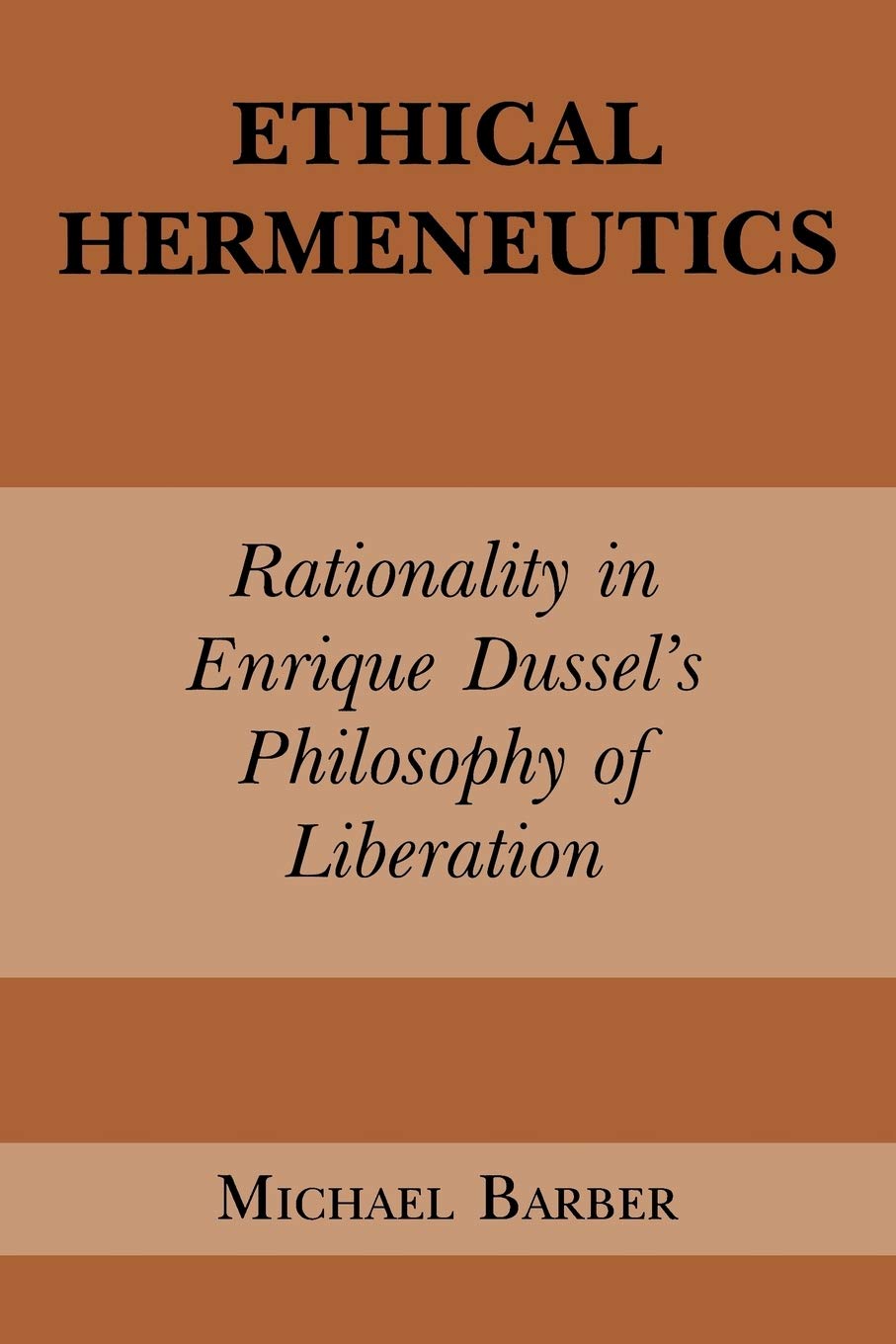
Ethical Hermeneutics: Rationality in Enrique Dussel's Philosophy of Liberation by Michael D. Barber – A Foundational Wor
Inclusive of all applicable taxes. FREE shipping on all orders.
Available Offers
- 🚚Free Delivery — Free shipping on all orders
- 💵Cash on Delivery — Pay when your order arrives
- ↩️15-Day Easy Returns — Hassle-free return policy
- 🔒Cash on Delivery — Pay safely when your order arrives
Check Delivery
Product Description
Introduction
In the vast landscape of contemporary philosophy, few thinkers have managed to bridge the gap between European critical theory and the lived realities of the Global South as powerfully as Enrique Dussel. Ethical Hermeneutics: Rationality in Enrique Dussel's Philosophy of Liberation, authored by Michael D. Barber and published by Fordham University Press, offers Indian students and scholars a rigorous yet accessible entry into Dussel's revolutionary thought. This hardcover volume is an indispensable resource for anyone seeking to understand how philosophy can serve the cause of justice, especially in contexts marked by colonial legacies, economic inequality, and cultural marginalisation.
Book Overview
Barber's work systematically unpacks Dussel's core project: an ethical hermeneutics that interprets reality from the standpoint of those whom Emmanuel Levinas called the 'other'—the vanquished, the forgotten, and the excluded. Rather than a dry academic treatise, the book traces Dussel's intellectual journey from his early engagement with Hegelian dialectics to his mature synthesis with Levinasian ethics. The result is a compelling argument for a rationality that is not neutral but deeply committed to the liberation of oppressed peoples. For Indian readers, this resonates with ongoing debates about caste, class, and postcolonial identity, making the book both timely and transformative.
Key Highlights
- Comprehensive exposition of Dussel's ethical hermeneutics, showing how it redefines rationality as a tool for liberation.
- Detailed analysis of Dussel's shift from Hegelian dialectics to Levinas's philosophy of the Other.
- Critical engagement with Dussel's stages of ethical theory, from meta-physics to concrete political praxis.
- Contextual relevance for postcolonial and subaltern studies, particularly applicable to Indian social realities.
- Scholarly yet readable prose, making complex ideas accessible to advanced undergraduates and researchers alike.
Inside the Book
Barber structures the narrative around Dussel's evolving thought. The opening chapters situate Dussel within the Latin American philosophy of liberation movement, contrasting it with Eurocentric traditions. Subsequent sections delve into Dussel's critique of modernity, his appropriation of Levinas's ethics, and his construction of an 'analectic' method that transcends Hegelian synthesis. The final chapters apply this framework to issues of economic exploitation, cultural imperialism, and political resistance. Each argument is supported by close readings of Dussel's major works, including Philosophy of Liberation and Ethics of Liberation.
Key Topics
- Ethical hermeneutics as a method for interpreting reality from the margins.
- The Hegelian dialectic and its limitations for liberation philosophy.
- Levinas's concept of the Other and its transformation by Dussel.
- The 'analectic' method: beyond synthesis to genuine dialogue with the excluded.
- Rationality, responsibility, and the critique of totalising systems.
- Dussel's contribution to postcolonial theory and global justice.
Reader Benefits
- Deepen your understanding of one of the most influential yet understudied philosophers of our time.
- Bridge Western and non-Western philosophy through Dussel's unique synthesis of European and Latin American thought.
- Enhance your critical thinking by engaging with arguments that challenge mainstream academic assumptions.
- Gain practical insights into how philosophy can inform activism, policy, and social change.
- Prepare for advanced research in ethics, political philosophy, or cultural studies with a solid foundation in liberation thought.
Learning Outcomes
By the end of this book, readers will be able to: articulate the core principles of Dussel's ethical hermeneutics; trace the intellectual lineage from Hegel and Levinas to Dussel; critically evaluate the role of rationality in perpetuating or challenging oppression; apply Dussel's framework to contemporary Indian issues such as caste discrimination, economic disparity, and cultural erasure; and engage in informed debates about the future of postcolonial philosophy.
Who Should Read
This book is ideal for Indian students and scholars of philosophy, political science, sociology, and cultural studies. It is also highly recommended for activists, theologians, and anyone interested in decolonial thought. Whether you are a postgraduate researcher exploring ethics and justice, or a curious reader seeking alternatives to Eurocentric philosophy, Barber's work offers a rigorous and rewarding journey.
About the Author
Michael D. Barber is a professor of philosophy at Saint Louis University, USA, and a leading authority on the philosophy of liberation. His research spans phenomenology, ethics, and social philosophy, with a particular focus on the work of Enrique Dussel and Emmanuel Levinas. Barber's clear, methodical writing style makes him an excellent guide through the complexities of liberation thought.
About the Publisher
Fordham University Press, based in New York, is a distinguished academic publisher known for its contributions to philosophy, theology, and the humanities. With a commitment to publishing works that challenge conventional wisdom and foster critical dialogue, Fordham Press has long been a trusted name in scholarly publishing worldwide.
Conclusion
Ethical Hermeneutics is more than a book—it is an invitation to rethink the very foundations of rationality and ethics in a world fractured by inequality. For Indian readers, Dussel's philosophy offers a powerful lens to examine our own histories of exclusion and resistance. Barber's masterful exposition ensures that this hardcover volume will remain a vital reference for years to come. Order your copy from Bookshops.in today and join the global conversation on liberation, justice, and the transformative power of philosophical thought.
Quick Summary
Ethical Hermeneutics: Rationality in Enrique Dussel's Philosophy of Liberation by Michael D. Barber is a seminal scholarly work that delves into the core of Dussel's liberation philosophy. The book introduces 'ethical hermeneutics,' a method that interprets reality from the vantage point of the marginalized 'other,' as conceptualized by Emmanuel Levinas. Barber meticulously traces Dussel's intellectual evolution, from his engagement with Hegelian dialectics to the formulation of his ethical theory. This book is essential for graduate students, researchers, and scholars in continental philosophy, critical theory, Latin American studies, and ethics. Readers will gain a deep understanding of how rationality can be reframed to address social exclusion and injustice. By purchasing this hardcover from Bookshops.in, Indian readers support a local bookstore while accessing a foundational text that challenges conventional Western philosophical paradigms and offers a powerful lens for social critique.
Book Highlights
Book Specifications
| ISBN-13 | 9780823217038 |
| ISBN-10 | 0823217035 |
| Publisher | Fordham Univ Pr |
| Language | English |
| Dimensions | 15.85 x 1.7 x 23.32 cm |
| Weight | 454 g |
| Country | India |
| Category | Philosophy › Ethics |
| Genre | Philosophy |
| Original Language | English |
Frequently Asked Questions
What is Ethical Hermeneutics about?
Who is the author of Ethical Hermeneutics?
What philosophical tradition does this book belong to?
Does the book cover Emmanuel Levinas?
Is this book suitable for beginners in philosophy?
How does the book relate to Hegel?
What is the ISBN-13 for this book?
Is this book relevant to Indian readers?
Does the book include a critique of Western philosophy?
What are the main themes of the book?
Can I use this book for academic research?
How is this book different from other books on Dussel?
Where can I buy this book in India?
Readers Also Search For
Customers Also Bought
Islam
Spiritual Economies (English, Daromir Rudnyckyj)

Islam
Who Is Allah? (English, Bruce B. Lawrence)
Islam
Islam and Liberal Citizenship: The Search for an Overlapping Consensus by Andrew F. March
Islam
Fiqh Us-Sunnah: Funerals and Diggers by Al-Sayyid Sabiq – Islamic Funeral Guide

Christianity
Genetics (English, Thomas a. Shannon | Mark P. Aulisio | Françoise Baylis)

Hinduism
Karma and Creativity by Christopher Key Chapple – Indian Philosophy
Related Products
View All
Philosophy
Latin American Philosophy: Currents, Issues, Debates by Eduardo Mendieta

Philosophy
Al-Farabi's Short Commentary on Aristotle's Prior Analytics by Nicholas Rescher – Philosophy
Philosophy
Poetics of Imagining: Modern to Post-modern by Richard Kearney
Philosophy
The Metaphysics of Extrinsic Properties: 11 (Metaphysical Research, 11)
Philosophy
Dialogues on Metaphysics and on Religion by Nicolas Malebranche – Philosophy
Philosophy