
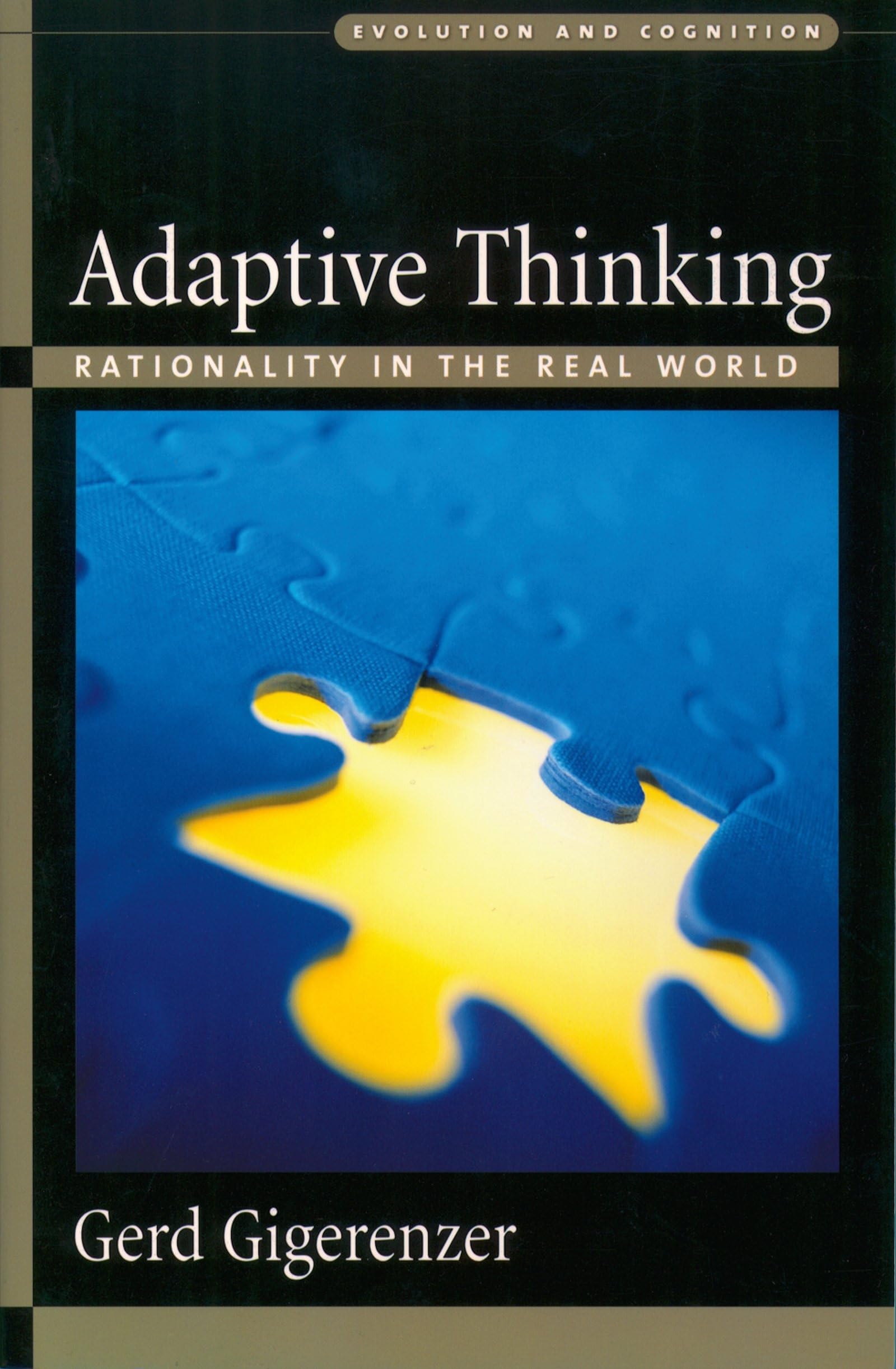
Adaptive Thinking: Rationality in the Real World by Gerd Gigerenzer – A Deep Dive into Ecological, Bounded, and Social R
Inclusive of all applicable taxes. FREE shipping on all orders.
Available Offers
- 🚚Free Delivery — Free shipping on all orders
- 💵Cash on Delivery — Pay when your order arrives
- ↩️15-Day Easy Returns — Hassle-free return policy
- 🔒Cash on Delivery — Pay safely when your order arrives
Check Delivery
Product Description
Introduction
In a world overflowing with information, how do we make decisions that truly work? Gerd Gigerenzer’s Adaptive Thinking: Rationality in the Real World offers a refreshingly practical approach to understanding human reasoning. This book challenges the traditional view of rationality as a set of abstract logical rules and instead presents it as a flexible, context-sensitive skill shaped by our environment. For Indian readers—whether students, professionals, or curious minds—this book provides powerful insights into how we think, decide, and solve problems every day, from navigating crowded markets to making life-changing health choices.
Book Overview
Adaptive Thinking is a groundbreaking work that redefines what it means to be rational. Gigerenzer argues that true rationality is not about following rigid mathematical formulas but about using simple, smart heuristics—mental shortcuts—that are adapted to specific situations. Drawing on decades of research in cognitive science, psychology, and behavioral economics, the book shows how our minds use these adaptive tools to cope with uncertainty, complexity, and social pressures. It is a compelling call to move beyond statistical rituals and embrace a more realistic, human-centered view of intelligence.
Key Highlights
- Introduces the concept of ecological rationality: how thinking is shaped by the environment we live in.
- Explores bounded rationality: the idea that our minds use limited information efficiently.
- Highlights social intelligence as a core component of adaptive decision-making.
- Critiques mindless statistical practices in social sciences and offers better alternatives.
- Provides real-world examples from medicine, business, and everyday life.
Inside the Book
This hardcover edition from Oxford University Press is a rich collection of essays and studies that take readers on a journey from the laboratory to the streets. Gigerenzer dissects how new ideas emerge, how we learn from others, and why intuition often outperforms complex analysis. Each chapter is packed with experiments, case studies, and practical takeaways. The book is written in an accessible style, making complex ideas easy to grasp without losing depth.
Key Topics
- The psychology of rationality and decision-making
- Heuristics and biases: when simple rules work best
- Social intelligence and cooperation
- Creativity and the origin of new ideas
- Statistical reasoning in real-world contexts
- Adaptive thinking in medicine, law, and business
Reader Benefits
Reading Adaptive Thinking will transform how you approach problems. You will learn to trust your gut when it makes sense, question overcomplicated methods, and make smarter decisions under uncertainty. The book equips you with mental tools that are immediately applicable—whether you are a student preparing for exams, a manager leading a team, or a professional navigating India’s fast-changing landscape. It also helps you spot when others are using flawed reasoning, giving you an edge in debates and negotiations.
Learning Outcomes
- Understand the difference between logical rationality and ecological rationality.
- Identify when simple heuristics outperform complex algorithms.
- Apply adaptive thinking to improve personal and professional decisions.
- Critically evaluate statistical claims in news, research, and advertising.
- Enhance your social intelligence by understanding how others think.
Who Should Read
This book is ideal for students and researchers in psychology, cognitive science, economics, and sociology. It is also highly valuable for professionals in medicine, counseling, law, and business who need practical decision-making tools. General readers with an interest in how the mind works will find it equally engaging. Indian readers, in particular, will appreciate how the concepts apply to diverse, high-uncertainty environments like our own.
About the Author
Gerd Gigerenzer is a renowned German psychologist and director of the Harding Center for Risk Literacy at the Max Planck Institute for Human Development. He is a leading authority on heuristics, risk communication, and decision-making. His work has influenced fields from behavioral economics to public health, and he has authored several bestselling books that make cognitive science accessible to everyone.
About the Publisher
Oxford University Press is a prestigious academic publisher with a global reputation for excellence. Known for its rigorous editorial standards and authoritative content, OUP brings this essential work to readers in India and around the world. This hardcover edition ensures durability and a premium reading experience.
Conclusion
Adaptive Thinking: Rationality in the Real World is a must-read for anyone who wants to think better, not harder. Gerd Gigerenzer’s insights are both profound and practical, offering a new lens to view human intelligence. Whether you are a student, a professional, or a lifelong learner, this book will change the way you make decisions—and help you thrive in a complex world. Order your hardcover copy from Bookshops.in today and start thinking adaptively.
Quick Summary
Adaptive Thinking: Rationality in the Real World by Gerd Gigerenzer is a landmark work that reimagines rationality as an adaptive process shaped by ecological, bounded, and social factors. Instead of treating human reasoning as flawed compared to abstract logic or probability, Gigerenzer shows how our minds use simple heuristics and environmental cues to make smart, fast decisions in real-world contexts. The book critiques the mindless statistical rituals common in social science and offers a fresh research program grounded in how people actually think and behave. Written in an engaging, accessible style, it is ideal for psychology, cognitive science, economics, and philosophy students in India, as well as general readers curious about decision-making. By purchasing from Bookshops.in, you get a genuine, high-quality hardcover edition delivered across India, backed by our commitment to authentic academic books and reliable service.
Book Highlights
Book Specifications
| ISBN-13 | 9780195153729 |
| ISBN-10 | 0195153723 |
| Publisher | Oxford Univ Pr on Demand |
| Language | English |
| Dimensions | 16.71 x 2.03 x 22.61 cm |
| Weight | 499 g |
| Category | Psychology › Cognitive Psychology |
| Genre | Non-fiction |
| Original Language | English |
Frequently Asked Questions
What is the main theme of Adaptive Thinking?
Who is Gerd Gigerenzer?
Is this book suitable for beginners?
What makes this book different from other rationality books?
Does the book cover heuristics and biases?
What is ecological rationality?
What is bounded rationality?
What is social rationality?
Is this book used in Indian university courses?
Can I buy this book from Bookshops.in?
Does the book include practical examples?
What is the reading level of this book?
What other books has Gerd Gigerenzer written?
Readers Also Search For
Customers Also Bought

Psychology
Koinonia: From Hate, Through Dialogue, to Culture in the Large Group by Patrick B. Demare

Psychology
Mindfulness-Based Interventions for Trauma and Its Consequences (Concise Guides on Trauma Care, 4)

Psychology
Handbook for Teaching Statistics and Research Methods by Mark E. Ware

Psychology
Psychoanalysis and the Nuclear Threat: Clinical and Theoretical Studies

Psychology
Humor and Psyche: Psychoanalytic Perspectives by James W. Barron

Relationships
The Experience and Expression of Uncertainty in Close Relationships by Jennifer A. Theiss
Related Products
View AllPsychology
Mindfulness-Based Interventions for Trauma and Its Consequences (Concise Guides on Trauma Care, 4)
Psychology
Handbook for Teaching Statistics and Research Methods by Mark E. Ware
Psychology
Psychoanalysis and the Nuclear Threat: Clinical and Theoretical Studies
Psychology
Humor and Psyche: Psychoanalytic Perspectives by James W. Barron

Psychology
Proceedings of the First International Conference on Genetic Algorithms and Their Applications
Psychology