
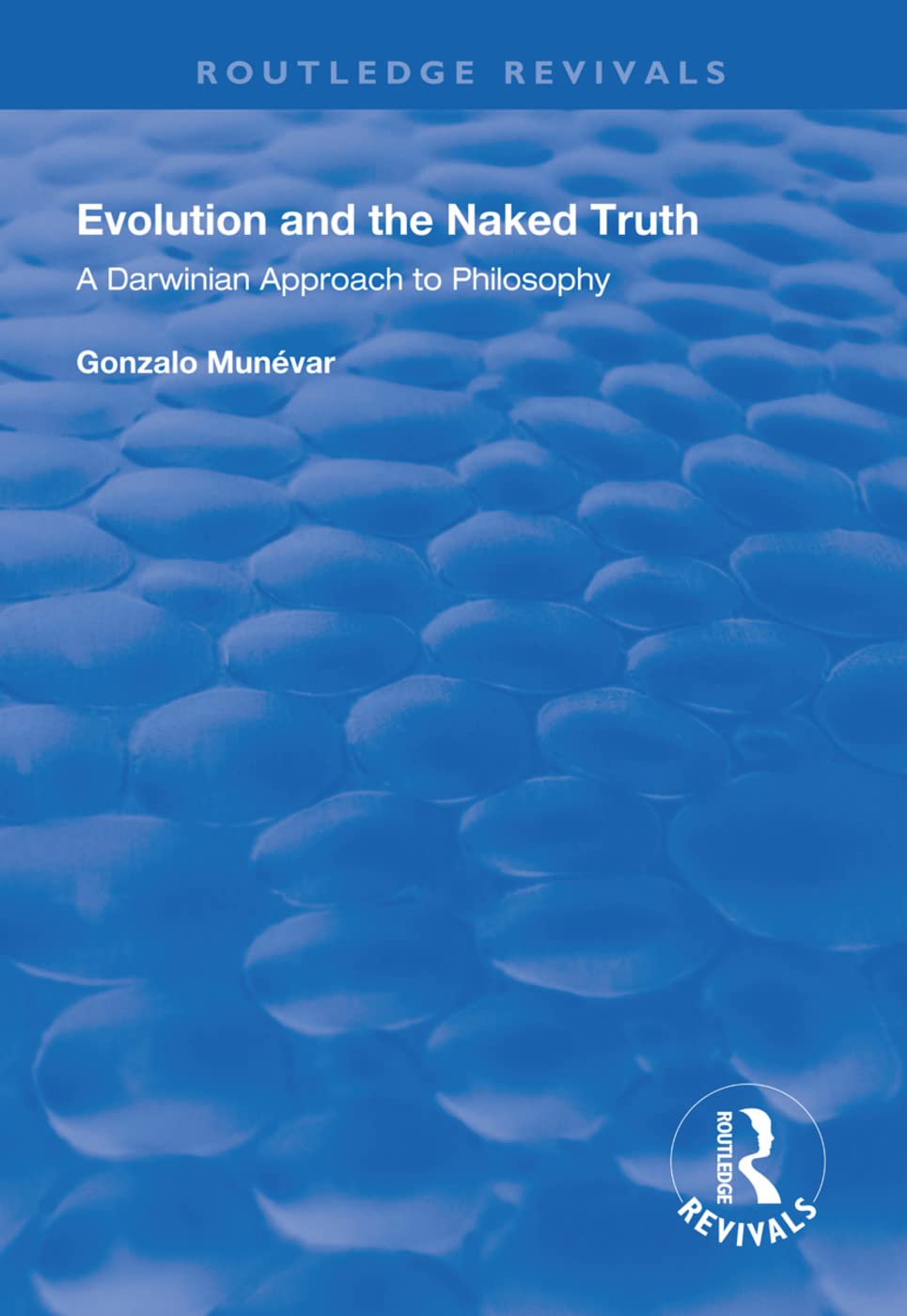
Evolution and the Naked Truth: A Darwinian Approach to Philosophy by Gonzalo Munevar – Exploring Rationality, Truth, and
Inclusive of all applicable taxes. FREE shipping on all orders.
Available Offers
- 🚚Free Delivery — Free shipping on all orders
- 💵Cash on Delivery — Pay when your order arrives
- ↩️15-Day Easy Returns — Hassle-free return policy
- 🔒Cash on Delivery — Pay safely when your order arrives
Check Delivery
Product Description
Introduction
What happens when the timeless questions of philosophy meet the relentless logic of evolution? In Evolution and the Naked Truth: Darwinian Approach to Philosophy, Gonzalo Munevar offers a bold and provocative answer. This hardcover edition, published by Routledge, bridges the gap between science and philosophy by applying a Darwinian framework to some of the most enduring problems in human thought. Whether you are a student of philosophy, a science enthusiast, or a curious reader in India, this book challenges you to rethink the nature of truth, knowledge, and rationality through the lens of natural selection.
Book Overview
First published in 1998, this seminal work uses a naturalistic, evolutionary perspective to tackle core philosophical dilemmas. Munevar argues that traditional epistemology—the study of knowledge—fails to account for how science actually works. Instead, he proposes a social concept of rationality rooted in our evolutionary heritage. The book explores two central problems: the rationality of science and the nature of truth. By rejecting individual rationality in favour of a collective, evolved reasoning process, Munevar shows that science remains a rational activity even when its theories change over time. He also develops a theory of relative truth, steering away from absolute realism toward an evolutionary relativism that respects both scientific progress and cultural diversity.
Key Highlights
- Original Darwinian Framework: Applies evolutionary principles to philosophy, offering a fresh alternative to traditional metaphysical approaches.
- Social Rationality: Challenges the idea of individual reason, proposing instead that rationality emerges from social and biological interactions.
- Evolutionary Relativism: Presents a nuanced theory of truth that is neither absolute nor arbitrary, but grounded in our evolved cognitive capacities.
- Critical Engagement: Engages deeply with thinkers like Thomas Kuhn and Paul Feyerabend, showing how their views on scientific revolutions actually support a naturalistic philosophy.
- Interdisciplinary Appeal: Blends philosophy of science, biology, and epistemology into a coherent, accessible narrative.
Inside the Book
The book is structured around key philosophical problems, each examined through an evolutionary lens. Munevar begins by dissecting the challenge posed by Kuhn and Feyerabend to traditional epistemology. He argues that their work highlights the need for a new model of rationality—one that is social, adaptive, and rooted in our biological history. Moving to the problem of truth, he dismantles the realist assumption that science discovers objective truths. Instead, he builds a case for evolutionary relativism: scientific knowledge is true relative to our evolved cognitive framework and ecological context. The final chapters explore how this relativism can still yield meaningful, practical truths that guide human action and inquiry.
Key Topics
- Philosophy of science and its evolution
- Rationality as a social and biological phenomenon
- Truth and relativism in scientific knowledge
- Naturalistic epistemology
- The legacy of Kuhn and Feyerabend
- Evolutionary psychology and cognition
- The limits of realism in science
- Darwinian approaches to metaphysics
Reader Benefits
- Deepen Your Understanding: Grasp complex philosophical ideas through a clear, evolutionary lens.
- Challenge Your Assumptions: Question what you think you know about truth, reason, and science.
- Bridge Disciplines: Connect biology, philosophy, and sociology in one compelling narrative.
- Think Critically: Learn to evaluate arguments about scientific change and knowledge.
- Indian Context: The evolutionary relativism discussed here resonates with India's diverse philosophical traditions that embrace multiple perspectives.
Learning Outcomes
- Understand how evolutionary theory can inform philosophical debates.
- Analyze the strengths and weaknesses of traditional epistemology.
- Evaluate the concept of social rationality and its implications for science.
- Explain the difference between absolute truth and relative truth.
- Critique realist and anti-realist positions in philosophy of science.
- Apply evolutionary thinking to contemporary issues in knowledge and ethics.
Who Should Read
This book is ideal for undergraduate and postgraduate students of philosophy, especially those studying philosophy of science, epistemology, or naturalism. It also serves researchers in evolutionary biology, cognitive science, and sociology who are interested in the philosophical foundations of their fields. General readers with a curiosity about how evolution shapes our thinking—and a willingness to engage with challenging ideas—will find this book both rewarding and provocative. Indian students preparing for competitive exams or university courses in humanities and science will benefit from its interdisciplinary approach.
About the Author
Gonzalo Munevar is a philosopher of science known for his work on naturalism and evolutionary epistemology. His research bridges the gap between the sciences and humanities, drawing on biology, neuroscience, and philosophy to address fundamental questions about knowledge and reality. Munevar has taught at several universities and published widely on topics such as scientific rationality, truth, and the philosophy of mind. His writing is rigorous yet accessible, making complex ideas understandable for a broad audience.
About the Publisher
Routledge is a globally respected academic publisher with a strong presence in philosophy, science, and social sciences. Known for its high-quality scholarly books and textbooks, Routledge brings together leading thinkers from around the world. This hardcover edition reflects Routledge's commitment to durable, well-produced books that stand the test of time—perfect for Indian libraries, universities, and personal collections.
Conclusion
Evolution and the Naked Truth is not just a book; it is an invitation to rethink the very foundations of knowledge. By grounding philosophy in the evolutionary processes that shaped our minds, Gonzalo Munevar offers a path that is both scientifically informed and philosophically rich. For Indian readers eager to explore the intersection of science and wisdom, this hardcover volume is an essential addition to your bookshelf. Order your copy today from Bookshops.in and embark on a journey that challenges what you know about truth, reason, and the human condition.
Quick Summary
Evolution and the Naked Truth: Darwinian Approach to Philosophy by Gonzalo Munevar is a seminal work that applies evolutionary principles to fundamental questions in philosophy, particularly those concerning science, rationality, and truth. The book argues that a naturalistic, Darwinian framework can resolve the challenges posed by philosophers like Thomas Kuhn and Paul Feyerabend, who questioned the rationality and objectivity of science. Munevar proposes a social concept of rationality, moving beyond individual cognition, and contends that a committed evolutionary philosophy does not support scientific realism but instead leads to a nuanced understanding of truth. This book is ideal for Indian students and researchers in philosophy of science, epistemology, and evolutionary biology who seek a rigorous, interdisciplinary perspective. Readers will learn to critically evaluate scientific progress, understand the evolution of knowledge, and engage with cutting-edge debates in naturalistic philosophy. By purchasing from Bookshops.in, customers receive a genuine Routledge hardcover edition with prompt pan-India delivery and excellent customer service.
Book Highlights
Book Specifications
| ISBN-13 | 9781138624467 |
| ISBN-10 | 1138624462 |
| Publisher | Routledge |
| Language | English |
| Dimensions | 15.84 x 1.98 x 23.46 cm |
| Weight | 640 g |
| Country | India |
| Category | Philosophy › Metaphysics |
| Genre | Non-fiction |
| Reading Age | Adult |
| Original Language | English |
Frequently Asked Questions
What is the main thesis of Evolution and the Naked Truth?
Who is the author of this book?
Is this book suitable for undergraduate students?
Does the book support scientific realism?
How does the book address the problem of rationality?
Which philosophers are discussed in the book?
Can this book be used in Indian philosophy courses?
What is the price of the book?
Is the book available in hardcover?
Does the book include references to Indian philosophy?
What is the ISBN-13 of this book?
Is this book part of a series?
Why should I buy from Bookshops.in?
Readers Also Search For
Customers Also Bought
Islam
Spiritual Economies (English, Daromir Rudnyckyj)

Islam
Who Is Allah? (English, Bruce B. Lawrence)

Islam
Islam and Liberal Citizenship: The Search for an Overlapping Consensus by Andrew F. March

Islam
Fiqh Us-Sunnah: Funerals and Diggers by Al-Sayyid Sabiq – Islamic Funeral Guide

Christianity
Genetics (English, Thomas a. Shannon | Mark P. Aulisio | Françoise Baylis)

Hinduism
Karma and Creativity by Christopher Key Chapple – Indian Philosophy
Related Products
View All
Philosophy
Latin American Philosophy: Currents, Issues, Debates by Eduardo Mendieta

Philosophy
Al-Farabi's Short Commentary on Aristotle's Prior Analytics by Nicholas Rescher – Philosophy

Philosophy
Poetics of Imagining: Modern to Post-modern by Richard Kearney

Philosophy
The Metaphysics of Extrinsic Properties: 11 (Metaphysical Research, 11)

Philosophy
Dialogues on Metaphysics and on Religion by Nicolas Malebranche – Philosophy
Philosophy