
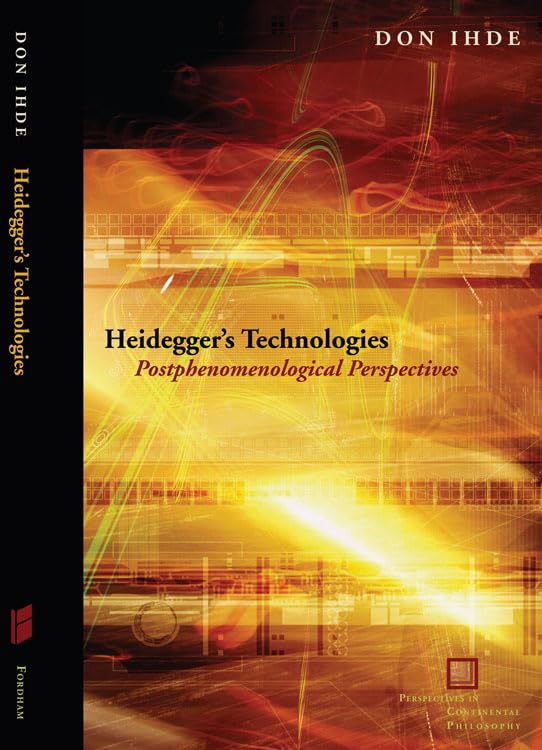
Heidegger's Technologies: Postphenomenological Perspectives by Don Ihde – A Critical Examination of Heidegger's Philosop
Inclusive of all applicable taxes. FREE shipping on all orders.
Available Offers
- 🚚Free Delivery — Free shipping on all orders
- 💵Cash on Delivery — Pay when your order arrives
- ↩️15-Day Easy Returns — Hassle-free return policy
- 🔒Cash on Delivery — Pay safely when your order arrives
Check Delivery
Product Description
Introduction
In an age where smartphones, artificial intelligence, and genetic engineering are reshaping our world, the philosophical questions surrounding technology have never been more urgent. Martin Heidegger, one of the most influential thinkers of the twentieth century, laid the groundwork for the philosophy of technology. But how relevant are his ideas today, especially in a rapidly modernizing nation like India? Don Ihde's Heidegger's Technologies: Postphenomenological Perspectives offers a fresh, critical, and deeply insightful re-examination of Heidegger's legacy. This book is not just a commentary—it is a bridge between classical philosophy and the cutting-edge technologies of the twenty-first century, making it an essential read for students, scholars, and anyone curious about the role of technology in our lives.
Book Overview
Published by Fordham University Press, this hardcover volume presents a rigorous yet accessible exploration of Heidegger's philosophy of technology through a postphenomenological lens. Don Ihde, a leading philosopher of technology, takes Heidegger's three foundational claims—that technology is not neutral, that modern technology differs qualitatively from traditional tools, and that technology is a metaphysical worldview—and tests them against the realities of contemporary innovations. From imaging technologies and nanotechnology to bioengineering and information systems, Ihde asks whether Heidegger's framework can still help us understand the tools we create and that, in turn, shape us. The result is a compelling dialogue between past and present, theory and practice, that challenges readers to think deeply about the technological world they inhabit.
Key Highlights
- Fresh Perspective: Applies Heidegger's ideas to modern technologies like MRI, CRISPR, and smartphones, moving beyond abstract theory to concrete analysis.
- Postphenomenological Approach: Integrates phenomenology with empirical studies of technology, offering a nuanced method for understanding human-technology relations.
- Critical Yet Balanced: Neither dismisses Heidegger nor blindly accepts his views; instead, it engages critically to uncover what remains valuable and what needs revision.
- Accessible Writing: Written for both philosophy students and general readers, with clear explanations of complex concepts.
- Timely Relevance: Addresses questions about digital life, surveillance, and environmental ethics that resonate strongly in today's tech-driven world.
Inside the Book
The book begins with an extensive introduction that situates Heidegger within the philosophical and technological debates of his era, from the rise of industrial machinery to the atomic age. Subsequent chapters delve into specific technologies: imaging technologies that transform how we see the body, information technologies that redefine communication, and biotechnologies that challenge our understanding of life itself. Ihde also explores how Heidegger's concept of 'enframing' (Gestell) applies—or fails to apply—to contemporary tools. Each chapter combines close reading of Heidegger's texts with case studies, making abstract ideas tangible. The final chapters reflect on the future of philosophy of technology, proposing a postphenomenological path forward that is both critical and constructive.
Key Topics
- Heidegger's three core claims about technology and their limitations
- Postphenomenology as a method for studying technology
- Imaging technologies and the transformation of perception
- Nanotechnology, bioengineering, and the question of human enhancement
- Information technology and the digital environment
- The concept of 'enframing' in the age of AI and automation
- Technology and environmental ethics
- The cultural specificity of technological development
Reader Benefits
- Deepen Your Understanding: Gain a nuanced grasp of one of philosophy's most challenging thinkers.
- Connect Theory to Reality: See how Heidegger's ideas illuminate—and sometimes fail to illuminate—the technologies you use daily.
- Enhance Critical Thinking: Develop the skills to question technological progress and its impact on human existence.
- Stay Relevant: Engage with a text that speaks directly to contemporary debates about AI, genetic engineering, and digital privacy.
- Academic Support: Ideal for philosophy, sociology, and science and technology studies courses.
Learning Outcomes
By reading this book, you will be able to: articulate Heidegger's major arguments about technology with clarity; critically evaluate the strengths and weaknesses of his philosophy; apply postphenomenological methods to analyze specific technologies; understand the historical context of Heidegger's work; and engage in informed discussions about the ethical and existential dimensions of modern innovation. These skills are invaluable for students preparing for exams, researchers developing new theoretical frameworks, and professionals navigating the ethical challenges of technological change.
Who Should Read
- Students of philosophy, especially those studying existentialism, phenomenology, or the philosophy of technology
- Scholars and researchers in science and technology studies (STS)
- Engineers, designers, and technologists interested in the ethical and social implications of their work
- Indian readers concerned with the rapid digitization and automation of society
- Anyone who has ever wondered: 'What does technology do to us as human beings?'
About the Author
Don Ihde is a distinguished professor of philosophy at Stony Brook University, State University of New York. A pioneer in the field of philosophy of technology, he has authored numerous influential works, including Technology and the Lifeworld and Postphenomenology: Essays in the Postmodern Context. Ihde is known for his accessible yet rigorous style, and for bringing phenomenology into dialogue with empirical studies of science and technology. His work has shaped the way scholars around the world think about human-technology relations, making him one of the most cited philosophers in the field today.
About the Publisher
Fordham University Press, based in New York, is a prestigious academic publisher known for its commitment to scholarly excellence in the humanities and social sciences. With a strong focus on philosophy, theology, and cultural studies, Fordham Press has published many landmark works that have influenced academic discourse globally. This edition of Heidegger's Technologies reflects the press's dedication to making complex ideas accessible to a wide readership, and its reputation for high-quality production ensures that this hardcover volume will be a lasting addition to any library.
Conclusion
In a world where technology is often seen as a neutral tool or an unstoppable force, Don Ihde's Heidegger's Technologies: Postphenomenological Perspectives offers a vital philosophical compass. It does not simply explain Heidegger—it challenges him, updates him, and shows how his ideas can still provoke and enlighten us. For Indian readers, who are witnessing an extraordinary technological transformation, this book provides the intellectual tools to reflect on what is being gained and what might be lost. Whether you are a student, a professional, or a curious mind, this book will change the way you see the devices, systems, and networks that shape your everyday life. Order your copy today from Bookshops.in and step into a deeper conversation about technology and humanity.
Quick Summary
'Heidegger's Technologies: Postphenomenological Perspectives' by Don Ihde is a critical and timely reexamination of Martin Heidegger's philosophy of technology, written for the 21st century. While Heidegger's ideas remain foundational, Ihde argues that the explosion of new technologies—bio-, nano-, info-, and imaging—demands a fresh philosophical approach. Using postphenomenology, a framework he pioneered, Ihde analyzes how these technologies shape human experience and questions whether Heidegger's three core claims (technology is not neutral, modern technology is qualitatively different, and technology is a metaphysical perspective) are still adequate. This book is ideal for Indian philosophy students, scholars of technology studies, and critical thinkers who want to understand the philosophical underpinnings of contemporary technoscience. Readers will learn to critically evaluate the role of technology in society and gain tools for analyzing emerging technologies. By choosing Bookshops.in, Indian customers receive a genuine hardcover edition from Fordham University Press, ensuring quality and supporting a local bookstore committed to academic excellence.
Book Highlights
Book Specifications
| ISBN-13 | 9780823233762 |
| ISBN-10 | 0823233766 |
| Publisher | Fordham Univ Pr |
| Language | English |
| Dimensions | 15.88 x 1.91 x 23.5 cm |
| Weight | 363 g |
| Country | India |
| Category | Philosophy › History & Surveys |
| Genre | Non-fiction |
| Original Language | English |
Frequently Asked Questions
What is 'Heidegger's Technologies: Postphenomenological Perspectives' about?
Who is the author of this book?
Who should read this book?
Is this book suitable for Indian students?
What are Heidegger's three claims about technology discussed in the book?
How does this book differ from Heidegger's original work?
What is postphenomenology?
Is this a hardcover or paperback book?
What is the ISBN of this book?
How is this book relevant to Indian readers?
Does this book cover bio- and nano-technology?
Can this book be used for academic courses?
What is the price of this book at Bookshops.in?
Is this book available in English?
Readers Also Search For
Customers Also Bought

Islam
Spiritual Economies (English, Daromir Rudnyckyj)

Islam
Who Is Allah? (English, Bruce B. Lawrence)

Islam
Islam and Liberal Citizenship: The Search for an Overlapping Consensus by Andrew F. March

Islam
Fiqh Us-Sunnah: Funerals and Diggers by Al-Sayyid Sabiq – Islamic Funeral Guide

Christianity
Genetics (English, Thomas a. Shannon | Mark P. Aulisio | Françoise Baylis)

Hinduism
Karma and Creativity by Christopher Key Chapple – Indian Philosophy
Related Products
View All
Philosophy
Latin American Philosophy: Currents, Issues, Debates by Eduardo Mendieta

Philosophy
Al-Farabi's Short Commentary on Aristotle's Prior Analytics by Nicholas Rescher – Philosophy

Philosophy
Poetics of Imagining: Modern to Post-modern by Richard Kearney

Philosophy
The Metaphysics of Extrinsic Properties: 11 (Metaphysical Research, 11)

Philosophy
Dialogues on Metaphysics and on Religion by Nicolas Malebranche – Philosophy

Philosophy