
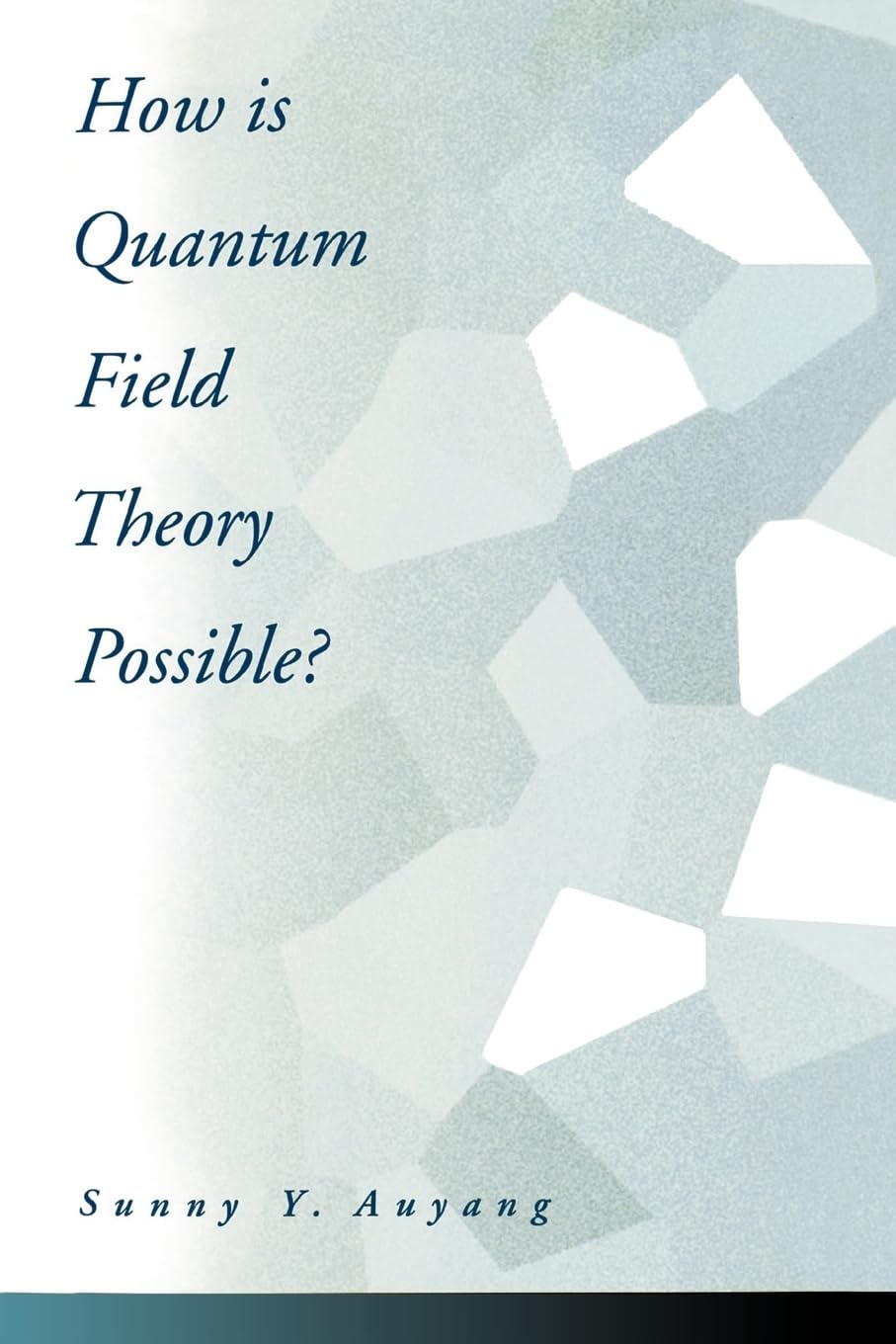
How is Quantum Field Theory Possible? A Philosophical Inquiry into the Foundations of Modern Physics by Sunny A. Auyang
Inclusive of all applicable taxes. FREE shipping on all orders.
Available Offers
- 🚚Free Delivery — Free shipping on all orders
- 💵Cash on Delivery — Pay when your order arrives
- ↩️15-Day Easy Returns — Hassle-free return policy
- 🔒Cash on Delivery — Pay safely when your order arrives
Check Delivery
Product Description
Introduction
Quantum field theory stands as one of the most profound intellectual achievements of modern physics, yet its philosophical underpinnings often remain obscure. In How is Quantum Field Theory Possible?, Sunny A. Auyang offers a rare and rigorous exploration that bridges the gap between advanced theoretical physics and the foundational questions of philosophy. This book is not merely another textbook on quantum mechanics; it is a deep inquiry into the very conditions that make quantum field theory a coherent description of reality. For Indian students and researchers grappling with the conceptual challenges of modern physics, this work provides a unique lens through which to understand the structure of physical theories and the nature of scientific knowledge.
Book Overview
Published by Oxford University Press, this hardcover volume presents a systematic analysis of quantum field theory (QFT) as the union of quantum mechanics and Einstein's special relativity. Auyang argues that QFT demands a radical rethinking of traditional philosophical categories such as substance, causality, and space-time. The book moves beyond the tired debates between realism and instrumentalism, offering instead a sophisticated framework that respects the mathematical and conceptual complexity of modern physics. It examines how we can claim knowledge of the microscopic world without a fully satisfactory measurement theory, and what general conditions of the world make such knowledge possible. This is a book for those who want to understand not just what QFT says, but why it is possible at all.
Key Highlights
- Bridges advanced theoretical physics with deep philosophical analysis, offering a rare interdisciplinary perspective.
- Challenges conventional interpretations of quantum mechanics, including the observer-observed distinction and space-time substantivalism.
- Provides a clear exposition of the mathematical structures underlying QFT, such as Fock spaces, symmetries, and renormalization.
- Written by a philosopher of science with a firm grasp of the technical details, ensuring both rigor and accessibility for serious readers.
- Includes critical discussions on the presuppositions of physical theories, making it valuable for both physicists and philosophers.
Inside the Book
The book is structured around the central question: How can quantum field theory, with its abstract mathematical formalism, describe a world that appears so different from our everyday experience? Auyang begins by laying out the conceptual foundations of QFT, including the principles of locality, causality, and gauge invariance. She then delves into the philosophical puzzles: the nature of particles and fields, the role of symmetry, and the meaning of probability in quantum contexts. Later chapters tackle the measurement problem, the interpretation of quantum states, and the relationship between theories and the world they describe. The final sections offer a constructive proposal for a new philosophical framework that can accommodate the complexities of modern physics without falling into either naive realism or radical anti-realism.
Key Topics
- Quantum field theory as the synthesis of quantum mechanics and special relativity
- The philosophical implications of Fock space and second quantization
- Symmetry principles and gauge theories in the context of ontology
- The measurement problem and the role of the observer in QFT
- Space-time structure and the debate between relationalism and substantivalism
- Renormalization and the limits of physical knowledge
- The presuppositions of empirical science and the conditions for objective knowledge
Reader Benefits
This book equips readers with a deeper understanding of the conceptual architecture of modern physics. It helps students and researchers move beyond rote calculations to grasp the philosophical significance of the theories they use. By clarifying the hidden assumptions in QFT, Auyang enables readers to critically evaluate competing interpretations and to appreciate the subtle interplay between mathematics, experiment, and reality. For those preparing for advanced research or teaching, this volume serves as a valuable resource for integrating philosophical reflection into scientific practice. Indian readers, in particular, will find the book's emphasis on foundational questions refreshing in a landscape often dominated by purely technical training.
Learning Outcomes
- Understand the core principles of quantum field theory from a conceptual and philosophical perspective.
- Critically analyze the presuppositions underlying modern physical theories.
- Evaluate the strengths and weaknesses of different interpretations of quantum mechanics.
- Develop a nuanced view of the relationship between mathematical formalism and physical reality.
- Gain insights into the nature of scientific explanation and the limits of empirical knowledge.
Who Should Read
This book is ideal for advanced undergraduate and graduate students in physics and philosophy of science, as well as professional researchers seeking a deeper conceptual grounding. It is also suitable for mathematicians and philosophers interested in the foundations of quantum theory. Readers should have a basic familiarity with quantum mechanics and some exposure to field theory, but the philosophical arguments are presented in a self-contained manner. For Indian academics and students in institutions like IITs, IISc, and central universities, this book offers a unique opportunity to engage with the cutting edge of foundational physics.
About the Author
Sunny A. Auyang is a philosopher of science with a distinguished career in both physics and philosophy. She has held research positions at the Massachusetts Institute of Technology and the National University of Singapore, and has written extensively on the conceptual foundations of modern physics. Her work is characterized by a rare ability to combine technical precision with philosophical depth, making her one of the few scholars capable of addressing the deepest questions of quantum field theory in a rigorous yet accessible manner.
About the Publisher
Oxford University Press is one of the world's most prestigious academic publishers, with a long history of producing authoritative works in the sciences and humanities. This hardcover edition reflects OUP's commitment to quality, featuring durable binding and clear typography suitable for sustained study. For Indian readers, OUP's global reputation ensures that the content meets the highest standards of scholarship.
Conclusion
How is Quantum Field Theory Possible? is an essential addition to the library of anyone serious about understanding the deepest structure of physical reality. It challenges readers to think beyond equations and experiments, asking the fundamental questions that make science meaningful. Whether you are a physicist, a philosopher, or a curious student, this book will transform the way you see the quantum world. Order your copy today from Bookshops.in and embark on a journey into the heart of modern physics.
Quick Summary
How is Quantum Field Theory Possible? by Sunny A. Auyang is a profound philosophical exploration of the foundations of quantum field theory (QFT), the most fundamental physical theory that unifies quantum mechanics with Einstein's special relativity. The book challenges readers to rethink how we can know the microscopic world without a fully satisfactory measurement theory, and argues that current debates on spacetime (relational vs. substantial) and quantum interpretations (observer vs. observed) are fundamentally flawed. Auyang systematically examines the presuppositions of physical theories and calls for an overhaul of philosophical categories to align with QFT's description of reality. This book is ideal for advanced physics students, researchers, and philosophers of science who seek a deeper conceptual understanding beyond mathematical formalism. By purchasing from Bookshops.in, Indian readers gain access to an authentic Oxford University Press hardcover edition, ensuring a premium reading and reference experience.
Book Highlights
Book Specifications
| ISBN-13 | 9780195093452 |
| ISBN-10 | 0195093453 |
| Publisher | OUP USA |
| Language | English |
| Dimensions | 15.24 x 1.7 x 22.86 cm |
| Weight | 408 g |
| Category | Psychology › Cognitive Psychology |
| Genre | Science & Mathematics |
| Original Language | English |
Frequently Asked Questions
What is the main thesis of this book?
Who is the author Sunny A. Auyang?
Is this book suitable for undergraduate students?
Does the book cover quantum mechanics or quantum field theory more?
What is the ISBN-13 of this book?
Which publisher released this book?
Does the book include mathematical equations?
What is the price of this book in India?
What is the reading level required?
Is this book part of a series?
How does this book differ from standard QFT textbooks?
Why should I buy this book from Bookshops.in?
Readers Also Search For
Customers Also Bought

Psychology
Koinonia: From Hate, Through Dialogue, to Culture in the Large Group by Patrick B. Demare

Psychology
Mindfulness-Based Interventions for Trauma and Its Consequences (Concise Guides on Trauma Care, 4)

Psychology
Handbook for Teaching Statistics and Research Methods by Mark E. Ware

Psychology
Psychoanalysis and the Nuclear Threat: Clinical and Theoretical Studies

Psychology
Humor and Psyche: Psychoanalytic Perspectives by James W. Barron

Relationships
The Experience and Expression of Uncertainty in Close Relationships by Jennifer A. Theiss
Related Products
View AllPsychology
Mindfulness-Based Interventions for Trauma and Its Consequences (Concise Guides on Trauma Care, 4)
Psychology
Handbook for Teaching Statistics and Research Methods by Mark E. Ware
Psychology
Psychoanalysis and the Nuclear Threat: Clinical and Theoretical Studies
Psychology
Humor and Psyche: Psychoanalytic Perspectives by James W. Barron

Psychology
Proceedings of the First International Conference on Genetic Algorithms and Their Applications
Psychology