
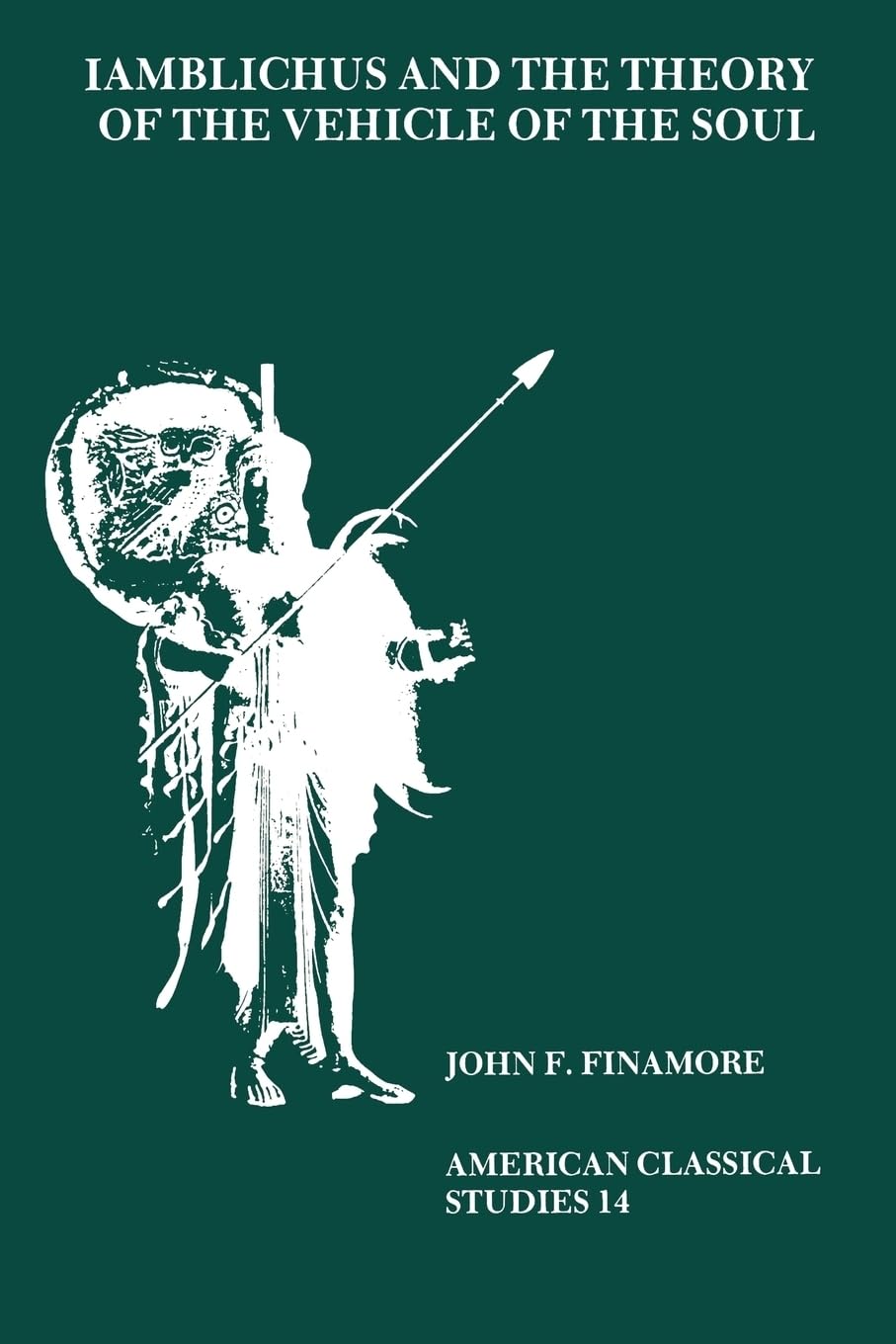
Iamblichus and the Theory of the Vehicle of the Soul by John F. Finamore – A Scholarly Exploration of Neoplatonic Psycho
Inclusive of all applicable taxes. FREE shipping on all orders.
Available Offers
- 🚚Free Delivery — Free shipping on all orders
- 💵Cash on Delivery — Pay when your order arrives
- ↩️15-Day Easy Returns — Hassle-free return policy
- 🔒Cash on Delivery — Pay safely when your order arrives
Check Delivery
Product Description
Introduction
In the vast and intricate tapestry of Neoplatonic philosophy, few concepts are as fascinating and elusive as the 'vehicle of the soul.' John F. Finamore's Iamblichus and the Theory of the Vehicle of the Soul offers a masterful exploration of this profound doctrine, shedding light on the intermediary substance that connects the immortal intellect with the mortal body. This hardcover edition, published by Oxford University Press, is an indispensable resource for scholars, students, and anyone drawn to the mysteries of ancient Greek thought. Finamore's rigorous analysis brings clarity to Iamblichus's complex metaphysics, making this book a cornerstone for understanding the soul's journey and its relationship with the divine.
Book Overview
This meticulously researched volume delves into the philosophical framework of Iamblichus, a pivotal figure in the Neoplatonic tradition. Finamore examines the theory of the 'vehicle of the soul' (ochêma), a subtle, luminous body that serves as the soul's permanent companion through its descent into the material world and its ascent back to the intelligible realm. Drawing on primary texts and commentaries, the book reconstructs Iamblichus's arguments about the nature, origin, and function of this vehicle. It situates the theory within the broader context of Platonic, Aristotelian, and Stoic influences, while also highlighting its significance for theurgy—the ritual practice aimed at uniting the soul with the divine. Finamore's work is both a detailed exegesis and a critical evaluation, offering fresh insights into a doctrine that has intrigued philosophers for centuries.
Key Highlights
- Authoritative Scholarship: John F. Finamore, a renowned expert in Neoplatonism, provides a comprehensive and accessible analysis of Iamblichus's theory.
- Rigorous Source Analysis: The book examines key texts, including Iamblichus's De Mysteriis and fragments from his lost works, alongside commentaries by Proclus and Damascius.
- Contextual Depth: Explores the historical and philosophical background of the vehicle theory, including its roots in Plato's Timaeus and Phaedrus.
- Focus on Theurgy: Highlights the practical implications of the vehicle for theurgic rituals, emphasizing the soul's purification and ascent.
Inside the Book
The volume is structured into thematic chapters that guide the reader through Iamblichus's metaphysical system. Finamore begins by defining the vehicle as a 'third kind' of substance—neither purely material nor purely intellectual. He then traces its role in the soul's descent, explaining how it acquires passions and impressions from the material world. Subsequent chapters address the vehicle's purification through theurgy, its relationship with the stars and daimons, and its ultimate role in the soul's return to the One. The book concludes with a discussion of the vehicle's immortality and its place in the hierarchy of being. Each argument is supported by careful textual references and comparative analysis, making the content both scholarly and engaging.
Key Topics
- The nature and origin of the soul's vehicle in Neoplatonic thought
- Iamblichus's critique of Plotinus and Porphyry on the soul's embodiment
- The role of the vehicle in theurgy and ritual ascent
- Connections between the vehicle, astral bodies, and daimonic intermediaries
- The vehicle's function in preserving individual identity across incarnations
- Comparative analysis with Aristotelian and Stoic theories of the soul-body relation
Reader Benefits
- Deepened Understanding: Gain a clear grasp of one of Neoplatonism's most intricate doctrines.
- Enhanced Scholarly Skills: Learn how to navigate and interpret ancient philosophical texts with precision.
- Broadened Perspective: Appreciate the interplay between metaphysics, cosmology, and religious practice in late antiquity.
- Critical Insight: Engage with Finamore's nuanced evaluation of Iamblichus's contributions to philosophy.
Learning Outcomes
- Explain the concept of the vehicle of the soul and its significance in Neoplatonic philosophy.
- Analyze Iamblichus's arguments regarding the soul's descent, embodiment, and ascent.
- Evaluate the role of theurgy in purifying the vehicle and achieving union with the divine.
- Compare Iamblichus's theory with those of other ancient philosophers, such as Plotinus and Aristotle.
- Apply the vehicle theory to broader discussions of soul-body dualism and spiritual transformation.
Who Should Read
This book is ideal for advanced undergraduate and postgraduate students of philosophy, classics, and religious studies. It is equally valuable for scholars specializing in Neoplatonism, ancient metaphysics, or the history of psychology. Indian readers with an interest in comparative philosophy—particularly those exploring parallels between Neoplatonic and Vedantic or Buddhist concepts of subtle bodies—will find this work especially illuminating. The book is also suitable for independent learners and enthusiasts of esoteric traditions who seek a rigorous, academic treatment of the subject.
About the Author
John F. Finamore is a distinguished professor of classics and philosophy at the University of Iowa. His research focuses on Neoplatonism, particularly the works of Iamblichus and the later Platonic tradition. He has authored numerous articles and books on ancient philosophy, including Iamblichus and the Theory of the Vehicle of the Soul and Proclus: Commentary on Plato's Timaeus. Finamore's scholarship is characterized by its clarity, depth, and commitment to making complex ideas accessible to modern readers.
About the Publisher
Oxford University Press is one of the world's oldest and most respected academic publishers. With a legacy spanning over five centuries, OUP is renowned for its rigorous editorial standards and commitment to disseminating knowledge across disciplines. This hardcover edition reflects their dedication to producing durable, high-quality volumes that serve as lasting resources for scholars and students alike.
Conclusion
Iamblichus and the Theory of the Vehicle of the Soul is a landmark study that illuminates a crucial yet often overlooked aspect of Neoplatonic philosophy. John F. Finamore's careful scholarship and engaging prose make this book an essential addition to any serious library. Whether you are a seasoned academic or a curious reader exploring the depths of ancient wisdom, this volume offers a rewarding journey into the soul's hidden vehicle and its path to the divine. Order your copy today from Bookshops.in and embark on an intellectual adventure that bridges the ancient and the timeless.
Quick Summary
Iamblichus and the Theory of the Vehicle of the Soul by John F. Finamore is a rigorous academic monograph that delves into one of the most intriguing concepts in Neoplatonic philosophy: the vehicle of the soul (ochêma). Iamblichus, a Syrian Neoplatonist of the 3rd-4th century CE, argued that the soul possesses a subtle, luminous body that serves as a bridge between the immaterial soul and the physical body. Finamore systematically unpacks this doctrine, tracing its roots in earlier Greek thought and its development within Iamblichus' own philosophical system. The book is intended for advanced students, scholars, and researchers in philosophy, classics, and religious studies. Readers will gain a thorough understanding of how Iamblichus' theory fits into the broader Neoplatonic tradition, including its differences from Plotinus and Porphyry. The work also explores the ethical and metaphysical implications of the soul's vehicle. This Oxford University Press hardcover edition is a lasting resource for any serious philosophy library. By purchasing from Bookshops.in, Indian readers receive a genuine, high-quality copy with prompt delivery, supporting local bookstores and academic enrichment.
Book Highlights
Book Specifications
| ISBN-13 | 9780891308836 |
| ISBN-10 | 0891308830 |
| Publisher | OUP USA |
| Language | English |
| Dimensions | 16.26 x 1.24 x 21.95 cm |
| Weight | 249 g |
| Category | Philosophy › History & Surveys |
| Genre | Philosophy |
| Original Language | English |
Frequently Asked Questions
What is the main topic of this book?
Who is the author of this book?
Is this book suitable for beginners in philosophy?
Which publisher released this book?
What is the binding of this book?
What is the ISBN for this book?
What language is the book in?
Can Indian students benefit from this book?
Does the book cover other Neoplatonists like Plotinus?
Is this a digital or physical book?
What is the price of this book on Bookshops.in?
Does the book include references and bibliography?
What is the 'vehicle of the soul' concept?
Why buy this book from Bookshops.in?
Readers Also Search For
Customers Also Bought
Islam
Spiritual Economies (English, Daromir Rudnyckyj)

Islam
Who Is Allah? (English, Bruce B. Lawrence)

Islam
Islam and Liberal Citizenship: The Search for an Overlapping Consensus by Andrew F. March
Islam
Fiqh Us-Sunnah: Funerals and Diggers by Al-Sayyid Sabiq – Islamic Funeral Guide

Christianity
Genetics (English, Thomas a. Shannon | Mark P. Aulisio | Françoise Baylis)

Hinduism
Karma and Creativity by Christopher Key Chapple – Indian Philosophy
Related Products
View All
Philosophy
Latin American Philosophy: Currents, Issues, Debates by Eduardo Mendieta

Philosophy
Al-Farabi's Short Commentary on Aristotle's Prior Analytics by Nicholas Rescher – Philosophy
Philosophy
Poetics of Imagining: Modern to Post-modern by Richard Kearney
Philosophy
The Metaphysics of Extrinsic Properties: 11 (Metaphysical Research, 11)
Philosophy
Dialogues on Metaphysics and on Religion by Nicolas Malebranche – Philosophy
Philosophy