
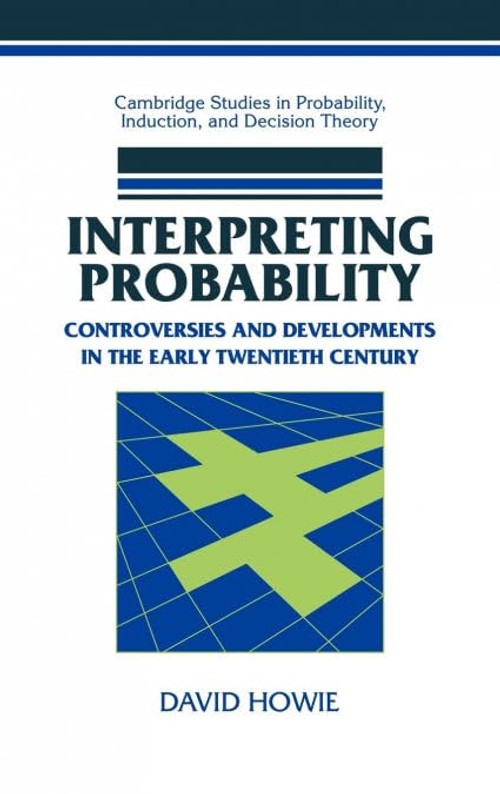
Interpreting Probability: Controversies and Developments in the Early Twentieth Century by David Howie – A Deep Dive int
Inclusive of all applicable taxes. FREE shipping on all orders.
Available Offers
- 🚚Free Delivery — Free shipping on all orders
- 💵Cash on Delivery — Pay when your order arrives
- ↩️15-Day Easy Returns — Hassle-free return policy
- 🔒Cash on Delivery — Pay safely when your order arrives
Check Delivery
Product Description
Introduction
Probability is a concept that lies at the heart of modern science, statistics, and everyday decision-making. Yet, for over a century, mathematicians and philosophers have debated what probability truly means. David Howie's Interpreting Probability: Controversies and Developments in the Early Twentieth Century offers a compelling journey into the heated debates that shaped our understanding of chance, uncertainty, and inference. Published by Cambridge University Press, this hardcover volume is essential reading for Indian students and researchers who wish to go beyond textbook formulas and explore the foundational ideas that continue to influence data science, artificial intelligence, and experimental research today.
Book Overview
This 2002 work examines the dramatic shift in the early twentieth century when the Bayesian interpretation of probability—long favoured by scientists—came under fierce attack. Howie focuses on a pivotal dispute between two British scientists, revealing how personal experiences and scientific aims, rather than pure logic, determined which interpretation of probability gained acceptance. The book bridges the gap between mathematics, history, and philosophy, making it a unique resource for anyone curious about how scientific theories evolve.
Key Highlights
- Historical Depth: Traces the rise and fall of Bayesianism in the 1920s and 1930s through real scientific controversies.
- Dual Perspectives: Clearly distinguishes between frequency interpretation and Bayesian (subjective) probability.
- Human Element: Shows that scientific choices are influenced by individual experiences and goals, not just mathematics.
- Interdisciplinary Approach: Connects statistics, philosophy of science, and intellectual history in one accessible narrative.
Inside the Book
Howie reconstructs the intellectual climate of early twentieth-century Britain, where figures like R.A. Fisher and Harold Jeffreys clashed over the foundations of statistical inference. Readers will encounter detailed analyses of how probability was used in physics, biology, and psychology. The book does not shy away from technical material, but explains key concepts in clear prose, making it suitable for both specialists and motivated general readers. Each chapter builds on the previous one, gradually revealing why the Bayesian approach was discredited and how it later experienced a revival.
Key Topics
- The frequency theory of probability and its advocates
- Bayesian inference and its philosophical underpinnings
- The Fisher–Jeffreys debate and its lasting impact
- Probability in scientific reasoning and experimental design
- The role of subjectivity in objective science
- How historical context shapes mathematical consensus
Reader Benefits
By reading this book, you will gain a nuanced understanding of probability that goes beyond any single textbook. You will learn why statisticians disagree on fundamental methods, and how to critically evaluate claims made using data. The book equips you with the intellectual tools to appreciate the assumptions behind different statistical techniques—a skill invaluable for researchers, data analysts, and anyone working with uncertainty.
Learning Outcomes
- Understand the key differences between frequentist and Bayesian interpretations of probability.
- Trace the historical events that led to the dominance of frequentist statistics in the mid-twentieth century.
- Analyse how personal and institutional biases can shape scientific theories.
- Evaluate modern statistical debates with a deeper historical perspective.
- Apply philosophical insights to practical problems in data interpretation.
Who Should Read
This book is ideal for undergraduate and postgraduate students in statistics, mathematics, physics, and philosophy. It is also highly recommended for data science professionals who wish to understand the roots of their craft. General readers with an interest in the history and sociology of science will find the narrative engaging and accessible. Indian students preparing for competitive exams or research careers will benefit from the rigorous yet readable treatment of foundational ideas.
About the Author
David Howie is a historian and philosopher of science with a deep expertise in the development of statistical thinking. His research focuses on the interplay between mathematics, scientific practice, and cultural context. Through meticulous archival work and clear exposition, Howie brings to life the personalities and arguments that shaped modern probability theory.
About the Publisher
Cambridge University Press is one of the world's oldest and most respected academic publishers. With a commitment to scholarly excellence, Cambridge produces works that set the standard in science, mathematics, and the humanities. This hardcover edition reflects the publisher's dedication to quality content and durable binding, making it a lasting addition to any library.
Conclusion
Interpreting Probability: Controversies and Developments in the Early Twentieth Century is more than a history book—it is a key to understanding the philosophical battles that continue to influence modern science and statistics. Whether you are a student in Mumbai, a researcher in Bangalore, or a curious reader in Delhi, this volume will change the way you think about chance and certainty. Order your hardcover copy from Bookshops.in today and explore the fascinating story behind one of mathematics' most debated concepts.
Quick Summary
Interpreting Probability: Controversies and Developments in the Early Twentieth Century by David Howie is a scholarly work that delves into the historical debate between two major interpretations of probability: the frequentist view, which sees probability as a long-run frequency, and the Bayesian view, which treats it as a measure of subjective uncertainty. Published by Cambridge University Press, this hardcover book examines how Bayesianism, once widely accepted in the 18th and 19th centuries, came under severe criticism during the 1920s and 1930s. Through a detailed analysis of a dispute between two prominent British scientists, Howie argues that the choice between interpretations is not forced by logic or mathematics alone but is shaped by the experiences and goals of the individuals involved. The book is ideal for Indian students and researchers in statistics, mathematics, philosophy of science, and data science who want to understand the foundations of statistical inference. Readers will gain a nuanced perspective on probability theory's evolution and learn why certain methodologies gained dominance. Buying from Bookshops.in ensures you receive a genuine hardcover copy with reliable delivery across India.
Book Highlights
Book Specifications
| ISBN-13 | 9780521812511 |
| ISBN-10 | 0521812518 |
| Publisher | Cambridge University Press |
| Language | English |
| Dimensions | 15.88 x 2.54 x 23.5 cm |
| Weight | 580 g |
| Country | India |
| Category | Philosophy › Epistemology |
| Genre | Non-fiction |
| Original Language | English |
Frequently Asked Questions
What is the main topic of this book?
Who is the author of 'Interpreting Probability'?
Is this book suitable for Indian students?
Does the book cover modern applications of probability?
What is the ISBN of this book?
Is this book available in paperback?
What is the price of this book on Bookshops.in?
What is the reading level required?
Does the book include mathematical formulas?
Who are the key scientists discussed?
Can this book help with statistics exams?
Is the book written in English?
Why should I buy from Bookshops.in?
Readers Also Search For
Customers Also Bought
Islam
Spiritual Economies (English, Daromir Rudnyckyj)

Islam
Who Is Allah? (English, Bruce B. Lawrence)
Islam
Islam and Liberal Citizenship: The Search for an Overlapping Consensus by Andrew F. March

Islam
Fiqh Us-Sunnah: Funerals and Diggers by Al-Sayyid Sabiq – Islamic Funeral Guide

Christianity
Genetics (English, Thomas a. Shannon | Mark P. Aulisio | Françoise Baylis)

Hinduism
Karma and Creativity by Christopher Key Chapple – Indian Philosophy
Related Products
View All
Philosophy
Latin American Philosophy: Currents, Issues, Debates by Eduardo Mendieta

Philosophy
Al-Farabi's Short Commentary on Aristotle's Prior Analytics by Nicholas Rescher – Philosophy

Philosophy
Poetics of Imagining: Modern to Post-modern by Richard Kearney

Philosophy
The Metaphysics of Extrinsic Properties: 11 (Metaphysical Research, 11)
Philosophy
Dialogues on Metaphysics and on Religion by Nicolas Malebranche – Philosophy
Philosophy