
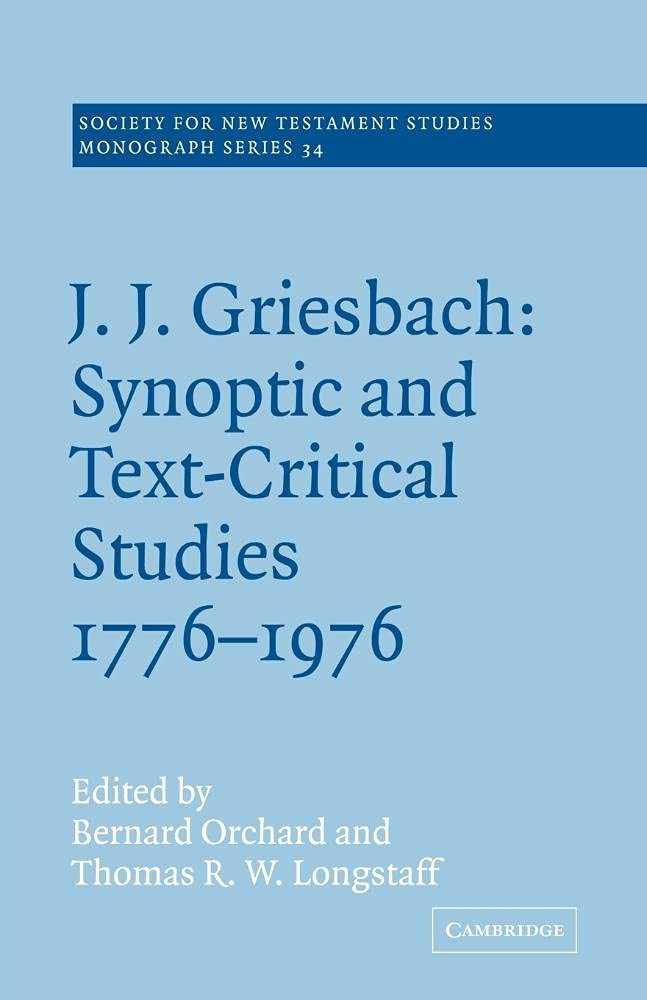
J. J. Griesbach: Synoptic and Text - Critical Studies 1776–1976 by Bernard Orchard – A Cambridge University Press Collec
Inclusive of all applicable taxes. FREE shipping on all orders.
Available Offers
- 🚚Free Delivery — Free shipping on all orders
- 💵Cash on Delivery — Pay when your order arrives
- ↩️15-Day Easy Returns — Hassle-free return policy
- 🔒Cash on Delivery — Pay safely when your order arrives
Check Delivery
Product Description
Introduction
For serious students of biblical scholarship, the name Johann Jakob Griesbach stands as a cornerstone of New Testament textual criticism and synoptic studies. This meticulously researched volume, curated by Bernard Orchard, commemorates the bicentenary of Griesbach's groundbreaking 1776 Greek Synopsis of Matthew, Mark, and Luke. Published by Cambridge University Press, this hardcover edition brings together landmark papers from the 1976 Griesbach Bicentenary Colloquium held in Münster, offering an authoritative exploration of Griesbach's life, methods, and enduring legacy. Whether you are a theologian, a seminary student, or a scholar of early Christian literature, this book provides an indispensable resource for understanding the foundations of modern Gospel criticism.
Book Overview
J. J. Griesbach: Synoptic and Text - Critical Studies 1776–1976 is a collection of scholarly papers presented by an international team of biblical experts. The work examines Griesbach's dual contribution: his creation of the first standalone Greek Synopsis of the Synoptic Gospels, and his influential hypothesis that Mark's Gospel was dependent on both Matthew and Luke—a theory still debated today. The volume also delves into Griesbach's pioneering text-critical methods, which shaped the way scholars approach variant readings in New Testament manuscripts. This is not a book for casual reading but a deep dive into the intellectual history and technical aspects of biblical studies.
Key Highlights
- Bicentenary Tribute: Commemorates 200 years of Griesbach's seminal 1776 Synopsis, a foundational tool for Gospel research.
- Authoritative Contributors: Features papers from distinguished biblical scholars, offering diverse perspectives on Griesbach's work.
- Comprehensive Scope: Covers text criticism, the Synoptic Problem, and the evolution of the Greek Synopsis as a research instrument.
- Historical Context: Provides a detailed account of Griesbach's life and the intellectual environment of 18th-century German academia.
- Enduring Relevance: Explains why Griesbach's hypothesis and methods remain central to contemporary New Testament scholarship.
Inside the Book
The volume is organized thematically, beginning with biographical essays that situate Griesbach within the broader context of Enlightenment-era theology. Subsequent sections examine the technical development of the Greek Synopsis, including its layout, textual apparatus, and influence on subsequent synopses like those of Tischendorf and Aland. A major portion is devoted to the Griesbach Hypothesis (the Two-Gospel Hypothesis), with papers arguing for and against Markan priority. Text-critical studies analyze Griesbach's classification of manuscripts and his canons of criticism, which anticipated modern methodologies. The book also includes appendices with bibliographic references and indices.
Key Topics
- Johann Jakob Griesbach's biography and academic career
- History and methodology of the Greek Synopsis
- The Synoptic Problem: the Griesbach Hypothesis vs. the Two-Source Hypothesis
- Principles of New Testament textual criticism
- Manuscript classification and the development of critical editions
- Reception history of Griesbach's work in the 19th and 20th centuries
Reader Benefits
This book offers a unique opportunity to engage with primary research papers that shaped modern Gospel studies. By reading this collection, you gain a nuanced understanding of how textual criticism and source criticism intersect. You will learn to evaluate competing hypotheses about Gospel relationships, and appreciate the technical challenges involved in reconstructing the earliest Christian texts. For Indian students and scholars, this volume provides a rigorous academic framework that can enhance your own research or teaching in biblical studies, theology, or religious history.
Learning Outcomes
- Understand the historical significance of Griesbach's 1776 Synopsis and its role in New Testament scholarship
- Analyze the strengths and weaknesses of the Griesbach Hypothesis regarding Mark's dependence on Matthew and Luke
- Apply Griesbach's text-critical principles to the study of New Testament manuscripts
- Trace the evolution of synoptic tools from Griesbach to the present day
- Critically assess scholarly arguments for and against different solutions to the Synoptic Problem
Who Should Read
This book is essential for postgraduate students and researchers in New Testament studies, biblical theology, and early Christian history. It is also highly recommended for seminary professors, clergy with an interest in academic biblical criticism, and advanced undergraduates undertaking thesis work on the Synoptic Problem or textual criticism. Libraries supporting theological curricula will find this a valuable reference work. Indian readers engaged in interfaith dialogue or comparative religious studies will also benefit from the rigorous methodological insights presented here.
About the Author
Bernard Orchard (1910–2006) was a distinguished English Benedictine monk and biblical scholar. He served as the headmaster of St. Benedict's School in Ealing, London, and later as a visiting professor at the Pontifical Biblical Institute in Rome. Orchard is best known for his work on the Synoptic Problem, particularly his advocacy of the Griesbach Hypothesis, which he championed in several publications including this edited volume. His editorial role brought together leading voices in the field, ensuring a balanced and comprehensive treatment of Griesbach's legacy.
About the Publisher
Cambridge University Press is one of the oldest and most respected academic publishers in the world, with a history dating back to 1534. Known for its rigorous peer-review process and high editorial standards, Cambridge University Press publishes authoritative works across all disciplines, including theology, history, and linguistics. This hardcover edition reflects the Press's commitment to producing durable, scholarly volumes that stand the test of time—ideal for libraries and personal collections.
Conclusion
J. J. Griesbach: Synoptic and Text - Critical Studies 1776–1976 is a vital addition to the library of any serious biblical scholar. It not only honors the legacy of a pioneering figure but also provides a rich resource for ongoing debates about the origins of the Gospels. By bringing together seminal papers from a landmark colloquium, Bernard Orchard has created a work that continues to inform and inspire new generations of researchers. If you are committed to understanding the textual and literary foundations of the New Testament, this book is an indispensable guide.
Quick Summary
J. J. Griesbach: Synoptic and Text - Critical Studies 1776–1976, edited by Bernard Orchard, is a scholarly collection of papers presented at the Griesbach Bicentenary Colloquium held in Munster in 1976. The book commemorates Johann Jakob Griesbach's pioneering work in creating the first Greek synopsis of Matthew, Mark, and Luke, and his influential hypothesis on the literary relationship among these Gospels. The volume brings together contributions from an international group of biblical scholars, offering an authoritative examination of Griesbach's life, his text-critical methods, and the enduring significance of the Griesbach hypothesis. Readers will gain deep insights into the history of New Testament source criticism, the development of synoptic studies, and the scholarly debates surrounding Gospel origins. This book is essential for Indian theology students, seminary scholars, and academic researchers seeking a comprehensive understanding of 18th-century biblical criticism. By purchasing from Bookshops.in, customers receive a genuine Cambridge University Press hardcover edition, ensuring quality and authenticity for their academic library.
Book Highlights
Book Specifications
| ISBN-13 | 9780521020558 |
| ISBN-10 | 0521020557 |
| Publisher | Cambridge University Press |
| Language | English |
| Dimensions | 13.97 x 1.55 x 21.59 cm |
| Weight | 322 g |
| Country | India |
| Category | Religion & Spirituality › Christianity |
| Genre | Non-fiction |
| Original Language | English |
Frequently Asked Questions
What is the main subject of this book?
Who edited this volume?
Is this book suitable for Indian students?
Does this book include the original Greek text?
What is the Griesbach hypothesis?
When was the colloquium held?
What language is the book in?
Is this book part of a series?
What is the ISBN?
Can I use this book for my PhD research?
Does the book cover modern textual criticism?
Why buy from Bookshops.in?
Readers Also Search For
Customers Also Bought
Islam
Spiritual Economies (English, Daromir Rudnyckyj)

Islam
Who Is Allah? (English, Bruce B. Lawrence)
Islam
Islam and Liberal Citizenship: The Search for an Overlapping Consensus by Andrew F. March
Islam
Fiqh Us-Sunnah: Funerals and Diggers by Al-Sayyid Sabiq – Islamic Funeral Guide

Christianity
Genetics (English, Thomas a. Shannon | Mark P. Aulisio | Françoise Baylis)

Hinduism
Karma and Creativity by Christopher Key Chapple – Indian Philosophy
Related Products
View All
Christianity
The Past of Jesus in the Gospels by Eugene E. Lemcio – Biblical Studies

Christianity
Jesus' Sermon on the Mount: Mandating a Better Righteousness by Jack R. Lundbom – Biblical Commentar

Christianity
Prayer Book and Psalms: Pocket Edition by David Mitchell James
Christianity
Undocumented and in College by Terry-Ann Jones – Immigration Policy and Higher Education
Christianity
A Historical-Critical Study of the Book of Obadiah (English, Ehud Ben Zvi)
Christianity