
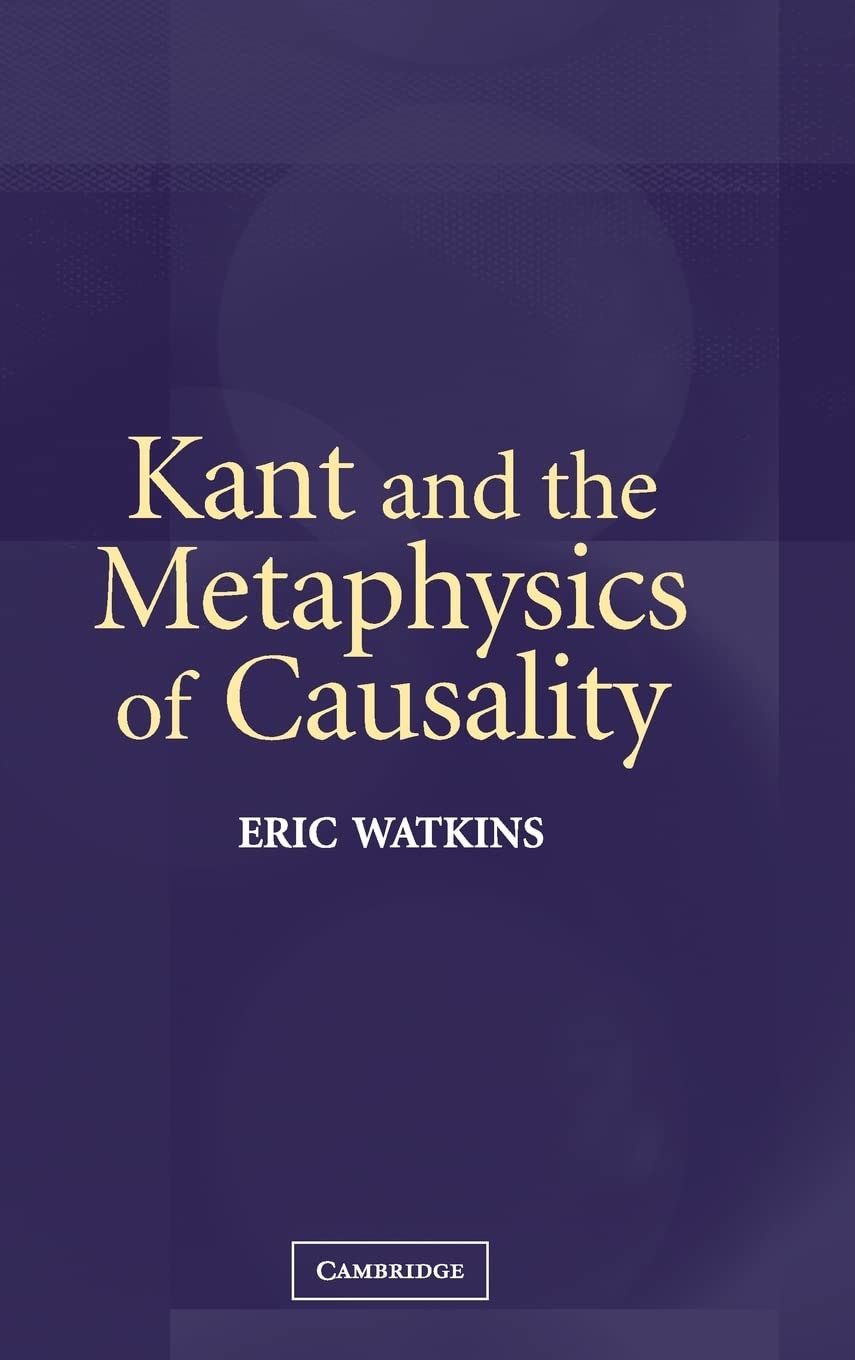
Kant and the Metaphysics of Causality: A Deep Dive into Kant's Causal Philosophy by Eric Watkins
Inclusive of all applicable taxes. FREE shipping on all orders.
Available Offers
- 🚚Free Delivery — Free shipping on all orders
- 💵Cash on Delivery — Pay when your order arrives
- ↩️15-Day Easy Returns — Hassle-free return policy
- 🔒Cash on Delivery — Pay safely when your order arrives
Check Delivery
Product Description
Introduction
In the vast landscape of Western philosophy, few figures stand as tall as Immanuel Kant, and few concepts are as foundational yet contentious as causality. Eric Watkins’ Kant and the Metaphysics of Causality offers a rigorous and illuminating exploration of Kant’s revolutionary ideas on causation, placing them firmly within the intellectual ferment of eighteenth-century Germany. This hardcover volume from Cambridge University Press is an indispensable resource for serious students of philosophy, metaphysics, and the history of science. For Indian readers and scholars engaged with Kantian thought, this book provides a fresh, historically grounded perspective that challenges conventional readings.
Book Overview
This scholarly work re-examines Kant’s critical philosophy by arguing that his model of causality is not about mere events following one another, but about substances endowed with causal powers. Watkins meticulously demonstrates how Kant’s views evolved in dialogue with Leibnizian and anti-Leibnizian traditions. The book reveals that Kant’s causal principles are neither purely metaphysical nor purely epistemological, but a sophisticated synthesis of both. By recovering the historical context, Watkins shows how Kant’s understanding of causality informs his entire critical project, including his views on time, freedom, and determinism.
Key Highlights
- Historically contextualized analysis: Situates Kant’s arguments within the rich debates of eighteenth-century German philosophy, moving beyond abstract interpretations.
- Original interpretation of causality: Proposes that Kant saw causality as a power inherent in substances, exercised according to their natures and circumstances, rather than as a relation between discrete events.
- Integration of metaphysics and epistemology: Shows how Kant’s causal principles bridge the gap between what we can know and what exists independently of us.
- Engagement with Hume’s skepticism: Offers a nuanced account of how Kant’s response to Hume is deeper and more systematic than commonly assumed.
- Addresses freedom and determinism: Provides a compelling reading of how Kant reconciled human freedom with a causally determined natural world.
Inside the Book
The book is structured to guide readers through Kant’s evolving thought. It begins by examining pre-Kantian German philosophy, particularly the Leibniz-Wolff tradition and its critics. Watkins then traces Kant’s early attempts to formulate a theory of causality, leading to the critical period of the Critique of Pure Reason. Detailed chapters analyze Kant’s Second Analogy of Experience, his treatment of causal powers, and the role of temporality. The final sections tackle the thorny issues of freedom and the transcendental ideal, showing how causality is central to Kant’s entire system. Each chapter is supported by careful textual analysis and engagement with secondary literature.
Key Topics
- Kant’s conception of substance and causal powers
- The Leibnizian and anti-Leibnizian background of Kant’s thought
- The distinction between phenomenal and noumenal causality
- Kant’s response to Hume’s problem of induction
- Time, succession, and the principle of sufficient reason
- Freedom of the will and moral agency in a determined world
- The role of nature and circumstances in causal explanation
Reader Benefits
This book equips readers with a deeper, more accurate understanding of one of philosophy’s most challenging topics. It clarifies why Kant’s causal theory is not a naive version of Hume’s but a sophisticated alternative. Scholars and students will benefit from the meticulous historical scholarship that corrects common misinterpretations. The book also enhances one’s grasp of Kant’s larger critical project, making it easier to engage with his ethics, aesthetics, and philosophy of science. For those preparing for competitive exams or advanced research, this volume offers authoritative insights that cut through decades of debate.
Learning Outcomes
- Understand the historical roots of Kant’s causal theory in early modern German philosophy.
- Analyze how Kant’s model of causality differs from event-based accounts.
- Evaluate Kant’s argument for the necessity of causal laws in experience.
- Critically assess Kant’s resolution of the free will versus determinism debate.
- Apply Kantian causal concepts to contemporary metaphysical discussions.
- Recognize the interplay between metaphysical and epistemological elements in Kant’s thought.
Who Should Read
This book is ideal for postgraduate students and researchers in philosophy, particularly those specializing in metaphysics, epistemology, or the history of modern philosophy. It is also highly valuable for undergraduate students taking advanced courses on Kant, as well as for scholars working on the philosophy of science, action theory, or early modern intellectual history. Indian readers pursuing M.Phil or Ph.D. programs in philosophy will find this work essential for their thesis work. Moreover, anyone with a serious interest in understanding how causality shapes our world will be rewarded by Watkins’ clear yet profound analysis.
About the Author
Eric Watkins is a distinguished professor of philosophy at the University of California, San Diego. He is a leading authority on Kant and early modern German philosophy. His research focuses on metaphysics, philosophy of science, and the history of philosophy. Watkins has authored and edited several acclaimed works, including Kant’s Critique of Pure Reason: Background Source Materials and The Divine Order, the Human Order, and the Order of Nature. His scholarship is known for its rigorous historical grounding and philosophical precision.
About the Publisher
Cambridge University Press is one of the oldest and most prestigious academic publishers in the world. Founded in 1534, it has a long tradition of publishing landmark works in philosophy, science, and the humanities. This hardcover edition reflects the press’s commitment to high-quality scholarship, with durable binding and clear typography. For Indian readers, Cambridge University Press titles are widely recognized as gold standards in academic publishing, ensuring reliability and academic rigor.
Conclusion
Kant and the Metaphysics of Causality by Eric Watkins is not merely a commentary on Kant, but a transformative reading that reshapes our understanding of one of philosophy’s central concepts. By restoring the historical context and offering a bold new interpretation, Watkins makes a compelling case for seeing Kant’s causality as a dynamic power inherent in substances. This hardcover volume is a must-have for any serious philosophy library in India, whether for academic study, research, or personal intellectual growth. Dive into this masterwork and discover how Kant’s metaphysics of causality remains profoundly relevant to our understanding of reality, freedom, and knowledge.
Quick Summary
Kant and the Metaphysics of Causality by Eric Watkins is a rigorous academic work that reinterprets Kant's theory of causality within the framework of 18th-century German philosophy. Watkins argues that Kant, influenced by Leibnizian and anti-Leibnizian thought, conceived causality not as a relation between events but as the exercise of causal powers inherent in substances. This perspective integrates both metaphysical and epistemological dimensions, offering a unified account that addresses Kant's views on temporality, freedom versus determinism, and his response to Humean skepticism. The book is ideal for advanced philosophy students, researchers, and scholars of Kantian metaphysics. By grounding Kant's ideas in their historical context, Watkins provides a nuanced understanding that challenges conventional interpretations. Readers will gain deep insights into Kant's critical philosophy and its lasting impact. Purchasing this hardcover edition from Bookshops.in ensures you receive a premium copy from India's trusted bookstore, delivered with care.
Book Highlights
Book Specifications
| ISBN-13 | 9780521835671 |
| ISBN-10 | 0521835674 |
| Publisher | Cambridge University Press |
| Language | English |
| Dimensions | 15.24 x 3.18 x 22.86 cm |
| Weight | 720 g |
| Category | Philosophy › Epistemology |
| Genre | Non-fiction |
| Original Language | English |
Frequently Asked Questions
What is the main argument of Kant and the Metaphysics of Causality?
Who is the author of this book?
Is this book suitable for undergraduate students?
How does this book relate to David Hume?
Does the book cover Kant's views on freedom?
What is the historical context of this book?
Is this a hardcover book?
What is the ISBN-13?
Can I use this book for a research paper on Kant?
Does the book discuss Kant's view of time?
Is this book available in Indian bookstores?
What makes this book different from other Kant studies?
Readers Also Search For
Customers Also Bought
Islam
Spiritual Economies (English, Daromir Rudnyckyj)

Islam
Who Is Allah? (English, Bruce B. Lawrence)
Islam
Islam and Liberal Citizenship: The Search for an Overlapping Consensus by Andrew F. March

Islam
Fiqh Us-Sunnah: Funerals and Diggers by Al-Sayyid Sabiq – Islamic Funeral Guide

Christianity
Genetics (English, Thomas a. Shannon | Mark P. Aulisio | Françoise Baylis)

Hinduism
Karma and Creativity by Christopher Key Chapple – Indian Philosophy
Related Products
View All
Philosophy
Latin American Philosophy: Currents, Issues, Debates by Eduardo Mendieta

Philosophy
Al-Farabi's Short Commentary on Aristotle's Prior Analytics by Nicholas Rescher – Philosophy
Philosophy
Poetics of Imagining: Modern to Post-modern by Richard Kearney
Philosophy
The Metaphysics of Extrinsic Properties: 11 (Metaphysical Research, 11)
Philosophy
Dialogues on Metaphysics and on Religion by Nicolas Malebranche – Philosophy
Philosophy