
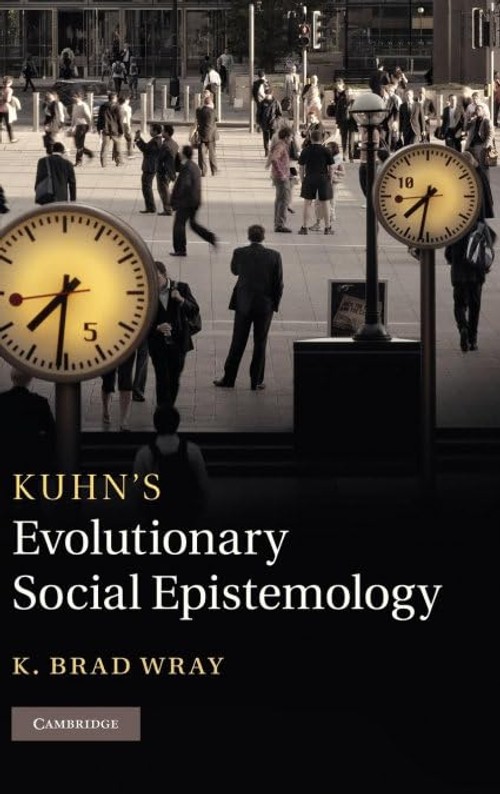
Kuhn's Evolutionary Social Epistemology by K. Brad Wray – A Comprehensive Study of Thomas Kuhn's Philosophy of Science a
Inclusive of all applicable taxes. FREE shipping on all orders.
Available Offers
- 🚚Free Delivery — Free shipping on all orders
- 💵Cash on Delivery — Pay when your order arrives
- ↩️15-Day Easy Returns — Hassle-free return policy
- 🔒Cash on Delivery — Pay safely when your order arrives
Check Delivery
Product Description
Introduction
Thomas Kuhn’s The Structure of Scientific Revolutions remains one of the most influential works in the philosophy of science. Yet, for decades, his ideas have been misunderstood—often dismissed as relativistic or socially constructed. In Kuhn's Evolutionary Social Epistemology, K. Brad Wray offers a fresh and rigorous reinterpretation, showing how Kuhn’s framework actually provides a robust foundation for an epistemology that embraces the constructive role of social factors in scientific inquiry. This hardcover edition from Cambridge University Press is an essential resource for scholars, students, and anyone curious about how science truly evolves.
Book Overview
Wray systematically unpacks the core concepts of Structure—paradigms, incommensurability, revolutionary science, and normal science—and connects them to Kuhn’s later, more mature writings. The book argues that Kuhn’s view is not a threat to scientific rationality but a sophisticated evolutionary and social epistemology. By examining landmark episodes like the Copernican revolution in astronomy and the plate tectonics revolution in geology, Wray demonstrates how scientific change is both a social and a rational process. This is not a mere commentary; it is a transformative reading that reclaims Kuhn for a new generation.
Key Highlights
- Original Reinterpretation: Challenges the common misreading of Kuhn as a relativist, presenting him instead as a pioneer of social epistemology.
- Evolutionary Framework: Shows how scientific knowledge grows through a Darwinian process of variation, selection, and retention—not just through accumulation.
- Case Studies: Detailed analyses of the Copernican and plate tectonics revolutions bring abstract ideas to life.
- Bridge to Later Kuhn: Connects the revolutionary ideas of 1962 with Kuhn’s nuanced later work on taxonomy, language, and scientific development.
- Interdisciplinary Appeal: Written for philosophers, sociologists, historians, and scientists alike.
Inside the Book
This hardbound volume is structured to guide readers from foundational concepts to advanced applications. Early chapters clarify Kuhn’s notion of paradigms and the nature of scientific revolutions. Middle chapters delve into the social dimensions of knowledge—how communities of scientists negotiate consensus, handle anomalies, and achieve paradigm shifts. The final chapters develop a full-fledged evolutionary epistemology, arguing that scientific progress is best understood as an adaptive process. Wray’s prose is clear and argumentative, making complex ideas accessible without oversimplification.
Key Topics
- Paradigms and their role in normal science
- Incommensurability and the possibility of rational theory choice
- The social construction of scientific facts
- Scientific revolutions as evolutionary events
- Kuhn’s later work on taxonomic categories and natural kinds
- Case studies: Copernican revolution, plate tectonics revolution
- Relativism vs. rationalism in science studies
- Epistemic values and scientific communities
Reader Benefits
By engaging with this book, you will gain a deeper appreciation for how science actually works—not as a solitary march toward truth, but as a communal, evolving enterprise. You will learn to critically evaluate common critiques of Kuhn and see why his ideas remain vital for contemporary debates in science studies. The book equips you with conceptual tools to analyze scientific controversies, understand resistance to new theories, and appreciate the role of social consensus in shaping knowledge. Whether you are a student preparing for exams or a researcher seeking fresh perspectives, this volume will sharpen your thinking.
Learning Outcomes
- Understand the core arguments of Kuhn’s Structure of Scientific Revolutions in their proper context.
- Distinguish between evolutionary epistemology and social epistemology, and see how they complement each other.
- Analyze historical scientific revolutions through a Kuhnian lens.
- Critique simplistic portrayals of science as either purely objective or purely social.
- Apply Kuhn’s concepts to contemporary issues in scientific practice and policy.
Who Should Read
This book is ideal for advanced undergraduate and postgraduate students in philosophy of science, sociology of science, history of science, and science and technology studies (STS). It will also appeal to practicing scientists curious about the philosophical foundations of their discipline, as well as scholars in epistemology and social theory. Indian readers, especially those in academic institutions with strong science and humanities programmes, will find this a valuable addition to their library. No prior expertise in Kuhn is required—though familiarity with basic philosophy of science concepts will enhance the reading experience.
About the Author
K. Brad Wray is a professor of philosophy at the University of Oslo, known for his work on the social dimensions of scientific knowledge. He has published extensively on Kuhn, scientific change, and collective epistemology. His scholarship is marked by clear argumentation and a commitment to making philosophy of science relevant to practicing scientists and historians. Wray’s deep engagement with both primary sources and contemporary debates makes him one of the leading interpreters of Kuhn’s legacy.
About the Publisher
Cambridge University Press is one of the world’s oldest and most prestigious academic publishers, with a strong reputation for quality in philosophy, science, and the humanities. Founded in 1534, it has a long tradition of disseminating rigorous scholarship. This hardcover edition is produced to the highest standards of binding and print, ensuring durability for years of reference and study. For Indian readers, Cambridge University Press titles are widely available and respected in university libraries across the country.
Conclusion
Kuhn's Evolutionary Social Epistemology is more than a commentary—it is a necessary corrective to decades of misinterpretation. K. Brad Wray offers a compelling case that Kuhn’s vision of science is both social and rational, evolutionary and progressive. For anyone serious about understanding how scientific knowledge grows and changes, this book is a vital resource. Add this hardcover edition to your collection and discover a Kuhn who is not a relativist, but a sophisticated epistemologist for our times.
Quick Summary
Kuhn's Evolutionary Social Epistemology by K. Brad Wray is a rigorous academic work that re-evaluates Thomas Kuhn's legacy in philosophy of science. The book argues that Kuhn's framework, often misread as relativistic or social constructionist, actually provides a coherent evolutionary social epistemology. Wray examines core concepts from Kuhn's Structure of Scientific Revolutions—such as paradigms, normal science, and incommensurability—and connects them with Kuhn's later writings to show how social factors play a constructive role in scientific inquiry. The book is intended for postgraduate students, researchers, and academics in philosophy, epistemology, and science studies. Readers will learn how scientific knowledge grows through social processes and why Kuhn's view remains relevant today. Published by Cambridge University Press, this hardcover edition is available at Bookshops.in, India's trusted online bookstore, offering reliable delivery and genuine products for the academic community.
Book Highlights
Book Specifications
| ISBN-13 | 9781107012233 |
| ISBN-10 | 1107012236 |
| Publisher | Cambridge University Press |
| Language | English |
| Dimensions | 15.24 x 1.27 x 22.86 cm |
| Weight | 500 g |
| Country | India |
| Category | Philosophy › Epistemology |
| Genre | Non-fiction |
| Original Language | English |
Frequently Asked Questions
What is Kuhn's Evolutionary Social Epistemology about?
Who is the author of this book?
Is this book suitable for Indian students?
Does the book cover Kuhn's later writings?
What is the main argument of the book?
Is this book a hardcover or paperback?
Can I use this book for my university course?
Does the book discuss the Copernican Revolution?
What is the ISBN of this book?
Is this book available at Bookshops.in?
What is the price of this book?
Who should read this book?
Does the book challenge common views about Kuhn?
Readers Also Search For
Customers Also Bought

Islam
Spiritual Economies (English, Daromir Rudnyckyj)

Islam
Who Is Allah? (English, Bruce B. Lawrence)

Islam
Islam and Liberal Citizenship: The Search for an Overlapping Consensus by Andrew F. March

Islam
Fiqh Us-Sunnah: Funerals and Diggers by Al-Sayyid Sabiq – Islamic Funeral Guide

Christianity
Genetics (English, Thomas a. Shannon | Mark P. Aulisio | Françoise Baylis)

Hinduism
Karma and Creativity by Christopher Key Chapple – Indian Philosophy
Related Products
View All
Philosophy
Latin American Philosophy: Currents, Issues, Debates by Eduardo Mendieta

Philosophy
Al-Farabi's Short Commentary on Aristotle's Prior Analytics by Nicholas Rescher – Philosophy

Philosophy
Poetics of Imagining: Modern to Post-modern by Richard Kearney

Philosophy
The Metaphysics of Extrinsic Properties: 11 (Metaphysical Research, 11)

Philosophy
Dialogues on Metaphysics and on Religion by Nicolas Malebranche – Philosophy

Philosophy