
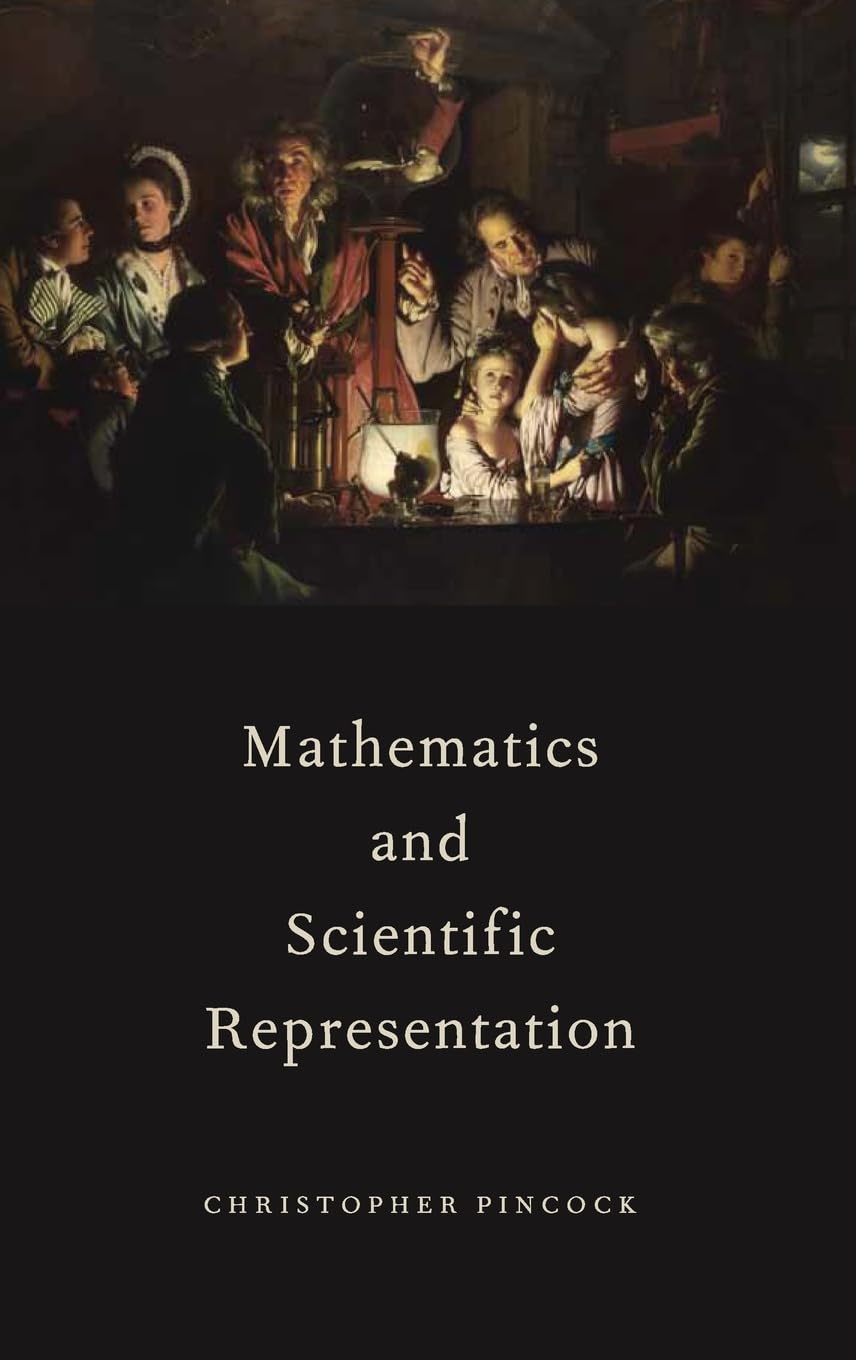
Mathematics and Scientific Representation by Christopher Pincock – A Philosophical Inquiry into the Role of Math in Scie
Inclusive of all applicable taxes. FREE shipping on all orders.
Available Offers
- 🚚Free Delivery — Free shipping on all orders
- 💵Cash on Delivery — Pay when your order arrives
- ↩️15-Day Easy Returns — Hassle-free return policy
- 🔒Cash on Delivery — Pay safely when your order arrives
Check Delivery
Product Description
Introduction
Mathematics is the silent engine behind many of the most powerful scientific theories, yet its precise role in shaping our understanding of the natural world remains a deep philosophical puzzle. In Mathematics and Scientific Representation, Christopher Pincock offers a fresh and rigorous exploration of how mathematical structures contribute to the success of scientific knowledge. Written for scholars, students, and curious readers alike, this hardcover volume from Oxford University Press bridges the gap between abstract mathematics and concrete scientific practice. Pincock’s work is essential for anyone seeking to grasp the epistemic foundations of modern science, where equations are not just tools but integral components of representation.
Book Overview
This book addresses a fundamental question that has long troubled philosophers and scientists: What exactly does mathematics do for science? Pincock moves beyond traditional debates about mathematical realism or nominalism to focus instead on the function of mathematics in scientific representation. He develops a novel framework that identifies how mathematical content enriches scientific models, theories, and explanations. The first half of the book clarifies the concept of scientific representation and outlines several distinct contributions that mathematics makes—from enabling precise predictions to structuring explanatory narratives. The second half critically examines alternative philosophical accounts, including those that emphasize scientific discovery and explanation. Throughout, Pincock argues that mathematics ultimately serves an epistemic purpose, enhancing our capacity to know the world.
Key Highlights
- Original Framework: Introduces a new way to assess how mathematics contributes to scientific knowledge by focusing on representation.
- Epistemic Focus: Argues that mathematics primarily boosts our scientific knowledge rather than merely serving as a convenient notation.
- Critical Engagement: Engages with major contemporary philosophies of mathematics in science, including structuralism and nominalism.
- Interdisciplinary Appeal: Bridges philosophy of science, philosophy of mathematics, and actual scientific practice.
- Rigorous Yet Accessible: Written with clarity for advanced undergraduates, graduate students, and professional researchers.
Inside the Book
The book is structured in two main parts. Part I begins by establishing a precise account of what it means for a scientific theory to represent the world. Pincock then identifies four distinct ways mathematics contributes: through epistemic reliability, explanatory power, predictive accuracy, and unification of diverse phenomena. Each contribution is illustrated with examples from physics, biology, and economics. Part II turns to a critical evaluation of rival views, such as the claim that mathematics aids scientific discovery or that it provides genuine explanations. Pincock carefully dissects these positions, showing where they fall short and how his own epistemic account offers a more comprehensive understanding. The book concludes with reflections on the implications for both philosophy and scientific practice.
Key Topics
- Scientific representation and its content
- Epistemic contributions of mathematics to science
- Mathematical explanation vs. scientific explanation
- Structural realism and mathematical structuralism
- Indispensability arguments in philosophy of mathematics
- Case studies from classical and modern physics
- Mathematics in the social and biological sciences
- Philosophical methodology for analysing scientific theories
Reader Benefits
Readers will gain a clear understanding of why mathematics is not merely a language but a vital epistemic resource. Pincock’s detailed argumentation helps clarify long-standing debates in philosophy of science, making this book a valuable resource for coursework and research. By focusing on representation, the book offers practical insights for scientists who use mathematics in their work and for philosophers who wish to ground their theories in real scientific examples. The rigorous yet engaging style ensures that even complex ideas become accessible.
Learning Outcomes
- Understand the different ways mathematics supports scientific knowledge
- Critically evaluate philosophical arguments about the role of mathematics in science
- Analyze scientific theories through the lens of representation
- Apply Pincock’s framework to contemporary scientific debates
- Develop a nuanced perspective on the relationship between mathematics and reality
Who Should Read
This book is ideal for advanced undergraduate and postgraduate students in philosophy of science, philosophy of mathematics, and theoretical science. It is also highly relevant for researchers in physics, economics, and biology who are interested in the foundational assumptions of their disciplines. General readers with a background in philosophy or mathematics will find Pincock’s arguments both stimulating and rewarding. Indian students and academics engaged in interdisciplinary studies will particularly appreciate the clear exposition and the integration of diverse scientific examples.
About the Author
Christopher Pincock is a professor of philosophy at the University of California, Irvine. He specializes in philosophy of science, philosophy of mathematics, and epistemology. His research focuses on how mathematical methods shape scientific knowledge, and he has published extensively on topics such as scientific representation, mathematical explanation, and the history of philosophy of science. Pincock is known for his clear, systematic approach and his ability to connect abstract philosophical questions to concrete scientific practice.
About the Publisher
Oxford University Press is one of the world’s oldest and most respected academic publishers, with a rich history of producing authoritative works in philosophy, science, and the humanities. Their commitment to scholarly excellence ensures that each title meets the highest standards of rigor and accessibility. This hardcover edition of Mathematics and Scientific Representation reflects OUP’s tradition of publishing transformative ideas that shape intellectual discourse globally.
Conclusion
Mathematics and Scientific Representation is a landmark contribution to the philosophy of science that reorients our understanding of mathematics’ role in human knowledge. Christopher Pincock’s careful analysis and original framework make this book indispensable for anyone serious about the foundations of science. Whether you are a philosopher, a scientist, or a curious student, this volume will deepen your appreciation of how mathematics helps us represent, understand, and know the world. Order your copy today from Bookshops.in and add this essential work to your library.
Quick Summary
Mathematics and Scientific Representation by Christopher Pincock is a rigorous philosophical work that investigates the precise ways mathematics enables scientific knowledge. Rather than asking whether mathematical objects exist, Pincock shifts the focus to how mathematical structures function within scientific representations to produce epistemic benefits. The book first clarifies the concept of scientific representation content, then identifies several distinct contributions mathematics makes—such as enabling inferences, providing explanatory power, and facilitating modeling. Each contribution is analyzed through real scientific examples, showing how mathematics is not merely a convenient language but an active epistemic tool. This book is ideal for graduate students, researchers, and academics in philosophy of science and mathematics, as well as scientists curious about the foundations of their disciplines. Readers will gain a nuanced understanding of the relationship between mathematics and scientific practice, equipping them with conceptual tools to evaluate scientific theories. Purchasing from Bookshops.in ensures you receive an authentic Oxford University Press hardcover at a fair price, delivered to your doorstep in India.
Book Highlights
Book Specifications
| ISBN-13 | 9780199757107 |
| ISBN-10 | 0199757100 |
| Publisher | OUP USA |
| Language | English |
| Dimensions | 23.62 x 3.3 x 15.49 cm |
| Weight | 599 g |
| Category | Philosophy › Logic |
| Genre | Nonfiction |
| Reading Age | Adult |
| Original Language | English |
Frequently Asked Questions
What is the main argument of Mathematics and Scientific Representation?
Who is the author Christopher Pincock?
Is this book suitable for undergraduate students?
Does the book cover mathematical realism?
What is the ISBN of this book?
Is this book part of a series?
What language is the book written in?
Can I use this book for a course on philosophy of science?
Does the book include examples from actual science?
What makes this book different from other philosophy of math books?
Is the book available in paperback?
Who is the publisher?
Why buy from Bookshops.in?
Readers Also Search For
Customers Also Bought

Islam
Spiritual Economies (English, Daromir Rudnyckyj)

Islam
Who Is Allah? (English, Bruce B. Lawrence)

Islam
Islam and Liberal Citizenship: The Search for an Overlapping Consensus by Andrew F. March

Islam
Fiqh Us-Sunnah: Funerals and Diggers by Al-Sayyid Sabiq – Islamic Funeral Guide

Christianity
Genetics (English, Thomas a. Shannon | Mark P. Aulisio | Françoise Baylis)

Hinduism
Karma and Creativity by Christopher Key Chapple – Indian Philosophy
Related Products
View All
Philosophy
Latin American Philosophy: Currents, Issues, Debates by Eduardo Mendieta

Philosophy
Al-Farabi's Short Commentary on Aristotle's Prior Analytics by Nicholas Rescher – Philosophy

Philosophy
Poetics of Imagining: Modern to Post-modern by Richard Kearney

Philosophy
The Metaphysics of Extrinsic Properties: 11 (Metaphysical Research, 11)
Philosophy
Dialogues on Metaphysics and on Religion by Nicolas Malebranche – Philosophy
Philosophy