
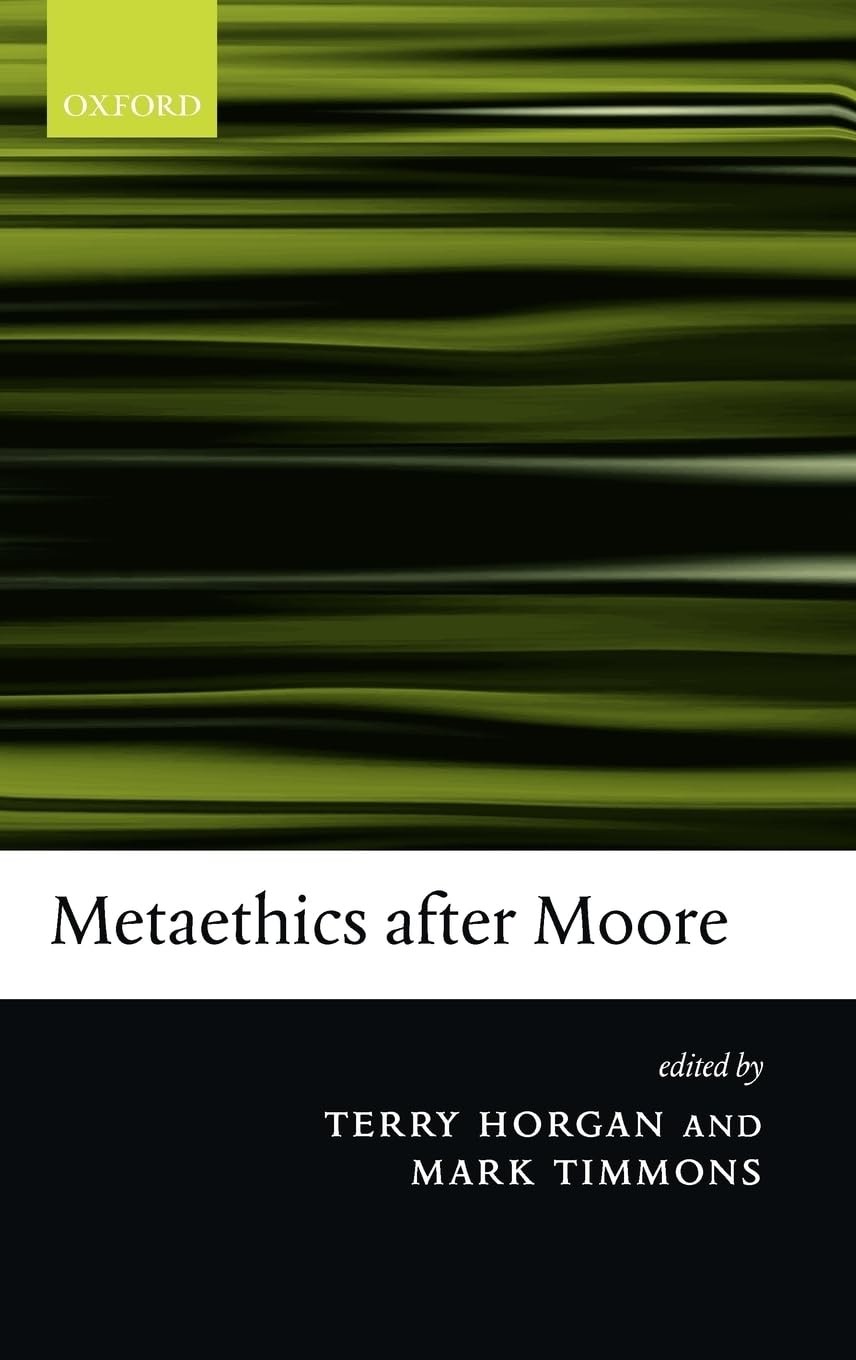
Metaethics After Moore: Contemporary Essays on Moral Philosophy by Terry Horgan – OUP Oxford
Inclusive of all applicable taxes. FREE shipping on all orders.
Available Offers
- 🚚Free Delivery — Free shipping on all orders
- 💵Cash on Delivery — Pay when your order arrives
- ↩️15-Day Easy Returns — Hassle-free return policy
- 🔒Cash on Delivery — Pay safely when your order arrives
Check Delivery
Product Description
Introduction
Metaethics After Moore is a landmark volume that explores the evolution of metaethical thought in the wake of G. E. Moore’s revolutionary work, Principia Ethica. Edited by Terry Horgan, this collection brings together sixteen original essays from some of the most influential philosophers of our time. For Indian students and scholars delving into the depths of moral philosophy, this hardbound edition offers a rigorous yet accessible gateway to understanding how metaethics has developed as a distinct branch of ethics. Whether you are preparing for advanced studies in philosophy or simply wish to engage with the foundational questions of morality, this book provides an indispensable resource.
Book Overview
This volume traces the trajectory of metaethics from Moore’s early twentieth-century insights to contemporary debates. While normative ethics asks what is good or right, metaethics steps back to examine the very nature of moral language, truth, and knowledge. The essays here address core issues such as moral realism, expressivism, error theory, and the semantics of moral discourse. Each chapter builds on or challenges Moore’s legacy, making the book a dynamic conversation across generations of thinkers. The contributors—including Robert Audi, Allan Gibbard, Michael Smith, and Judith Jarvis Thomson—offer diverse perspectives that reflect the richness of current metaethical scholarship.
Key Highlights
- Original Essays: Sixteen specially commissioned chapters, most never published before, providing fresh insights into metaethics.
- Influential Contributors: Features leading philosophers like Stephen Darwall, Russ Shafer-Landau, and Connie Rosati, ensuring depth and authority.
- Moore’s Enduring Legacy: Directly engages with Moore’s open-question argument and naturalistic fallacy, showing their relevance today.
- Critical Debates: Explores tensions between moral realism and anti-realism, cognitivism and non-cognitivism, and more.
- Indian Context: While rooted in Western analytic philosophy, the discussions resonate with universal questions about morality that are central to Indian philosophical traditions.
Inside the Book
The collection is structured around key themes that have defined metaethics after Moore. Early chapters revisit Moore’s own arguments, examining their strengths and weaknesses. Later essays push into new territory, including the role of moral psychology, the nature of moral facts, and the implications of evolutionary biology for ethics. Readers will find close analyses of moral language, the possibility of moral knowledge, and the metaphysics of value. The book also includes contributions on moral motivation, practical reason, and the relationship between metaethics and normative ethics. Each essay is self-contained but gains depth when read alongside the others, making the volume ideal for both course adoption and independent study.
Key Topics
- G. E. Moore’s open-question argument and its critics
- Moral realism vs. expressivism
- Error theory and moral skepticism
- Semantics of moral terms and sentences
- Moral epistemology and intuitionism
- Naturalism and non-naturalism in ethics
- Moral psychology and motivation
- Practical reason and moral judgment
- Evolutionary debunking arguments
- Metaethics and normative ethical theory
Reader Benefits
- Gain a thorough grounding in the central debates of contemporary metaethics.
- Understand how Moore’s ideas continue to shape philosophical inquiry.
- Access cutting-edge arguments from top scholars in the field.
- Develop critical thinking skills applicable to ethics, logic, and philosophy of language.
- Enhance your ability to analyze moral concepts and arguments in academic and everyday contexts.
Learning Outcomes
By engaging with Metaethics After Moore, readers will be able to: identify and evaluate key metaethical positions; articulate the strengths and weaknesses of Moore’s legacy; analyze the semantics of moral language with precision; assess arguments for and against moral realism; connect metaethical theories to broader philosophical issues; and apply these insights to contemporary ethical debates in fields like law, politics, and social sciences. The book is designed to move readers from foundational understanding to advanced critical engagement.
Who Should Read
This book is essential for postgraduate and advanced undergraduate students in philosophy, particularly those specializing in ethics or metaethics. It is also valuable for researchers in moral psychology, political theory, and legal philosophy who wish to engage with the conceptual foundations of their disciplines. Indian readers with an interest in analytic philosophy or comparative ethics will find the discussions intellectually stimulating. Professors and instructors will appreciate the breadth of coverage and the quality of the contributions for course design. Anyone curious about the deep questions of morality—what it means to call something good or right—will find this volume rewarding.
About the Author
Terry Horgan is a distinguished professor of philosophy at the University of Arizona, widely recognized for his contributions to metaethics, philosophy of mind, and metaphysics. He has published extensively on moral realism, expressivism, and the nature of moral judgment. His editorial work on this volume reflects his commitment to advancing philosophical dialogue across traditions. Horgan’s own essays in the book further demonstrate his innovative approach to longstanding problems in ethics.
About the Publisher
Oxford University Press (OUP) is one of the world’s oldest and most respected academic publishers, with a strong presence in India. OUP’s philosophy list includes seminal works that shape contemporary scholarship. This hardcover edition, published by OUP Oxford, upholds the press’s tradition of rigorous editorial standards and high-quality production, making it a durable addition to any library.
Conclusion
Metaethics After Moore is not just a collection of essays; it is a vibrant map of the terrain of modern metaethics. For Indian readers seeking to understand the philosophical underpinnings of moral thought, this book offers both depth and breadth. By bringing together the voices of leading scholars, Terry Horgan has created a volume that will inform and inspire students, researchers, and anyone passionate about the foundations of ethics. Add this hardbound treasure to your collection and join the ongoing conversation that began with Moore over a century ago.
Quick Summary
Metaethics After Moore, edited by Terry Horgan, is a landmark collection of sixteen original essays that chart the course of metaethics in the wake of G. E. Moore's revolutionary work, Principia Ethica. This volume brings together some of the most influential philosophers of our time—including Robert Audi, Allan Gibbard, Jonathan Dancy, and Stephen Darwall—to examine the second-order questions that define metaethics: What does moral language mean? Do moral properties exist? How can we have moral knowledge? The essays delve into topics such as moral realism, expressivism, intuitionism, and the naturalistic fallacy, offering a comprehensive overview of contemporary debates. This book is ideal for postgraduate students, researchers, and professors in philosophy departments across India who seek to deepen their understanding of moral theory. Readers will gain critical insights into the semantics, metaphysics, and epistemology of morality, and learn how Moore's legacy continues to shape philosophical inquiry. By purchasing from Bookshops.in, customers receive a genuine hardcover edition with fast, reliable shipping and excellent customer service, making it a valuable addition to any academic library.
Book Highlights
Book Specifications
| ISBN-13 | 9780199269907 |
| ISBN-10 | 0199269904 |
| Publisher | Clarendon Pr |
| Language | English |
| Dimensions | 23.39 x 2.39 x 15.6 cm |
| Weight | 762 g |
| Category | Philosophy › Ethics |
| Genre | Philosophy |
| Original Language | English |
Frequently Asked Questions
What is Metaethics After Moore about?
Who edited Metaethics After Moore?
Is this book suitable for beginners in philosophy?
Does the book include contributions from Indian philosophers?
What is the ISBN of Metaethics After Moore?
Is this book available in hardcover?
Who are some of the contributors to this volume?
What is the price of Metaethics After Moore?
Can I use this book for my PhD research?
Does the book cover moral realism?
Is this book part of a series?
What is the language of the book?
Why should I buy this book from Bookshops.in?
Readers Also Search For
Customers Also Bought
Islam
Spiritual Economies (English, Daromir Rudnyckyj)

Islam
Who Is Allah? (English, Bruce B. Lawrence)
Islam
Islam and Liberal Citizenship: The Search for an Overlapping Consensus by Andrew F. March
Islam
Fiqh Us-Sunnah: Funerals and Diggers by Al-Sayyid Sabiq – Islamic Funeral Guide

Christianity
Genetics (English, Thomas a. Shannon | Mark P. Aulisio | Françoise Baylis)

Hinduism
Karma and Creativity by Christopher Key Chapple – Indian Philosophy
Related Products
View All
Philosophy
The Metaphysics of Extrinsic Properties: 11 (Metaphysical Research, 11)
Philosophy
Dialogues on Metaphysics and on Religion by Nicolas Malebranche – Philosophy
Philosophy
Metaphysics and Oppression: Heidegger's Challenge to Western Philosophy by John McCumber

Philosophy
Merleau-Ponty's Philosophy by Lawrence Hass – Phenomenology & Continental Philosophy
Philosophy
Feminism, Capitalism, and Ecology
Philosophy