
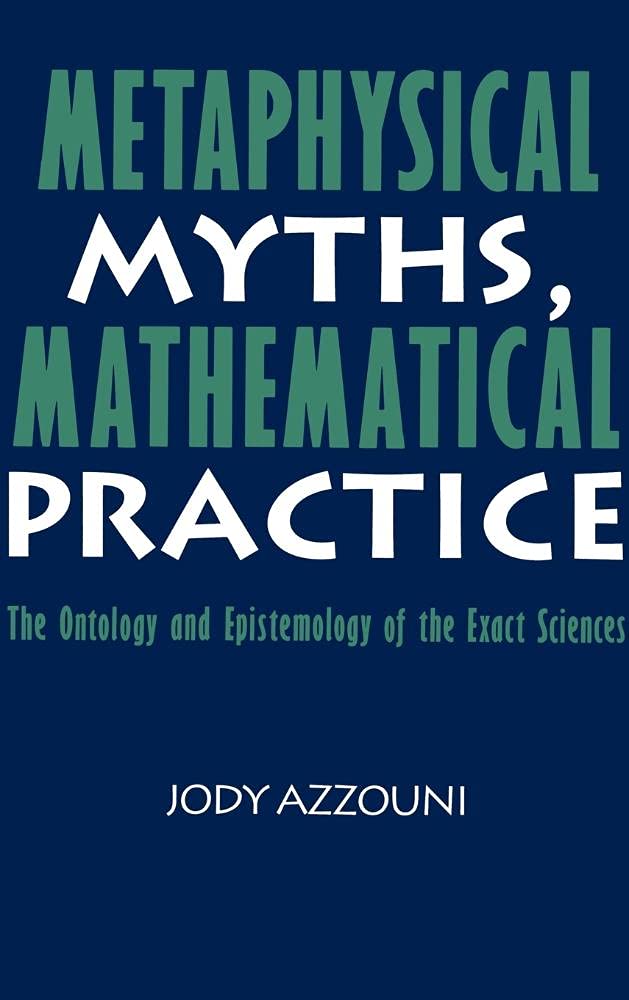
Metaphysical Myths, Mathematical Practice: The Ontology and Epistemology of the Exact Sciences by Jody Azzouni – A Criti
Inclusive of all applicable taxes. FREE shipping on all orders.
Available Offers
- 🚚Free Delivery — Free shipping on all orders
- 💵Cash on Delivery — Pay when your order arrives
- ↩️15-Day Easy Returns — Hassle-free return policy
- 🔒Cash on Delivery — Pay safely when your order arrives
Check Delivery
Product Description
Introduction
In the vast landscape of philosophical inquiry into mathematics, few works challenge conventional wisdom as boldly as Jody Azzouni's Metaphysical Myths, Mathematical Practice: The Ontology and Epistemology of the Exact Sciences. This hardbound volume from Cambridge University Press invites Indian students, researchers, and scholars to rethink long-held assumptions about the nature of mathematical knowledge. Rather than forcing mathematics into the mold of empirical science, Azzouni offers a refreshing perspective that honors the unique character of mathematical practice itself.
Book Overview
This seminal work tackles a fundamental tension in the philosophy of mathematics: how can we claim to know truths about abstract objects like numbers, sets, and functions when these entities seem inaccessible to our senses? Azzouni navigates this puzzle with precision, arguing that mathematical knowledge is a special kind of cognition with its own distinctive methods of gathering evidence. He systematically dismantles the notion that mathematical truths must be justified by the same epistemic standards we apply to physics or biology. Instead, he reveals how mathematicians operate within a framework that is both rigorous and autonomous, shaped by practice rather than metaphysical prejudice.
Key Highlights
- Original thesis: Mathematical knowledge is not reducible to empirical knowledge; it has its own unique evidential basis.
- Critical analysis: Exposes common linguistic pitfalls and misperceptions that have misled philosophers for decades.
- Practice-oriented approach: Centers on how mathematicians actually work, rather than imposing external philosophical constraints.
- Clarity in complexity: Makes dense ontological and epistemological debates accessible without oversimplification.
- Interdisciplinary relevance: Bridges philosophy, mathematics, and cognitive science for a holistic understanding.
Inside the Book
The book unfolds in carefully argued chapters that first identify the metaphysical myths surrounding mathematical objects—such as the view that numbers must exist in a platonic realm to be meaningful. Azzouni then examines the epistemological challenges, questioning why we trust mathematical proofs when they involve entities we cannot observe. He introduces the concept of “algorithmic epistemology” to explain how mathematical practice generates reliable knowledge without requiring direct perceptual access. Throughout, he engages with major thinkers from Plato to Quine, offering incisive critiques while building his own constructive theory. The final sections explore the implications for the exact sciences, showing how mathematics maintains its objectivity despite its abstract foundations.
Key Topics
- The ontology of mathematical objects: Do numbers, sets, and functions really exist?
- Epistemology of proof: How do we know mathematical truths are valid?
- Linguistic analysis of mathematical discourse: The pitfalls of everyday language in philosophy.
- Comparison with empirical sciences: Why epistemic principles from physics do not apply to mathematics.
- Algorithmic and computational perspectives on mathematical knowledge.
- The role of intuition and formalization in mathematical practice.
Reader Benefits
- Deepens understanding: Gain a sophisticated grasp of why mathematics is both abstract and trustworthy.
- Enhances critical thinking: Learn to identify and avoid common philosophical errors in reasoning about science and math.
- Bridges disciplines: Perfect for students of philosophy, mathematics, or computer science who want cross-domain insights.
- Sharpens argumentation: Azzouni’s clear, logical style models how to build compelling philosophical arguments.
- Prepares for advanced study: An essential foundation for anyone pursuing research in philosophy of mathematics or exact sciences.
Learning Outcomes
- Articulate the key differences between mathematical and empirical knowledge.
- Critically evaluate traditional metaphysical views about mathematical objects.
- Apply Azzouni’s practice-based approach to contemporary debates in philosophy.
- Recognize how linguistic structures shape philosophical misunderstandings.
- Develop a nuanced position on the ontology and epistemology of the exact sciences.
Who Should Read
This book is ideal for advanced undergraduate and postgraduate students in philosophy, mathematics, and theoretical computer science. It will also appeal to academic researchers, educators, and intellectually curious readers who wish to explore foundational questions about the nature of truth, knowledge, and reality. Indian readers preparing for competitive examinations in philosophy or pursuing research in logic and foundations will find it particularly valuable.
About the Author
Jody Azzouni is a distinguished philosopher of mathematics and science, known for his incisive and original contributions to metaphysics and epistemology. He has taught at Tufts University and is widely published in leading philosophical journals. Azzouni’s work is characterized by a rare combination of technical rigor and accessible prose, making complex ideas understandable without sacrificing depth. His other notable books include Deflating Existential Consequence and Tracking Reason, both of which have influenced contemporary debates in ontology.
About the Publisher
Cambridge University Press is one of the world’s oldest and most prestigious academic publishers, with a legacy of excellence spanning over four centuries. Known for its rigorous peer-review process and commitment to scholarly quality, Cambridge University Press publishes works that shape academic discourse globally. This hardcover edition upholds the press’s high standards of production, ensuring durability and readability for years of study and reference.
Conclusion
Metaphysical Myths, Mathematical Practice is more than a philosophical treatise—it is an invitation to rethink how we understand mathematics itself. By clearing away the myths that obscure mathematical practice, Jody Azzouni opens a path to a more honest and productive engagement with the exact sciences. For Indian readers seeking a rigorous yet accessible exploration of these deep questions, this book is an indispensable addition to any scholarly library.
Quick Summary
Metaphysical Myths, Mathematical Practice: The Ontology and Epistemology of the Exact Sciences by Jody Azzouni is a groundbreaking work in the philosophy of mathematics. Azzouni challenges the prevailing view that mathematical knowledge must be either assimilated to empirical scientific knowledge or dismissed as illusory. Instead, he argues that mathematics has its own distinctive means of gathering evidence and that philosophers often misinterpret mathematical practice due to linguistic pitfalls and misapplied epistemic principles. The book systematically examines how ontological and epistemological questions about mathematics can be addressed by paying close attention to how mathematicians actually work. It critiques both realist and anti-realist positions that fail to respect the autonomy of mathematical methods. Readers will learn to identify hidden assumptions in philosophical arguments, understand the unique nature of mathematical evidence, and appreciate a practice-sensitive ontology that takes mathematics seriously on its own terms. This book is ideal for graduate students, researchers, and advanced undergraduates in philosophy, mathematics, and related fields. By purchasing from Bookshops.in, Indian readers gain access to an authentic Cambridge University Press hardcover edition with reliable service and competitive pricing.
Book Highlights
Book Specifications
| ISBN-13 | 9780521442237 |
| ISBN-10 | 0521442230 |
| Publisher | Cambridge University Press |
| Language | English |
| Dimensions | 16.51 x 1.91 x 24.13 cm |
| Weight | 513 g |
| Country | India |
| Category | Philosophy › History & Surveys |
| Genre | Non-fiction |
| Reading Age | Adult |
| Original Language | English |
Frequently Asked Questions
What is the main thesis of Metaphysical Myths, Mathematical Practice?
Who is the author of this book?
Is this book suitable for beginners in philosophy?
What topics does the book cover?
Does the book defend mathematical realism?
How does this book differ from other philosophy of mathematics texts?
Is this book used in Indian university courses?
What is the ISBN-13 of this book?
Does the book cover set theory and numbers?
Is this book available in paperback?
What language is the book written in?
Can I use this book for my PhD research?
Why should I buy from Bookshops.in?
Readers Also Search For
Customers Also Bought

Islam
Spiritual Economies (English, Daromir Rudnyckyj)

Islam
Who Is Allah? (English, Bruce B. Lawrence)

Islam
Islam and Liberal Citizenship: The Search for an Overlapping Consensus by Andrew F. March

Islam
Fiqh Us-Sunnah: Funerals and Diggers by Al-Sayyid Sabiq – Islamic Funeral Guide

Christianity
Genetics (English, Thomas a. Shannon | Mark P. Aulisio | Françoise Baylis)

Hinduism
Karma and Creativity by Christopher Key Chapple – Indian Philosophy
Related Products
View All
Philosophy
Latin American Philosophy: Currents, Issues, Debates by Eduardo Mendieta

Philosophy
Al-Farabi's Short Commentary on Aristotle's Prior Analytics by Nicholas Rescher – Philosophy
Philosophy
Poetics of Imagining: Modern to Post-modern by Richard Kearney

Philosophy
The Metaphysics of Extrinsic Properties: 11 (Metaphysical Research, 11)
Philosophy
Dialogues on Metaphysics and on Religion by Nicolas Malebranche – Philosophy
Philosophy