
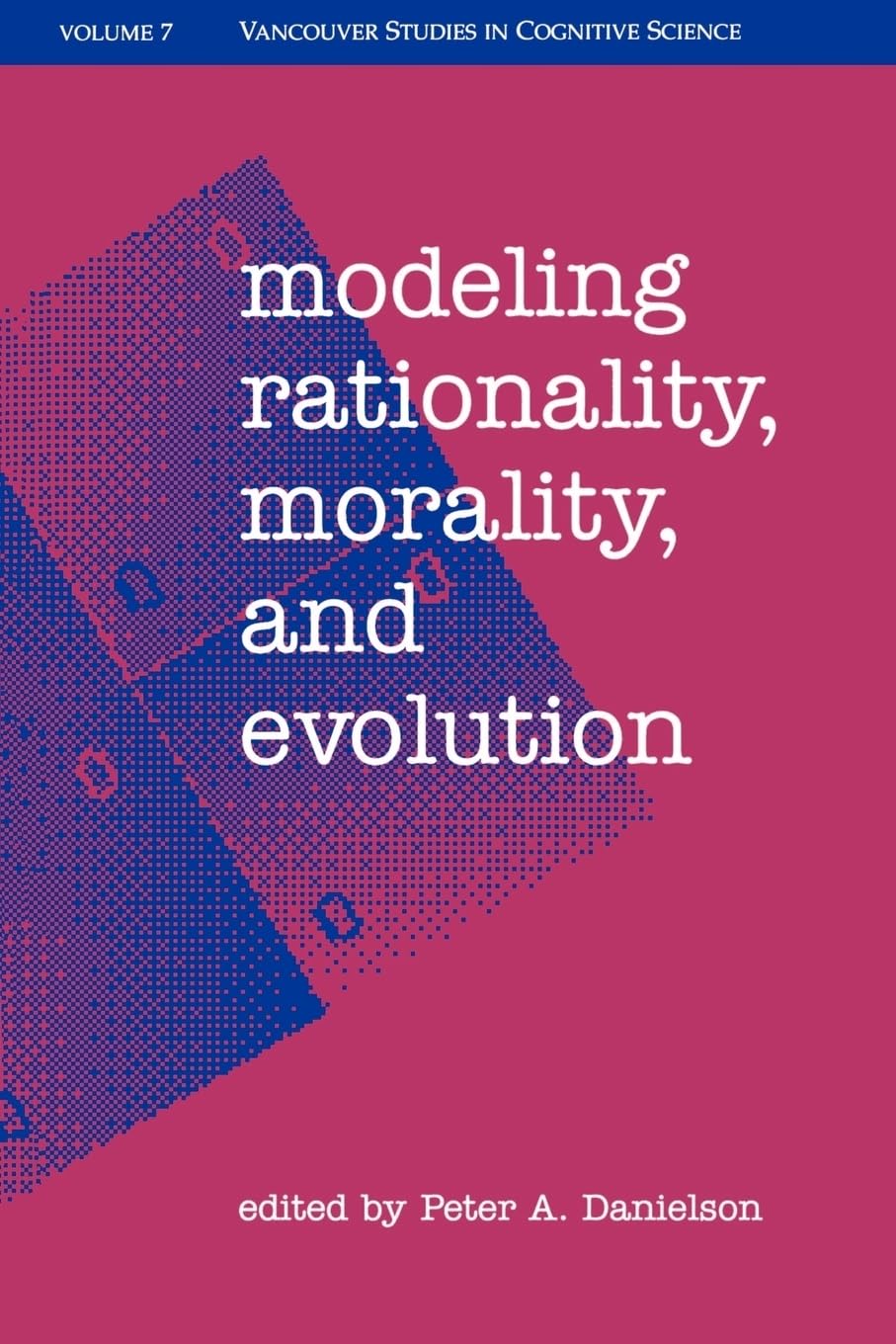
Modeling Rationality, Morality, and Evolution by Peter A. Danielson – A Deep Dive into Game Theory, Ethics, and Evolutio
Inclusive of all applicable taxes. FREE shipping on all orders.
Available Offers
- 🚚Free Delivery — Free shipping on all orders
- 💵Cash on Delivery — Pay when your order arrives
- ↩️15-Day Easy Returns — Hassle-free return policy
- 🔒Cash on Delivery — Pay safely when your order arrives
Check Delivery
Product Description
Introduction
In an age where artificial intelligence, behavioral economics, and evolutionary biology are reshaping our understanding of human nature, the question of how rationality, morality, and evolution intersect has never been more urgent. Modeling Rationality, Morality, and Evolution by Peter A. Danielson offers a rigorous yet accessible exploration of these profound themes. Published by Oxford University Press, this hardcover volume is an essential addition to the library of any serious student or scholar of philosophy, cognitive science, or the social sciences in India. It brings together cutting-edge research that uses formal models—from game theory to evolutionary dynamics—to shed light on age-old ethical dilemmas.
Book Overview
This collection of essays is a landmark work that bridges the gap between philosophical ethics and the empirical sciences. The book centers on the idea that moral behavior can be understood through the lens of rational choice theory and evolutionary processes. By framing questions such as “Is it rational to be moral?” within the context of the Prisoner’s Dilemma and other game-theoretic scenarios, Danielson and his contributors demonstrate how cooperation, altruism, and moral norms can emerge naturally from the interplay of self-interest and evolutionary pressures. The volume is not merely a theoretical exercise; it engages with real-world implications for ethics, politics, and our understanding of human society.
Key Highlights
- Interdisciplinary Approach: Combines insights from philosophy, evolutionary biology, cognitive science, and economics to provide a holistic understanding of morality.
- Pioneering Contributors: Features essays by leading thinkers such as David Gauthier, Paul M. Churchland, Brian Skyrms, Ronald de Sousa, and Elliot Sober.
- Formal Modeling: Utilizes mathematical and computational models, including game theory and evolutionary simulations, to test ethical theories.
- Focus on Cooperation: Examines the evolution of cooperation through the classic Prisoner’s Dilemma and its variations.
- Philosophical Depth: Addresses foundational questions about the nature of rationality, the origins of moral norms, and the relationship between facts and values.
Inside the Book
The book is structured as a curated collection of original essays, each offering a unique perspective on the central themes. Readers will encounter detailed analyses of how rational agents might choose moral actions even when self-interest seems to dictate otherwise. The chapters delve into the mechanics of reciprocal altruism, the role of emotions in moral decision-making, and the evolutionary roots of fairness and justice. Through careful argumentation and mathematical rigor, the book shows how moral systems can be modeled as adaptive strategies that have evolved over millennia. The writing is scholarly yet clear, making complex ideas accessible to advanced undergraduate and postgraduate students.
Key Topics
- Rational Choice Theory and Morality: Can moral behavior be reconciled with the principles of rational self-interest?
- The Prisoner’s Dilemma: How does this classic game illuminate the evolution of cooperation and trust?
- Evolutionary Ethics: How do natural selection and genetic inheritance shape our moral intuitions?
- Game Theory and Social Contracts: Using formal models to understand the emergence of social norms and institutions.
- Cognitive Science of Morality: The role of the brain, emotions, and reasoning in ethical judgments.
- Altruism and Reciprocity: Why do humans and other animals sometimes act against their immediate self-interest?
Reader Benefits
- Deepen Your Understanding: Gain a sophisticated grasp of how morality can be studied scientifically without losing its philosophical significance.
- Enhance Analytical Skills: Learn to think critically about ethical problems using formal models and logical reasoning.
- Stay Current: Engage with ideas that are at the forefront of contemporary research in ethics and evolutionary theory.
- Build a Strong Foundation: Ideal for students preparing for competitive exams or academic research in philosophy, psychology, or economics.
- Expand Your Horizons: Explore connections between seemingly disparate fields, from biology to political philosophy.
Learning Outcomes
- Ability to analyze moral dilemmas using game-theoretic concepts like Nash equilibrium and evolutionary stable strategies.
- Understanding of the key debates in evolutionary ethics, including the is-ought problem and the naturalistic fallacy.
- Familiarity with the work of major philosophers and scientists who have shaped the field of evolutionary morality.
- Skill in evaluating arguments about the rationality of moral behavior in both individual and social contexts.
- Capacity to apply these models to contemporary issues such as environmental ethics, artificial intelligence, and public policy.
Who Should Read
This book is ideally suited for advanced undergraduate and postgraduate students of philosophy, ethics, and cognitive science. It is also highly recommended for researchers in evolutionary biology, psychology, and economics who are interested in the foundations of human cooperation. Indian readers preparing for civil services examinations or pursuing interdisciplinary studies will find this volume invaluable for its rigorous treatment of rationality and morality. Additionally, anyone with a keen interest in understanding the scientific underpinnings of ethical behavior will be rewarded by the depth and clarity of the essays.
About the Author
Peter A. Danielson is a distinguished philosopher and professor at the University of British Columbia, where he specializes in ethics, political philosophy, and the philosophy of the social sciences. His research focuses on using computer models and game theory to explore moral and political norms. Danielson is the author of several influential works, including Artificial Morality: Virtuous Robots for Virtual Games, and has contributed extensively to the literature on evolutionary ethics and rational choice. His work is known for its innovative blend of analytical philosophy and computational modeling.
About the Publisher
Oxford University Press (OUP) is a globally respected academic publisher with a rich history of producing authoritative works in philosophy, science, and the humanities. Known for its rigorous editorial standards and commitment to scholarly excellence, OUP has been a trusted name in India for decades, providing students and researchers with high-quality textbooks and reference materials. This hardcover edition reflects OUP's dedication to durable, beautifully produced books that are built to last.
Conclusion
Modeling Rationality, Morality, and Evolution is not just a book—it is an intellectual adventure that challenges readers to rethink the very foundations of ethics. By bringing together formal models and philosophical inquiry, Peter A. Danielson has crafted a volume that is as relevant today as when it was first published. Whether you are a student, a researcher, or a curious mind, this book will equip you with the tools to understand the complex interplay between reason, morality, and the evolutionary forces that have shaped us. Order your copy from Bookshops.in today and join the conversation that is redefining moral philosophy for the 21st century.
Quick Summary
Modeling Rationality, Morality, and Evolution, edited by Peter A. Danielson, is a groundbreaking collection that bridges philosophy, game theory, and evolutionary biology. It tackles fundamental questions such as 'Is it rational to be moral?' and examines how cooperation evolves through the lens of the Prisoner's Dilemma. Featuring essays from renowned scholars like David Gauthier, Paul Churchland, Brian Skyrms, and Elliot Sober, the book presents formal models and philosophical analyses that challenge and refine our understanding of moral behavior. Ideal for graduate students and researchers in ethics, cognitive science, and evolutionary theory, this hardcover edition from Oxford University Press provides a rigorous yet accessible exploration of interdisciplinary moral thought. Indian readers will find it invaluable for academic study and research. By purchasing from Bookshops.in, you receive authentic copies with prompt service across India.
Book Highlights
Book Specifications
| ISBN-13 | 9780195125504 |
| ISBN-10 | 0195125509 |
| Publisher | Oxford Univ Pr on Demand |
| Language | English |
| Dimensions | 15.24 x 2.77 x 22.86 cm |
| Weight | 612 g |
| Category | Philosophy › Epistemology |
| Genre | Non-fiction |
| Original Language | English |
Frequently Asked Questions
What is this book about?
Who edited this collection?
Which publishers released this book?
Is this book suitable for beginners?
What are the main themes covered?
Does it include mathematical models?
Who are the contributing authors?
What is the ISBN?
Is this a hardcover or paperback?
Can I use this for a university course?
Does it discuss Indian philosophy?
Why should I buy from Bookshops.in?
Readers Also Search For
Customers Also Bought
Islam
Spiritual Economies (English, Daromir Rudnyckyj)

Islam
Who Is Allah? (English, Bruce B. Lawrence)
Islam
Islam and Liberal Citizenship: The Search for an Overlapping Consensus by Andrew F. March

Islam
Fiqh Us-Sunnah: Funerals and Diggers by Al-Sayyid Sabiq – Islamic Funeral Guide

Christianity
Genetics (English, Thomas a. Shannon | Mark P. Aulisio | Françoise Baylis)

Hinduism
Karma and Creativity by Christopher Key Chapple – Indian Philosophy
Related Products
View All
Philosophy
Latin American Philosophy: Currents, Issues, Debates by Eduardo Mendieta

Philosophy
Al-Farabi's Short Commentary on Aristotle's Prior Analytics by Nicholas Rescher – Philosophy
Philosophy
Poetics of Imagining: Modern to Post-modern by Richard Kearney

Philosophy
The Metaphysics of Extrinsic Properties: 11 (Metaphysical Research, 11)

Philosophy
Dialogues on Metaphysics and on Religion by Nicolas Malebranche – Philosophy
Philosophy