
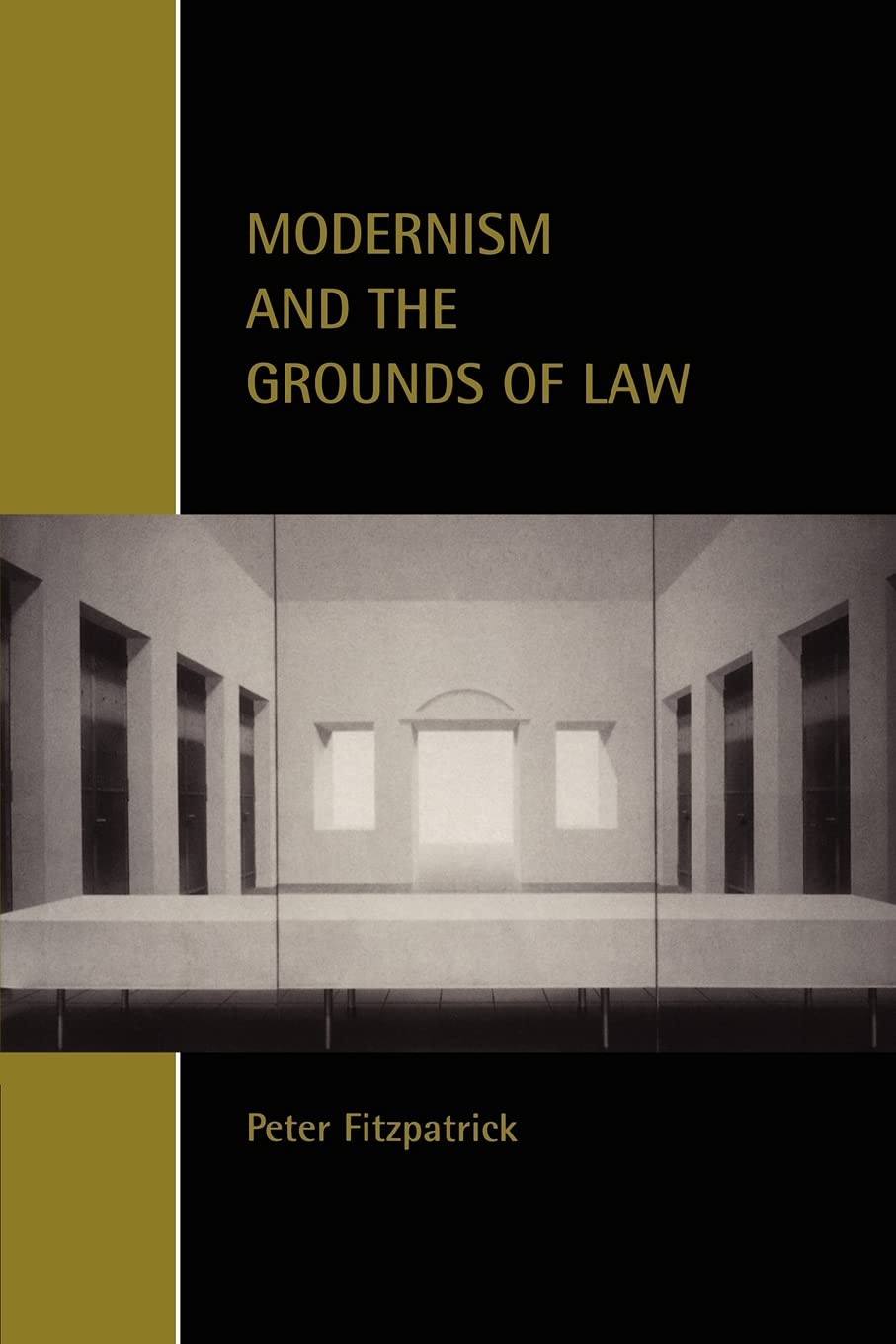
Modernism and the Grounds of Law by Peter Fitzpatrick – A Groundbreaking Legal Theory Book on Modernity and Jurisprudenc
Inclusive of all applicable taxes. FREE shipping on all orders.
Available Offers
- 🚚Free Delivery — Free shipping on all orders
- 💵Cash on Delivery — Pay when your order arrives
- ↩️15-Day Easy Returns — Hassle-free return policy
- 🔒Cash on Delivery — Pay safely when your order arrives
Check Delivery
Product Description
Introduction
In the ever-evolving landscape of legal theory, few works have dared to challenge the foundational assumptions of law's relationship with society as boldly as Peter Fitzpatrick's Modernism and the Grounds of Law. This seminal hardcover volume, published by Cambridge University Press, offers Indian readers—especially students of jurisprudence, legal philosophy, and social theory—a profound rethinking of how law is situated within modernity. Fitzpatrick dismantles the binary of law as either autonomous or merely a reflection of society, proposing instead a dynamic, interwoven existence that draws from both modern and pre-modern sources. For those seeking to understand law not as a static system but as a living force that shapes and is shaped by civilization, this book is an indispensable addition to any serious library.
Book Overview
Modernism and the Grounds of Law is a rigorous intellectual journey that places law at the very heart of modern society. Fitzpatrick argues that law is not a detached, self-contained entity but a product of modernity that simultaneously constitutes modern society. By incorporating what he terms 'pre-modern' elements—savagery and the sacred—law acquires its unique identity and impetus. The book traces this complex relationship from the colonizations of the Americas through the European Enlightenment, culminating in a critical engagement with contemporary claims of the 'global'. This is not a conventional law-and-society textbook; it is a philosophical excavation that redefines the grounds upon which law stands.
Key Highlights
- Original theoretical framework: Challenges both autonomy and groundedness as inadequate models for understanding law.
- Historical breadth: Spans from early colonial encounters to modern globalisation, offering a panoramic view of law's evolution.
- Interdisciplinary approach: Draws from social theory, philosophy, and postcolonial studies to enrich legal analysis.
- Critical engagement with modernity: Explores how law both reflects and creates the conditions of modern life.
- Relevance to contemporary debates: Addresses issues of global law, sovereignty, and the legacy of colonialism.
Inside the Book
The book is structured around a series of interconnected arguments that build toward a comprehensive thesis. Fitzpatrick begins by critiquing existing approaches that see law as either autonomous or grounded in society, showing their limitations. He then introduces untapped resources from social theory, particularly the works of thinkers like Michel Foucault and Jacques Derrida, to propose a new understanding. Key chapters examine law's role in the colonisation of the Americas, where European legal systems were imposed on indigenous peoples, and the Enlightenment's attempt to rationalise law while retaining sacred and savage elements. The final sections tackle the contemporary 'global' turn, questioning whether law can truly transcend its modern roots. Throughout, Fitzpatrick maintains a dense but rewarding prose that invites careful reading.
Key Topics
- The autonomy versus groundedness debate in legal theory
- Law and the construction of modern society
- Pre-modern influences on legal systems
- Colonialism and the imposition of law
- Enlightenment thought and legal rationalisation
- The sacred and the savage in legal foundations
- Globalisation and the future of law
- Postcolonial legal criticism
Reader Benefits
Indian readers, particularly those engaged with legal studies in universities or practising law with a philosophical bent, will find this book a transformative resource. It equips readers with a critical vocabulary to question received notions of law's neutrality and universality. By understanding law's embeddedness in modernity, students can better grasp the complexities of India's own legal system, which bears the imprint of colonial history and continues to negotiate between tradition and modernity. The book also enhances analytical skills, encouraging readers to think across disciplines and historical periods. For scholars, it offers a fresh framework for researching law's role in social change.
Learning Outcomes
- Understand the limitations of traditional law-and-society models.
- Analyse law as both a product and producer of modernity.
- Critically evaluate the role of colonialism in shaping legal systems.
- Apply social theory concepts to legal philosophy.
- Engage with contemporary debates on global law and sovereignty.
- Develop a nuanced perspective on law's relationship with culture and power.
Who Should Read
This book is essential reading for undergraduate and postgraduate students of law, especially those enrolled in jurisprudence, legal theory, or law-and-society courses. It will also appeal to scholars of political science, sociology, and philosophy who are interested in the intersection of law and modernity. Practitioners seeking a deeper theoretical foundation for their work, as well as readers curious about the origins of legal systems in the context of global history, will find it equally valuable. Indian law students preparing for competitive examinations or academic research will benefit from the book's critical perspective, which complements standard textbooks.
About the Author
Peter Fitzpatrick is a distinguished legal scholar and professor of law at the University of London. His work has significantly influenced the fields of legal philosophy, postcolonial legal studies, and social theory. Fitzpatrick is known for his innovative approach to understanding law's role in modernity, and his previous writings have explored themes of imperialism, sovereignty, and the sacred. With Modernism and the Grounds of Law, he extends his earlier contributions, offering a mature and provocative synthesis of his ideas. His scholarship is marked by a deep engagement with continental philosophy and a commitment to challenging orthodoxies in legal thought.
About the Publisher
Cambridge University Press is one of the world's oldest and most respected academic publishers, with a history dating back to 1534. Known for its rigorous peer-review process and high-quality publications, the Press has been a cornerstone of scholarly communication for centuries. This hardcover edition reflects Cambridge's commitment to producing durable, well-edited works that meet the highest academic standards. For Indian readers, a Cambridge University Press publication carries a mark of authority and excellence, making this book a trusted addition to any academic collection.
Conclusion
Modernism and the Grounds of Law is not merely a book; it is an invitation to rethink the very foundations of legal thought. Peter Fitzpatrick's masterful synthesis of history, philosophy, and social theory offers a path beyond stale debates, revealing law as a dynamic force that both emerges from and shapes modern society. For Indian students and scholars navigating a world where law must contend with colonial legacies, global pressures, and local aspirations, this volume provides the critical tools needed to engage deeply. Order your hardcover copy from Bookshops.in today and add a landmark work to your library—one that will challenge and inspire for years to come.
Quick Summary
Modernism and the Grounds of Law by Peter Fitzpatrick is a transformative work in legal theory that reimagines the relationship between law and society. Moving beyond the binary of law as either autonomous or socially grounded, Fitzpatrick draws on overlooked social theory to position law as a central, dynamic force within modernity. The book argues that law derives its identity from modern society while simultaneously constituting that society through the incorporation of 'pre-modern' elements such as savagery and the sacred. Ranging from the colonizations of the Americas to the European Enlightenment and contemporary global assertions, this volume offers a sweeping historical and theoretical analysis. Ideal for law students, sociologists, and critical legal scholars, the book challenges readers to rethink law's foundational role. Published by Cambridge University Press, this hardcover edition is a valuable addition to any academic library. Purchase from Bookshops.in for authentic copies and prompt service across India.
Book Highlights
Book Specifications
| ISBN-13 | 9780521002530 |
| ISBN-10 | 0521002532 |
| Publisher | Cambridge University Press |
| Language | English |
| Dimensions | 15.21 x 1.75 x 22.89 cm |
| Weight | 400 g |
| Country | India |
| Category | Humanities › Philosophy |
| Genre | Non-fiction |
| Original Language | English |
Frequently Asked Questions
What is Modernism and the Grounds of Law about?
Who is the author of this book?
Is this book suitable for Indian law students?
Which publisher released this book?
What is the ISBN-13?
Is the book available in hardcover?
What topics does the book cover?
Can I use this book for my PhD research?
Does the book discuss Indian law?
What is the price in INR?
Is this a beginner-friendly book?
Does it include case studies?
Why buy from Bookshops.in?
Readers Also Search For
Customers Also Bought
Islam
Spiritual Economies (English, Daromir Rudnyckyj)

Islam
Who Is Allah? (English, Bruce B. Lawrence)
Islam
Islam and Liberal Citizenship: The Search for an Overlapping Consensus by Andrew F. March

Islam
Fiqh Us-Sunnah: Funerals and Diggers by Al-Sayyid Sabiq – Islamic Funeral Guide

Christianity
Genetics (English, Thomas a. Shannon | Mark P. Aulisio | Françoise Baylis)

Hinduism
Karma and Creativity by Christopher Key Chapple – Indian Philosophy
Related Products
View All
Philosophy
Latin American Philosophy: Currents, Issues, Debates by Eduardo Mendieta

Philosophy
Al-Farabi's Short Commentary on Aristotle's Prior Analytics by Nicholas Rescher – Philosophy
Philosophy
Poetics of Imagining: Modern to Post-modern by Richard Kearney

Philosophy
The Metaphysics of Extrinsic Properties: 11 (Metaphysical Research, 11)
Philosophy
Dialogues on Metaphysics and on Religion by Nicolas Malebranche – Philosophy
Philosophy