
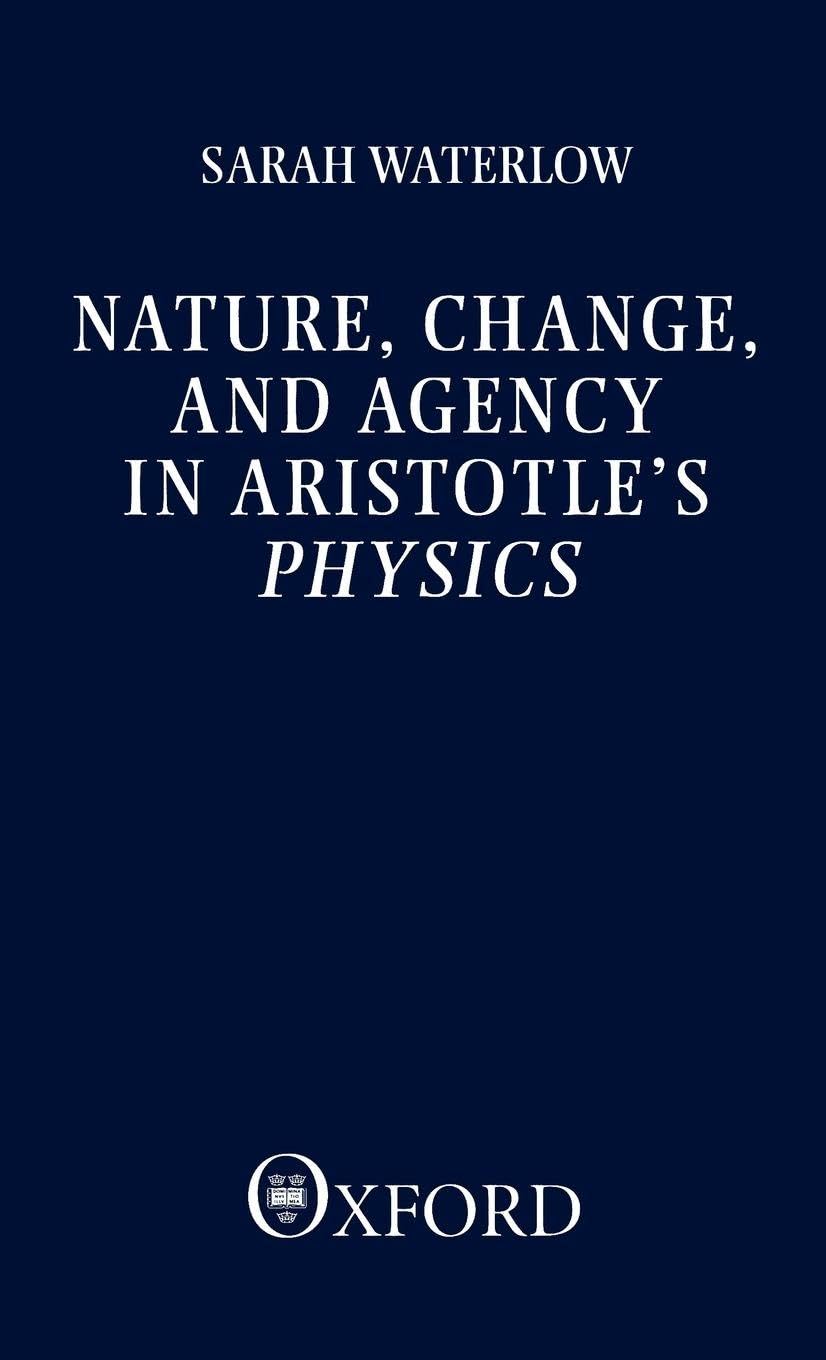
Nature, Change, and Agency in Aristotle's Physics: A Philosophical Study by Sarah Waterslow – A Comprehensive Examinatio
Inclusive of all applicable taxes. FREE shipping on all orders.
Available Offers
- 🚚Free Delivery — Free shipping on all orders
- 💵Cash on Delivery — Pay when your order arrives
- ↩️15-Day Easy Returns — Hassle-free return policy
- 🔒Cash on Delivery — Pay safely when your order arrives
Check Delivery
Product Description
Introduction
For students and scholars of ancient philosophy, Aristotle’s Physics remains one of the most profound and challenging texts in the Western intellectual tradition. In Nature, Change, and Agency in Aristotle's Physics: A Philosophical Study, Sarah Waterslow offers a rigorous and illuminating examination of Aristotle’s core concepts. This hardcover volume from OUP Oxford is an essential resource for Indian university libraries, philosophy departments, and serious readers seeking to understand how Aristotle’s metaphysics of nature shapes our understanding of change, causality, and the very fabric of reality.
Book Overview
This philosophical study delves deep into Aristotle’s notion of natural substance—what it means for something to exist by nature rather than by artifice. Waterslow unpacks the intricate web of ideas surrounding change, process, agency, and teleology, showing how these concepts are interwoven with Aristotle’s views on mathematical continuity and eternal motion. The book does not merely summarise Aristotle’s arguments; it critically evaluates their conceptual power, revealing both their enduring insights and their inherent scientific limitations. For Indian readers engaged in classical Indian philosophy or comparative metaphysics, this work provides a rigorous Western counterpart to debates about substance, causality, and change found in Nyāya and Vaiśeṣika traditions.
Key Highlights
- Original Philosophical Analysis: Offers a fresh, systematic interpretation of Aristotle’s natural philosophy, moving beyond standard commentaries.
- Focus on Agency and Teleology: Explains how natural substances act as sources of change, with a special emphasis on purpose-driven processes.
- Critical Engagement: Balances admiration for Aristotle’s framework with a clear-eyed view of its scientific shortcomings.
- Academic Rigour: Suitable for advanced undergraduate and postgraduate study in philosophy and classical studies.
Inside the Book
The book is structured around a series of interconnected arguments. Waterslow begins by defining natural substance and its intrinsic capacity for change. She then explores the paradoxes of motion and continuity, drawing on Aristotle’s own mathematical insights. A significant portion is devoted to teleology—how natural processes aim at ends—and the role of the unmoved mover. The final chapters tackle the tension between eternal motion and the finite, perishable world of everyday experience. Each chapter builds on the last, creating a cohesive and challenging narrative.
Key Topics
- The concept of physis (nature) and its distinction from techne (art)
- Substance, form, and matter in the context of change
- Aristotle’s theory of motion and the infinite
- Teleological explanation and the principle of final causality
- Agency in natural beings: self-motion and external causation
- The relationship between time, continuity, and eternal motion
- Internal tensions in Aristotle’s metaphysical system
Reader Benefits
By engaging with this text, readers will develop a nuanced understanding of one of philosophy’s most influential thinkers. The book sharpens analytical skills, as it requires careful dissection of complex arguments. It also provides a solid foundation for further study in metaphysics, philosophy of science, and the history of ideas. Indian students of philosophy will find it particularly valuable for cross-cultural comparisons with Indian theories of causality and natural change.
Learning Outcomes
- Grasp Aristotle’s definition of nature and natural substance
- Analyse the logic behind change, process, and agency in the physical world
- Critically evaluate teleological explanations and their limits
- Understand the mathematical underpinnings of Aristotle’s cosmology
- Identify the unresolved tensions in Aristotle’s system that later philosophers addressed
Who Should Read
This book is ideal for postgraduate students and researchers in philosophy, especially those specialising in ancient Greek thought or metaphysics. It is also highly recommended for advanced undergraduates studying Aristotle’s Physics in a structured course. Scholars of Indian philosophy seeking a rigorous comparative framework will find it equally rewarding. The text assumes some familiarity with Aristotle’s basic concepts, making it best suited for readers who have already encountered introductory works on his philosophy.
About the Author
Sarah Waterslow is a distinguished scholar of ancient philosophy, known for her meticulous and creative interpretations of Aristotle’s works. Her research focuses on the intersection of metaphysics, physics, and philosophy of science in the classical world. With a career spanning several decades, she has contributed significantly to contemporary debates on Aristotle’s natural philosophy, and her writings are widely cited in academic circles.
About the Publisher
OUP Oxford is one of the world’s oldest and most respected academic publishers. With a commitment to scholarly excellence, OUP produces authoritative editions of philosophical texts and critical studies. This hardcover volume is printed on high-quality paper with a durable binding, ensuring it will serve as a lasting reference for years to come. Bookshops.in is proud to offer this title to Indian readers, supporting the growth of serious philosophical discourse in the country.
Conclusion
Nature, Change, and Agency in Aristotle's Physics: A Philosophical Study is a masterful work that challenges and enlightens. Sarah Waterslow’s careful analysis brings Aristotle’s ideas to life while honestly assessing their limitations. Whether you are a philosophy student preparing for examinations, a researcher building your library, or a curious mind drawn to the deepest questions about nature and change, this book deserves a place on your shelf. Order your copy from Bookshops.in today and explore the timeless power of Aristotelian thought.
Quick Summary
Nature, Change, and Agency in Aristotle's Physics: A Philosophical Study by Sarah Waterslow is a rigorous academic work that delves into Aristotle's foundational text, the Physics, to explore his concepts of natural substance, change, process, agency, teleology, mathematical continuity, and eternal motion. The book reveals both the profound conceptual strengths and the inherent tensions within Aristotle's metaphysical framework, offering a balanced critique that highlights its scientific limitations. This study is intended for advanced philosophy students, researchers, and scholars of ancient Greek thought who seek a deeper understanding of Aristotelian natural philosophy. Readers will learn how Aristotle's ideas about nature and change have shaped Western philosophy and science, and will gain critical tools for analyzing classical texts. Purchasing from Bookshops.in ensures you receive a genuine OUP hardcover edition, securely packaged and delivered across India, with the assurance of a trusted Indian bookstore dedicated to academic excellence.
Book Highlights
Book Specifications
| ISBN-13 | 9780198244820 |
| ISBN-10 | 0198244827 |
| Publisher | Clarendon Pr |
| Language | English |
| Dimensions | 13.79 x 1.63 x 21.59 cm |
| Weight | 386 g |
| Category | Philosophy › History & Surveys |
| Genre | Nonfiction |
| Reading Age | Adult |
| Original Language | English |
Frequently Asked Questions
What is the main focus of this book?
Who is the author Sarah Waterslow?
Is this book suitable for beginners in philosophy?
Does the book cover Aristotle's entire Physics?
Is this book used in Indian universities?
What is the price of this book?
What language is the book in?
Can I get this book delivered to my city in India?
Is this a digital or physical book?
What is the ISBN of this book?
Does the book include criticisms of Aristotle?
What rating does this book have?
Readers Also Search For
Customers Also Bought
Islam
Spiritual Economies (English, Daromir Rudnyckyj)

Islam
Who Is Allah? (English, Bruce B. Lawrence)
Islam
Islam and Liberal Citizenship: The Search for an Overlapping Consensus by Andrew F. March

Islam
Fiqh Us-Sunnah: Funerals and Diggers by Al-Sayyid Sabiq – Islamic Funeral Guide

Christianity
Genetics (English, Thomas a. Shannon | Mark P. Aulisio | Françoise Baylis)

Hinduism
Karma and Creativity by Christopher Key Chapple – Indian Philosophy
Related Products
View All
Philosophy
Latin American Philosophy: Currents, Issues, Debates by Eduardo Mendieta

Philosophy
Al-Farabi's Short Commentary on Aristotle's Prior Analytics by Nicholas Rescher – Philosophy
Philosophy
Poetics of Imagining: Modern to Post-modern by Richard Kearney

Philosophy
The Metaphysics of Extrinsic Properties: 11 (Metaphysical Research, 11)
Philosophy
Dialogues on Metaphysics and on Religion by Nicolas Malebranche – Philosophy
Philosophy