
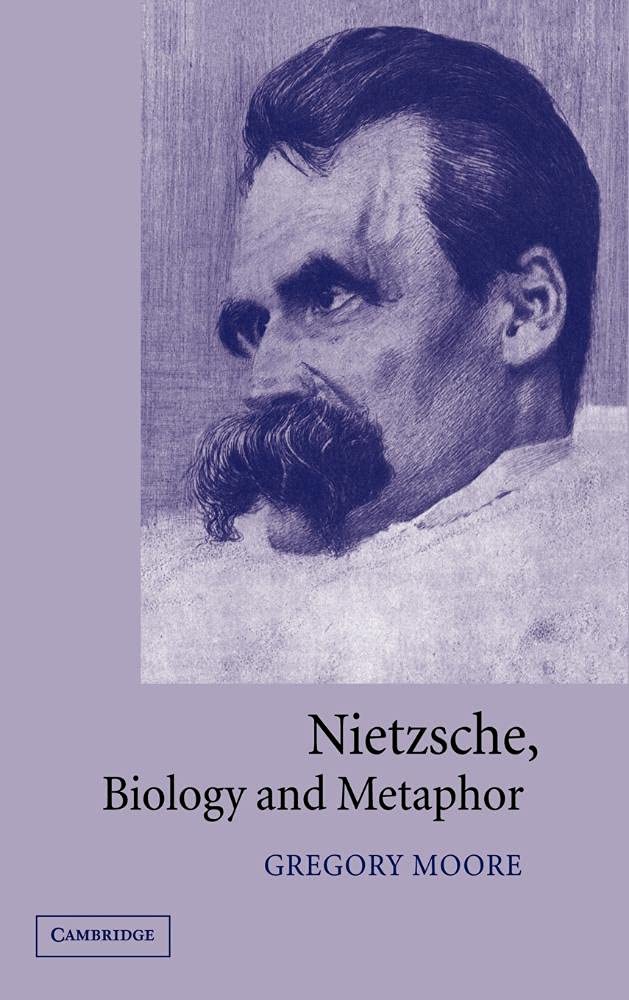
Nietzsche, Biology and Metaphor by Gregory Moore – A Scholarly Analysis of Nietzsche's Response to Darwin and Evolutiona
Inclusive of all applicable taxes. FREE shipping on all orders.
Available Offers
- 🚚Free Delivery — Free shipping on all orders
- 💵Cash on Delivery — Pay when your order arrives
- ↩️15-Day Easy Returns — Hassle-free return policy
- 🔒Cash on Delivery — Pay safely when your order arrives
Check Delivery
Product Description
Introduction
Friedrich Nietzsche remains one of the most provocative and misunderstood figures in Western philosophy. In Nietzsche, Biology and Metaphor, Gregory Moore offers a groundbreaking exploration of how the philosopher engaged with the scientific and cultural upheavals of his time, particularly the debates ignited by Darwin's theory of evolution. This hardcover edition from Cambridge University Press is an essential addition for Indian scholars, students of philosophy, and anyone curious about the intersection of science and thought in the late nineteenth century.
Book Overview
This meticulously researched work delves into Nietzsche's extensive use of biological metaphors—terms like 'degeneration,' 'breeding,' and 'selection'—to argue that he was far more immersed in the scientific discourse of his era than often acknowledged. Moore challenges the popular image of Nietzsche as a purely subversive, postmodern thinker, instead revealing a philosopher deeply engaged with evolutionary theory, racial science, and the anxieties of fin-de-siècle Europe. The book is divided into two parts: the first examines Nietzsche's complex relationship with Darwinism, while the second applies this biological lens to his cultural criticism, including his attack on Judeo-Christian morality and his diagnosis of modern nihilism.
Key Highlights
- Original analysis of Nietzsche's response to Darwin and the evolutionary debates of the 19th century
- Detailed interpretation of biological metaphors in Nietzsche's major works
- Contextual study of the intellectual climate in Germany and Europe during the 1880s and 1890s
- Critical examination of Nietzsche's influence on later thinkers and his place in modern philosophy
- Hardcover edition from Cambridge University Press, a trusted academic publisher
Inside the Book
The volume opens with a thorough introduction to the scientific landscape of Nietzsche's time, before moving into a chapter-by-chapter exploration of his writings. Moore dissects key texts such as Thus Spoke Zarathustra, Beyond Good and Evil, and On the Genealogy of Morals, showing how Nietzsche used biological language to critique morality, art, and religion. The second part of the book addresses Nietzsche's anti-Wagnerian polemics and his fears about cultural decline, linking them to contemporary fears about race and degeneration. The writing is clear and scholarly, making it accessible to advanced undergraduates while remaining rigorous for specialists.
Key Topics
- Nietzsche and Darwin: influence, disagreement, and misinterpretation
- The role of biological metaphors in philosophical argumentation
- Evolution, degeneration, and the concept of the Übermensch
- Nietzsche's critique of Christianity and modern morality
- The relationship between science, culture, and philosophy in the late 19th century
- Fin-de-siècle anxieties about race, heredity, and social decay
Reader Benefits
Indian readers and students will find this book particularly valuable as it bridges the gap between continental philosophy and the history of science. It offers a fresh perspective on Nietzsche that moves beyond popular clichés, providing tools to understand how scientific ideas shape cultural and moral thought. The book also serves as an excellent resource for those studying the reception of Darwinism outside the Anglophone world, including its impact on German intellectual life.
Learning Outcomes
- Understand Nietzsche's nuanced position on evolution and natural selection
- Analyze how biological metaphors function in philosophical texts
- Critically evaluate the relationship between science and philosophy in the modern era
- Gain insight into the historical context of Nietzsche's major works
- Develop a deeper appreciation for the interdisciplinary nature of 19th-century thought
Who Should Read
This book is ideal for postgraduate students and researchers in philosophy, intellectual history, and German studies. It is also highly recommended for undergraduate students taking courses on Nietzsche, 19th-century philosophy, or the history of science. General readers with a strong interest in Nietzsche's ideas or the cultural impact of Darwinism will also find it rewarding. Libraries and academic institutions in India will benefit from adding this title to their collections.
About the Author
Gregory Moore is a scholar of German intellectual history with a focus on Nietzsche and the philosophy of the 19th century. He has published extensively on the intersections of literature, science, and philosophy, and his work is known for its meticulous archival research and clarity of argument. Moore teaches at the University of Cambridge, where he continues to explore the cultural dimensions of evolutionary thought.
About the Publisher
Cambridge University Press is one of the oldest and most respected academic publishers in the world. Known for its rigorous peer-review process and high-quality hardcover editions, Cambridge publishes works that set the standard in fields ranging from philosophy to the natural sciences. This volume reflects their commitment to advancing scholarship that crosses disciplinary boundaries.
Conclusion
Nietzsche, Biology and Metaphor is a vital contribution to Nietzsche studies and the history of ideas. It rescues the philosopher from simplistic readings and places him firmly within the scientific debates of his age. For Indian readers seeking a deeper, more contextual understanding of Nietzsche, this hardcover edition from Cambridge University Press is an indispensable resource. Order your copy today from Bookshops.in and add a work of lasting scholarly value to your library.
Quick Summary
Nietzsche, Biology and Metaphor by Gregory Moore is a scholarly exploration of Friedrich Nietzsche's intellectual engagement with the evolutionary debates sparked by Darwin's Origin of Species. The book meticulously examines the biological metaphors that permeate Nietzsche's writings, revealing a thinker deeply embedded in late 19th-century discussions on evolution, degeneration, and race. Moore challenges the recent tendency to view Nietzsche as a purely subversive or post-modern philosopher, instead situating him within the scientific and cultural currents of his time. The first part offers a detailed analysis of Nietzsche's complex relationship with Darwinism, while the second part shows how his evolutionary perspective shaped his moral and aesthetic philosophy. This hardcover volume is ideal for advanced philosophy students, researchers in intellectual history, and anyone interested in the intersection of science and philosophy. By purchasing from Bookshops.in, Indian readers gain access to a premium academic text with reliable delivery and customer service.
Book Highlights
Book Specifications
| ISBN-13 | 9780521812306 |
| ISBN-10 | 0521812305 |
| Publisher | Cambridge University Press |
| Language | English |
| Dimensions | 15.88 x 3.18 x 23.5 cm |
| Weight | 510 g |
| Country | India |
| Category | Philosophy › History & Surveys |
| Genre | Non-fiction |
| Original Language | English |
Frequently Asked Questions
What is Nietzsche, Biology and Metaphor about?
Who is the author?
Is this book suitable for beginners?
Does the book cover Nietzsche's view on race?
Is this a hardcover edition?
What is the ISBN?
Does the book challenge Nietzsche's post-modern image?
Can I use this for my PhD research?
Does it include a bibliography?
Is the book only about biology?
What language is the book in?
Where can I buy this book in India?
Is this book part of a series?
Readers Also Search For
Customers Also Bought
Islam
Spiritual Economies (English, Daromir Rudnyckyj)

Islam
Who Is Allah? (English, Bruce B. Lawrence)
Islam
Islam and Liberal Citizenship: The Search for an Overlapping Consensus by Andrew F. March

Islam
Fiqh Us-Sunnah: Funerals and Diggers by Al-Sayyid Sabiq – Islamic Funeral Guide

Christianity
Genetics (English, Thomas a. Shannon | Mark P. Aulisio | Françoise Baylis)

Hinduism
Karma and Creativity by Christopher Key Chapple – Indian Philosophy
Related Products
View All
Philosophy
Latin American Philosophy: Currents, Issues, Debates by Eduardo Mendieta

Philosophy
Al-Farabi's Short Commentary on Aristotle's Prior Analytics by Nicholas Rescher – Philosophy
Philosophy
Poetics of Imagining: Modern to Post-modern by Richard Kearney

Philosophy
The Metaphysics of Extrinsic Properties: 11 (Metaphysical Research, 11)
Philosophy
Dialogues on Metaphysics and on Religion by Nicolas Malebranche – Philosophy

Philosophy