
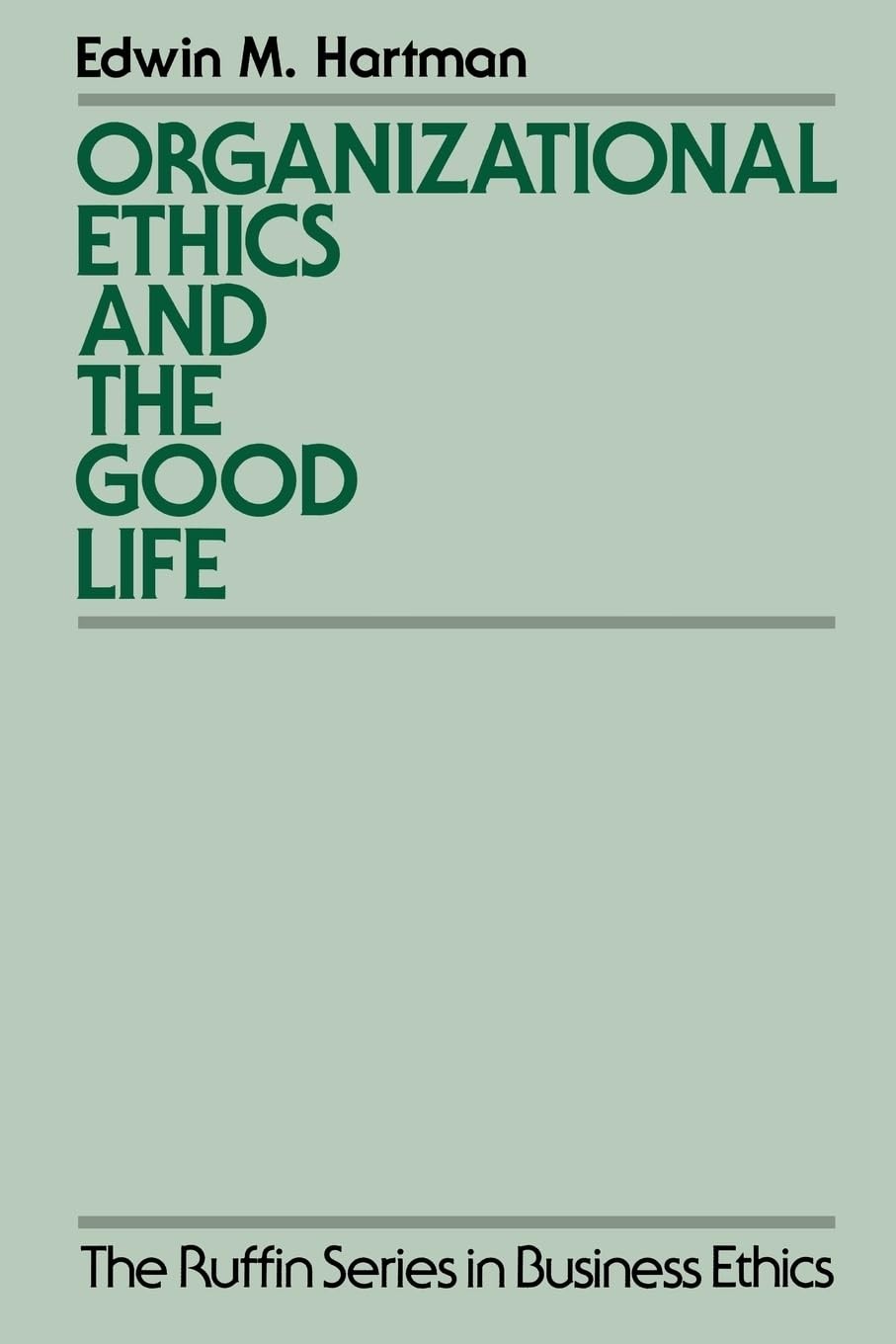
Organizational Ethics and the Good Life (English, Edwin Hartman)
Inclusive of all applicable taxes. FREE shipping on all orders.
Available Offers
- 🚚Free Delivery — Free shipping on all orders
- 💵Cash on Delivery — Pay when your order arrives
- ↩️15-Day Easy Returns — Hassle-free return policy
- 🔒Cash on Delivery — Pay safely when your order arrives
Check Delivery
Product Description
In giving an account of what is ethical, we can begin by describing the community that accommodates the good life; to be ethical, then, is to be a contributor to that sort of community. We live in political communities as well as in communities built around families, neighborhoods, churches, and other associations. But for many of us the community that will afford the good life that is the purpose of morality is the organization that employs us. Aristotle claimed tht the greatest ethical questions are political ones; today we have reason to believe that the greatest ethical questions are organizational ones.In Organizational Ethics and the Good Life, Edwin Hartman contends that, as ethics is about the good community, a great part of business ethics is about the good organization. He argues that a large and complex organization has the characteristic of the "commons" studied by game theorists, and that it is the task of management to preserve the commons in the long-term interests of all its members, principally by creating an appropriate corporate culture. A good corporate culture not only serves the interests of the participants but makes the organization a place in which they can develop interests that are compatible with both autonomy and good corporate citizenship: that is, they can develop a sense of the good life that is appropriate to the moral person.Hartman opposes the standard view that the study of organizational ethics is a matter of considering how certain foundational ethical principles apply in organizational settings; instead, he argues, business ethicists should consider how free and rational people arrive at a consensus on practical ethical principles in a morally good organization that leaves room for moral progress. And what makes an organization morally good? In discussing justice, loyalty, and other features of a morally good organization, Hartman draws largely on the work of Rawls and Hirschman. In describing the good life as one in which well-being and morality overlap, Hartman proposes a new version of an idea as old as Aristotle, who taught that human beings are rational but also irreducibly communal creatures.
Book Specifications
| ISBN-13 | 9780195100778 |
| ISBN-10 | 0195100778 |
| Publisher | Oxford Univ Pr on Demand |
| Language | English |
| Dimensions | 15.88 x 1.47 x 23.5 cm |
| Weight | 340 g |
| Country | United Kingdom |
| Category | Philosophy › Ethics |
Frequently Asked Questions
What is the price of Organizational Ethics and the Good Life?
Does BookShops.in offer free delivery for Organizational Ethics and the Good Life?
Is Cash on Delivery available for Organizational Ethics and the Good Life?
What is the return policy for Organizational Ethics and the Good Life?
Is Organizational Ethics and the Good Life authentic?
Customers Also Bought
Islam
Spiritual Economies (English, Daromir Rudnyckyj)

Islam
Who Is Allah? (English, Bruce B. Lawrence)
Islam
Islam and Liberal Citizenship: The Search for an Overlapping Consensus by Andrew F. March
Islam
Fiqh Us-Sunnah: Funerals and Diggers by Al-Sayyid Sabiq – Islamic Funeral Guide

Christianity
Genetics (English, Thomas a. Shannon | Mark P. Aulisio | Françoise Baylis)

Hinduism
Karma and Creativity by Christopher Key Chapple – Indian Philosophy
Related Products
View All
Philosophy
Latin American Philosophy: Currents, Issues, Debates by Eduardo Mendieta

Philosophy
Al-Farabi's Short Commentary on Aristotle's Prior Analytics by Nicholas Rescher – Philosophy
Philosophy
Poetics of Imagining: Modern to Post-modern by Richard Kearney

Philosophy
The Metaphysics of Extrinsic Properties: 11 (Metaphysical Research, 11)
Philosophy
Dialogues on Metaphysics and on Religion by Nicolas Malebranche – Philosophy
Philosophy