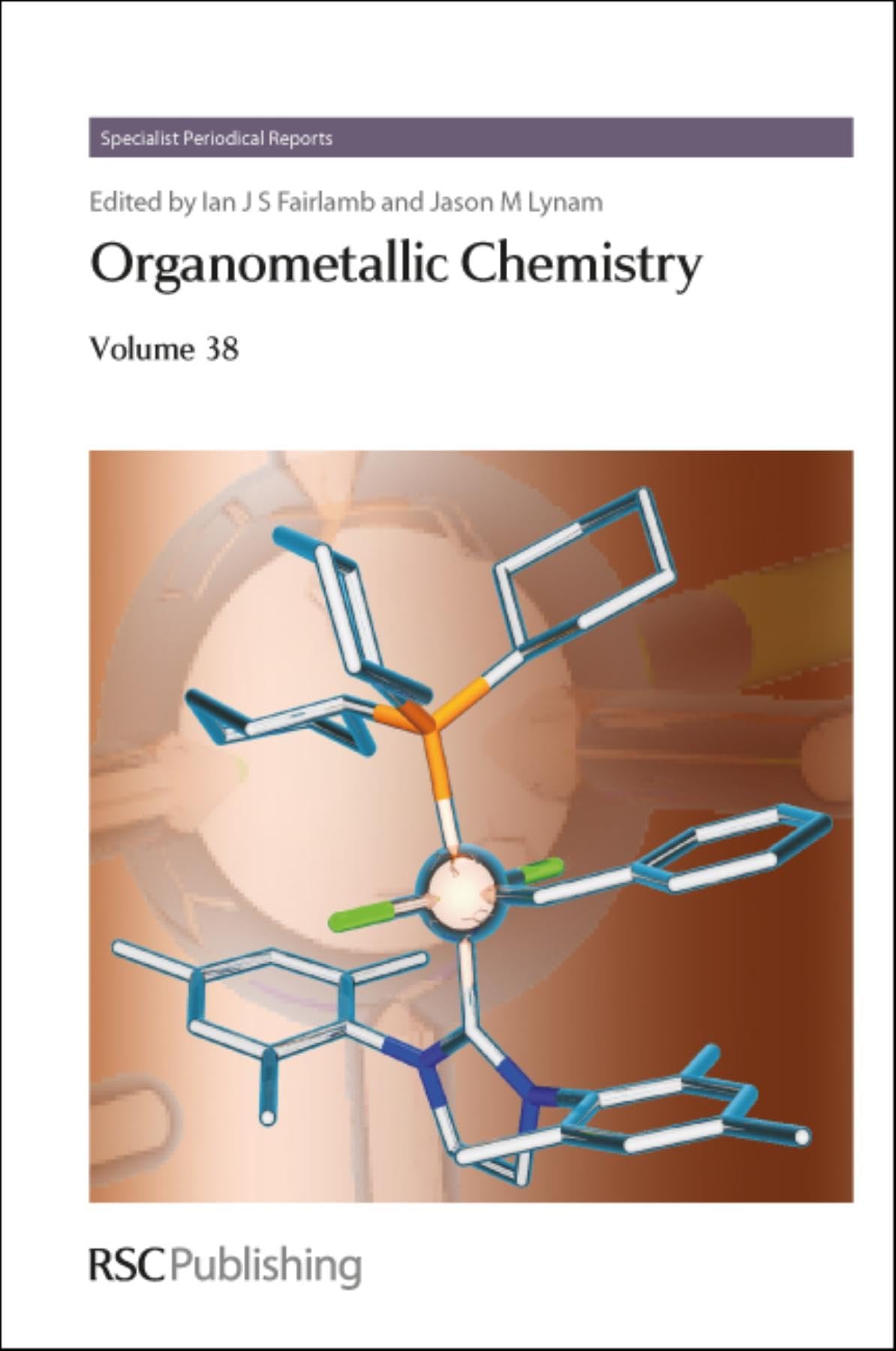
Organometallic Chemistry: Volume 38 (Specialist Periodical Reports - Organometallic Chemistry)
Inclusive of all applicable taxes. FREE shipping on all orders.
Available Offers
- 🚚Free Delivery — Free shipping on all orders
- 💵Cash on Delivery — Pay when your order arrives
- ↩️15-Day Easy Returns — Hassle-free return policy
- 🔒Cash on Delivery — Pay safely when your order arrives
Check Delivery
Product Description
About This Book
A series of critical reviews and perspectives focussing on specific aspects of organometallic chemistry interfacing with other fields of study are provided. For this volume, the critical reviews cover topics such as the activation of "inert" carbon-hydrogen bonds, ligand design and organometallic radical species. For example, Charlie O'Hara discusses how mixed-metal compounds may perform the highly selective activation of C-H bonds and, in particular, how synergic relationships between various metals are crucial to this approach. The chemistry of a remarkable series of air-stable chiral primary phosphine ligands is discussed in some depth by Rachel Hiney, Arne Ficks, Helge M³ller-Bunz, Declan Gilheany and Lee Higham. This article focuses on the preparation of these ligands and also how they may be applied in various catalytic applications. Bas De Bruin reports on how ligand radical reactivity can be employed in synthetic organometallic chemistry and catalysis to achieve selectivity in radical-type transformations. As well as highlighting ligand-centered radical transformations in open-shell transition metals, an overview of the catalytic mechanism of Co(II)-catalysed olefin cyclopropanation is given, showing that enzyme-like cooperative metal-ligand-radical reactivity is no longer limited to real enzymes. Valuable and informative comprehensive reviews in the field of organometallic chemistry are also covered in this volume. For example, organolithium and organocuprate chemistry are reviewed by Joanna Haywood and Andrew Wheatley; aspects in Group 2 (Be-Ba) and Group 12 (Zn-Hg) compounds by Robert Less, Rebecca Melen and Dominic Wright; metal clusters by Mark Humphrey and Marie Cifuentes; and recent developments in the chemistry of the elements of Group 14 - focusing on low-coordination number compounds by Richard Layfield. This volume therefore covers many synthetic and applied aspects of modern organometallic chemistry which ought to be of interest to inorganic, organic and applied catalysis fields.
About the Author
Organometallic Chemistry: Volume 38 is authored by Ian J. S. Fairlamb | Jason M. Lynam.
Book Highlights
Book Specifications
| ISBN-13 | 9781849733762 |
| ISBN-10 | 1849733767 |
| Publisher | Royal Society of Chemistry |
| Language | English |
| Dimensions | 15.6 x 1.2 x 23.4 cm |
| Weight | 363 g |
| Country | India |
| Category | Science & Mathematics › Chemistry |
Frequently Asked Questions
What is the price of Organometallic Chemistry: Volume 38?
Does BookShops.in offer free delivery for Organometallic Chemistry: Volume 38?
Is Cash on Delivery available for Organometallic Chemistry: Volume 38?
What is the return policy for Organometallic Chemistry: Volume 38?
Is Organometallic Chemistry: Volume 38 authentic?
Customers Also Bought
Mathematics
Stereotype Spaces and Algebras: 73 (De Gruyter Expositions in Mathematics, 73)
Mathematics
Semigroups in Algebra, Geometry and Analysis: 20 (De Gruyter Expositions in Mathematics, 20)
Mathematics
Geometry from the Pacific Rim: Proceedings of the Pacific Rim Geometry Conference held at National University of Singapore, Republic of Singapore, ... 1994 (De Gruyter Proceedings in Mathematics)
Mathematics
First International Tainan-Moscow Algebra Workshop: Proceedings of the International Conference held at National Cheng Kung University Tainan, Taiwan, ... 1994 (De Gruyter Proceedings in Mathematics)
Mathematics
Differential Geometry - Proceedings of the VIII International Colloquium (English, Jesus A. Alvarez Lopez | Eduardo Garcia-Rio)
Mathematics
Mathematical Theory of Optimal Processes (Classics of Soviet Mathematics)
Related Products
View All
Chemistry
Proceedings of the Third USSR - FRG Symposium, Makhachkala (USSR), October 2–6, 1980: 001
Chemistry
Confining Electrochemistry to Nanopores: From Fundamentals to Applications: Volume 17 (Detection Science)
Chemistry
Inorganic Chemistry of the Main-Group Elements: Volume 1 (Specialist Periodical Reports - Inorganic Chemistry of the Main-Group Elements)
Chemistry
SYNTHETIC POLYMER CHEMISTRY: INNOVATIONS AND OUTLOOK: Volume 32 (Polymer Chemistry Series)
Chemistry
Theoretical Chemistry for Electronic Excited States: Volume 12 (Theoretical and Computational Chemistry Series)
Chemistry