All Books
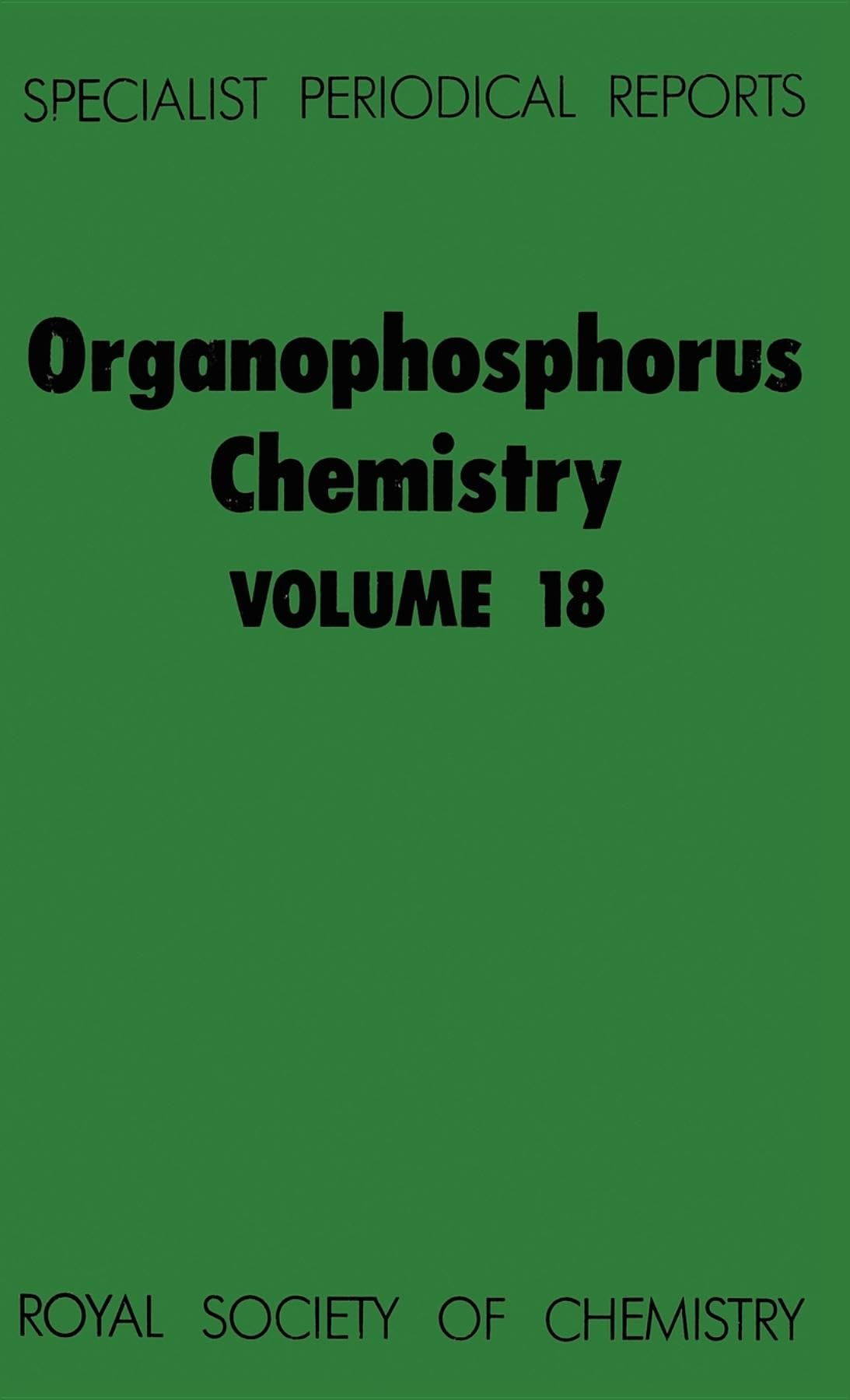
Organophosphorus Chemistry: Volume 18 (Specialist Periodical Reports - Organophosphorus Chemistry)
Chemistry

Organophosphorus Chemistry: Volume 18 (Specialist Periodical Reports - Organophosphorus Chemistry)

5,558

Inclusive of all applicable taxes. FREE shipping on all orders.

Quantity:
1
Share:
Free DeliveryOn every order
15-Day ReturnEasy returns
Genuine BookPhysical copy only

Available Offers

  • 🚚Free DeliveryFree shipping on all orders
  • 💵Cash on DeliveryPay when your order arrives
  • ↩️15-Day Easy ReturnsHassle-free return policy
  • 🔒Cash on DeliveryPay safely when your order arrives

Check Delivery

Product Description

About This Book

Organophosphorus Chemistry provides a comprehensive annual review of the literature. Coverage includes phosphines and their chalcogenides, phosphonium salts, low coordination number phosphorus compounds, penta- and hexa-coordinated compounds, tervalent phosphorus acids, nucleotides and nucleic acids, ylides and related compounds, and phosphazenes. The series will be of value to research workers in universities, government and industrial research organisations, whose work involves the use of organophosphorus compounds. It provides a concise but comprehensive survey of a vast field of study with a wide variety of applications, enabling the reader to rapidly keep abreast of the latest developments in their specialist areas. Specialist Periodical Reports provide systematic and detailed review coverage of progress in the major areas of chemical research. Written by experts in their specialist fields the series creates a unique service for the active research chemist, supplying regular critical in-depth accounts of progress in particular areas of chemistry. For over 80 years the Royal Society of Chemistry and its predecessor, the Chemical Society, have been publishing reports charting developments in chemistry, which originally took the form of Annual Reports. However, by 1967 the whole spectrum of chemistry could no longer be contained within one volume and the series Specialist Periodical Reports was born. The Annual Reports themselves still existed but were divided into two, and subsequently three, volumes covering Inorganic, Organic and Physical Chemistry. For more general coverage of the highlights in chemistry they remain a 'must'. Since that time the SPR series has altered according to the fluctuating degree of activity in various fields of chemistry. Some titles have remained unchanged, while others have altered their emphasis along with their titles; some have been combined under a new name whereas others have had to be discontinued. The current list of Specialist Periodical Reports can be seen on the inside flap of this volume.

About the Author

Organophosphorus Chemistry: Volume 18 is authored by B. J. Walker.

Product description Excerpt. © Reprinted by permission. All rights reserved. Organophosphorus Chemistry Volume 18A Review of the Literature published between July 1985 and June 1986By B. J. WalkerThe Royal Society of ChemistryCopyright © 1987 The Royal Society of ChemistryAll rights reserved.ISBN: 978-0-85186-166-1ContentsCHAPTER 1 Phosphines and Phosphonium Salts By D.W. Allen, CHAPTER 2 Pentaco-ordinated and Hexaco-ordinated Compounds By C.D. Hall, CHAPTER 3 Phosphine Oxides and Related Compounds By B.J. Walker, CHAPTER 4 Tervalent Phosphorus Acids By O. Dahl, CHAPTER 5 Quinquevalent Phosphorus Acids By R.S. Edmundson, CHAPTER 6 Nucleotides and Nucleic Acids By J.B. Hobbs, CHAPTER 7 Ylides and Related Compounds By B.J. Walker, CHAPTER 8 Phosphazenes By C.W. Allen, CHAPTER 9 Physical Methods By J.C. Tebby, AUTHOR INDEX, 425, CHAPTER 1Phosphines and Phosphonium SaltsBY D. W. ALLEN1 Phosphines1.1 Preparation1.1.1 From Halogenophosphines and Organometallic Reagents.- A greatly improved route to tris-t-butylphosphine is afforded by the addition of a benzene solution of phosphorus trichloride to a pentane solution of t-butyllithium. Direct metallation of benzenechromiumtricarbonyl with butyllithium at -30 °C, followed by treatment with chlorodiphenylphosphine, provides a more direct route to diphenylbenchrotenylphosphine (1). The reactions of pentadienyllithium with halogenophosphines have given a series of pentadienylphosphines, e.g. (2), isolated as the corresponding oxides after treatment with hydrogen peroxide. Lithiation of o-bromophenyldimethylarsine with butyllithium, followed by treatment with phosphorus trichloride, gives the new polydentate ligand (3), but in only 15% yield. The reaction of the α-diazomethyllithium reagent (4) with chlorodi(isopropylamino)-phosphine leads to the first α-diazomethylphosphine, (5), which is stable to distillation. Photolysis of (5) generates the phosphinocarbene (6), which is found to be more stable than might have been expected, behaving either as a phosphorus vinyl ylide or as a λ5-phospha-acetylene. The heterocyclic systems (7) are formed in the reactions of triphenylsilyllithium with the corresponding heterocyclic chlorophosphines.Conventional aryl Grignard procedures have been used in the synthesis of the new phosphines (8), (9) and (10). The reactions of chlorodiphenylphosphine with Grignard reagents derived from chloromethylsilanes have given a range of phosphines bearing a silicon-containing substituent or back-bone, e.g. (11). The trideritate phosphine ligand (12; R = Me) is formed on treatment of the precursor halogenophosphine (12; R = Cl) with an excess of methylmagnesium chloride. The reactions of the unsaturated dichloro(amino)phosphine (13) with a range of alkyl Grignard reagents give rise to a mixture of the rearranged phosphines (14) and (15).1.1.2 Preparation of Phosphines from Metallated Phosphines.- It has been shown that phosphide anions may be generated from primary and secondary phosphines under aqueous conditions using concentrated aqueous alkali in DMSO or other dipolar aprotic solvents. Alkylation of the resulting anions has given a range of secondary and tertiary phosphines.The generation of the bismetallophosphide reagents (16) by lithium-induced cleavage of phenyl groups from α,ω-bis(diphenylphosphino)alkanes is greatly facilitated by irradiation with ultrasound. The direction of the lithium-induced cleavage of the heterocyclic diphosphine (17) depends on the nature of the non-phosphorus substituents. When R = Ph, P-P cleavage takes place, whereas when R = But, cleavage of an exocyclic phenyl group occurs, resulting in the formation of the cyclic anion (18), which undergoes the expected protonation and alkylation reactions at phosphorus on subsequent treatment with electrophilic reagents. Treatment of 2,4-bis(chloromethyl)pyrazolium salts with lithium diphenylphosphide affords the pyrazolyldiphosphine (19), which is found to be very easily oxidised by air and is therefore stored in the form of a nickel complex from which it can be freed by cyanide ion. The reaction of the dilithiodiphosphide (20) with white phosphorus generates the lithiophosphide (21) derived from the 2,3-dihydro-1H-benzotriphosphole system. The [2+1] cyclocondensation of 1,2-dichloropropane with dilithium t-butylphosphide yields the surprisingly stable phosphirane (22).Baudler's group has continued to investigate the uses of inorganic polyphosphides, e.g. Li3P7 and Li2P16, in the synthesis of polycyclic organophosphines of ever-increasing complexity. In related work, the first bicyclo[3,2,0]heptaphosphine, P7But5, (23), has been isolated from the reaction of butyldichlorophosphine, phosphorus trichloride, and magnesium. The reactions of various lithium phosphides with dichlorodiorganosilanes have given a range of cyclic silylphosphines. The four-membered ring system (24), isolated in 76%, yield in the reaction of monolithium phosphide with di-t-butyldichlorosilane, has bee

Book Highlights

Published by ‎ Royal Society of Chemistry
Language: ‎ English
Publication date: ‎ 1 January 1987
Edition: ‎ 1st
Category: Science & Mathematics > Chemistry
Dimensions: ‎ 13.8 x 3.02 x 21.59 cm
Weight: ‎ 739 g
FREE shipping on all BookShops.in orders
15-day hassle-free return policy
Cash on Delivery (COD) available across India

Book Specifications

ISBN-139780851861661
ISBN-100851861660
Publisher‎ Royal Society of Chemistry
Language‎ English
Dimensions‎ 13.8 x 3.02 x 21.59 cm
Weight‎ 739 g
CategoryScience & Mathematics › Chemistry

Frequently Asked Questions

What is the price of Organophosphorus Chemistry: Volume 18?
Organophosphorus Chemistry: Volume 18 is available at ₹5,558 on BookShops.in.
Does BookShops.in offer free delivery for Organophosphorus Chemistry: Volume 18?
FREE delivery on all orders for Organophosphorus Chemistry: Volume 18.
Is Cash on Delivery available for Organophosphorus Chemistry: Volume 18?
Yes, Cash on Delivery (COD) is available for Organophosphorus Chemistry: Volume 18 on BookShops.in. Pay when your order arrives.
What is the return policy for Organophosphorus Chemistry: Volume 18?
BookShops.in offers a 15-day hassle-free return policy for Organophosphorus Chemistry: Volume 18. Contact us at [email protected] or call +91 81899 68108.
Is Organophosphorus Chemistry: Volume 18 authentic?
Organophosphorus Chemistry: Volume 18 is listed on BookShops.in after verification of product details including ISBN, title, and availability information.
Get In Touch

Contact BookShops.in

Find our bookstore in Madurai on the map below, or let us know about your reading experience by leaving a review.

Phone+91 81899 68108
Address12, Rajan Street, Main Road, KK Nagar, Madurai — 625020, Tamil Nadu, India
Support HoursMon–Sat, 10:00 AM – 6:00 PM (IST)

Value your feedback

Enjoyed the books you ordered from us? Your review helps fellow readers discover our store and helps us improve.

Leave a Google Review

Your Cart

Your cart is empty

Add books to get started