
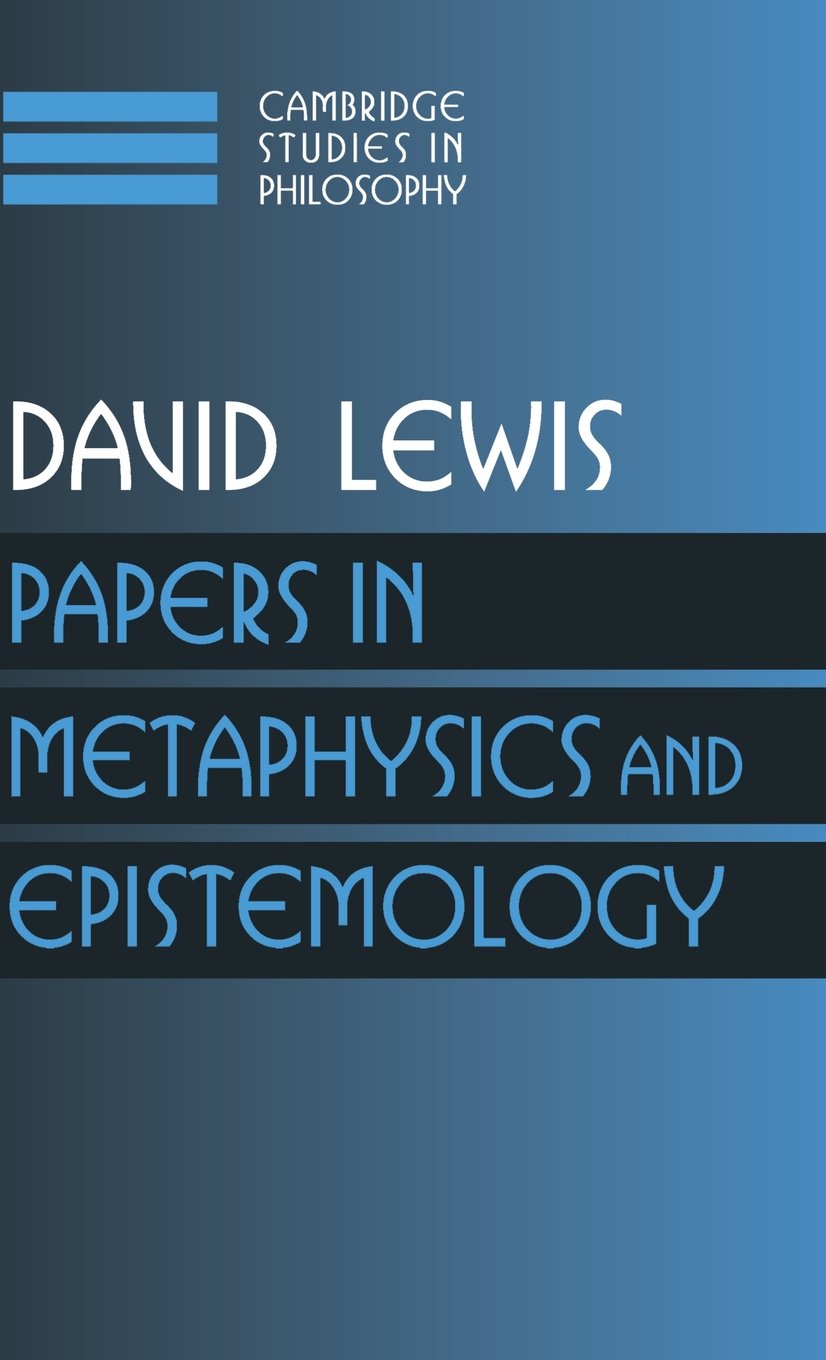
Papers in Metaphysics and Epistemology: Essential Essays by David Lewis on Ontology, Possibility, and Knowledge
Inclusive of all applicable taxes. FREE shipping on all orders.
Available Offers
- 🚚Free Delivery — Free shipping on all orders
- 💵Cash on Delivery — Pay when your order arrives
- ↩️15-Day Easy Returns — Hassle-free return policy
- 🔒Cash on Delivery — Pay safely when your order arrives
Check Delivery
Product Description
Introduction
For students and scholars of philosophy seeking a rigorous and original exploration of the deepest questions about reality and knowledge, David Lewis’s Papers in Metaphysics and Epistemology stands as an indispensable resource. This hardcover volume, published by Cambridge University Press, brings together some of the most influential essays by one of the twentieth century’s most significant analytic philosophers. Carefully curated, this collection offers a comprehensive view into Lewis’s bold and systematic thinking on topics ranging from the nature of properties and possibility to the foundations of belief and perception. Whether you are a postgraduate student navigating complex metaphysical debates or a teacher looking for authoritative reference material, this book provides a clear, challenging, and rewarding journey into the core of contemporary philosophy.
Book Overview
This volume is the second in a series of collected papers by David Lewis, focusing specifically on his groundbreaking contributions to metaphysics and epistemology. The essays span several decades of Lewis’s career, showcasing his unique ability to combine logical precision with imaginative thought experiments. From defending modal realism—the view that possible worlds are as real as our own—to developing a sophisticated theory of causation and counterfactuals, Lewis reshapes how philosophers understand necessity, possibility, and the structure of reality. On the epistemological side, the book tackles issues of knowledge, belief, and perceptual experience, offering arguments that remain central to current debates. Each paper is self-contained yet thematically connected, making the collection ideal for both targeted study and comprehensive reading.
Key Highlights
- Definitive Collection: Brings together 24 of Lewis’s most seminal papers, many of which have become classics in analytic philosophy.
- Broad Scope: Covers both metaphysics (ontology, properties, possible worlds, truthmaking, mind-body problem) and epistemology (vision, belief, knowledge, probability).
- Original Arguments: Features Lewis’s famous defenses of modal realism, Humean supervenience, and the principal principle in probability.
- Clear and Engaging Style: Known for his lucid prose and rigorous reasoning, Lewis makes complex ideas accessible without oversimplification.
- Critical Reference: An essential resource for academic libraries, philosophy departments, and serious students of metaphysics and epistemology.
Inside the Book
The book is organized into thematic sections that reflect Lewis’s main areas of inquiry. Early papers delve into the metaphysics of properties and relations, challenging nominalist and realist accounts alike. The middle section explores the nature of possibility and necessity, including Lewis’s controversial but influential theory of possible worlds. Later essays address truthmaking, causation, and the mind-body problem, where Lewis defends a materialist view of the mind. The epistemological portion of the volume examines the nature of vision, the role of belief in action, and the conditions for knowledge. Each paper is prefaced with a brief note where Lewis sometimes reflects on his own arguments or responds to critics, adding a layer of intellectual autobiography. The book concludes with papers on probability and decision theory, including the famous ‘Principal Principle’ linking chance and credence.
Key Topics
- Modal Realism: The thesis that possible worlds are concrete, spatiotemporally isolated entities.
- Properties and Universals: Debates about the existence and nature of properties, including Lewis’s ‘sparse theory’ of universals.
- Causation and Counterfactuals: Lewis’s influential analysis of causation in terms of counterfactual dependence.
- Truthmaking: The relation between truth and being, and what it means for something to make a proposition true.
- Mind-Body Problem: Arguments for materialism and against dualism, including the ‘argument from phenomenal properties’.
- Perception and Belief: The nature of visual experience, the content of belief, and the role of belief in rational action.
- Probability: The Principal Principle, chance, and subjective probability.
- Ontology: Questions about what exists, from mereological sums to abstract objects.
Reader Benefits
Reading this volume offers several distinct advantages. First, it provides direct access to the primary texts that have shaped contemporary metaphysics and epistemology, allowing you to engage with Lewis’s arguments in their original form. Second, the collection saves you the effort of tracking down individual journal articles, many of which are not easily available in India. Third, Lewis’s writing is a masterclass in philosophical method—his careful definitions, rigorous argumentation, and creative thought experiments serve as an excellent model for students learning to do philosophy. Fourth, the breadth of topics ensures that you can use the book for multiple courses or research projects, from a seminar on possible worlds to a study of the metaphysics of science. Finally, owning this hardcover edition means you have a durable, well-bound volume that will last through years of reference and study.
Learning Outcomes
By studying this collection, readers will be able to: critically evaluate arguments for and against modal realism; understand the key debates in the metaphysics of properties and causation; analyze the relationship between truth and being through truthmaking theory; apply Lewis’s counterfactual analysis to problems in philosophy of science and mind; assess materialist solutions to the mind-body problem; and grasp the foundations of the Principal Principle in probability theory. Additionally, readers will develop skills in reconstructing complex philosophical arguments, identifying hidden assumptions, and constructing their own positions in response to Lewis’s views. These outcomes are valuable not only for academic philosophy but also for any field requiring rigorous logical thinking, such as law, computer science, or cognitive science.
Who Should Read
This book is ideal for postgraduate students and advanced undergraduates in philosophy, especially those specializing in metaphysics, epistemology, or philosophy of language. It is also essential reading for professional philosophers and academic researchers who need a comprehensive reference on Lewis’s work. Teachers and lecturers will find the collection useful for designing course syllabi on topics like possible worlds, causation, or the metaphysics of science. Additionally, intellectually curious readers with a background in philosophy—such as those who have studied introductory logic or metaphysics—will find much to engage with, though some prior familiarity with analytic philosophy is recommended. Given its academic depth, the book is less suited for casual readers, but for those committed to understanding the foundations of reality and knowledge, it is a treasure trove.
About the Author
David Lewis (1941–2001) was one of the most influential philosophers of the twentieth century. He spent most of his career at Princeton University, where he trained a generation of leading philosophers. His work spans metaphysics, epistemology, philosophy of language, philosophy of mind, and decision theory. Lewis is best known for his systematic defense of modal realism, his counterfactual theory of causation, and his contributions to the metaphysics of properties and probability. His writing is characterized by clarity, rigor, and a willingness to defend bold, counterintuitive positions. Beyond his technical contributions, Lewis’s philosophical style—marked by thought experiments, precise definitions, and a commitment to systematic theory-building—continues to inspire philosophers worldwide.
About the Publisher
Cambridge University Press is one of the oldest and most respected academic publishers in the world. With a history dating back to 1534, Cambridge University Press has a strong tradition of publishing groundbreaking scholarship in philosophy, science, and the humanities. This volume is part of their acclaimed series of collected papers by major philosophers, ensuring high editorial standards, accurate text, and durable binding. For Indian readers, Cambridge University Press books are widely available through academic distributors, making this an accessible and reliable choice for university libraries and personal collections alike.
Conclusion
Papers in Metaphysics and Epistemology is more than a collection of essays—it is a window into the mind of a philosopher who redefined the landscape of analytic philosophy. For anyone serious about understanding the nature of reality, the limits of knowledge, and the tools of philosophical reasoning, this volume is an essential addition to your library. Its combination of depth, originality, and clarity makes it a lasting resource for study and reference. Whether you are preparing for a research paper, teaching a course, or simply exploring the frontiers of human thought, David Lewis’s work will challenge and inspire you. Order your hardcover copy from Bookshops.in today and begin a journey into the most profound questions of metaphysics and epistemology.
Quick Summary
Papers in Metaphysics and Epistemology is a curated collection of David Lewis's most influential essays, offering a deep dive into the core questions of analytic philosophy. The book covers a wide range of topics including the nature of properties, ontology, possibility, truthmaking, probability, the mind-body problem, vision, belief, and knowledge. Lewis's rigorous arguments and thought experiments make this volume an essential resource for philosophy students, teachers, and researchers. Written for an academic audience, it is particularly valuable for Indian students pursuing advanced studies in metaphysics and epistemology, as well as those preparing for competitive exams like UGC NET Philosophy. The essays are presented in a clear, engaging style that reflects Lewis's reputation as one of the 20th century's most original thinkers. By purchasing from Bookshops.in, Indian readers gain access to a genuine hardcover edition from Cambridge University Press, ensuring a high-quality reading experience. This book not only enhances understanding of key philosophical concepts but also serves as a reliable reference for scholarly work.
Book Highlights
Book Specifications
| ISBN-13 | 9780521582483 |
| ISBN-10 | 0521582482 |
| Publisher | Cambridge University Press |
| Language | English |
| Dimensions | 15.24 x 3.18 x 22.23 cm |
| Weight | 660 g |
| Country | India |
| Category | Philosophy › Epistemology |
| Genre | Non-fiction |
| Reading Age | Adult |
| Original Language | English |
Frequently Asked Questions
What is the main focus of Papers in Metaphysics and Epistemology?
Who is the author of this book?
Is this book suitable for undergraduate students in India?
Does the book cover the mind-body problem?
Can I use this book for UGC NET Philosophy preparation?
Is this a reference book or a textbook?
What is the language of the book?
Does the book include Lewis's work on possible worlds?
Is this book part of a series?
What is the price of this book in India?
Is the book available in paperback?
Why should I buy from Bookshops.in?
Readers Also Search For
Customers Also Bought
Islam
Spiritual Economies (English, Daromir Rudnyckyj)

Islam
Who Is Allah? (English, Bruce B. Lawrence)
Islam
Islam and Liberal Citizenship: The Search for an Overlapping Consensus by Andrew F. March

Islam
Fiqh Us-Sunnah: Funerals and Diggers by Al-Sayyid Sabiq – Islamic Funeral Guide

Christianity
Genetics (English, Thomas a. Shannon | Mark P. Aulisio | Françoise Baylis)

Hinduism
Karma and Creativity by Christopher Key Chapple – Indian Philosophy
Related Products
View All
Philosophy
Latin American Philosophy: Currents, Issues, Debates by Eduardo Mendieta

Philosophy
Al-Farabi's Short Commentary on Aristotle's Prior Analytics by Nicholas Rescher – Philosophy
Philosophy
Poetics of Imagining: Modern to Post-modern by Richard Kearney

Philosophy
The Metaphysics of Extrinsic Properties: 11 (Metaphysical Research, 11)
Philosophy
Dialogues on Metaphysics and on Religion by Nicolas Malebranche – Philosophy
Philosophy