
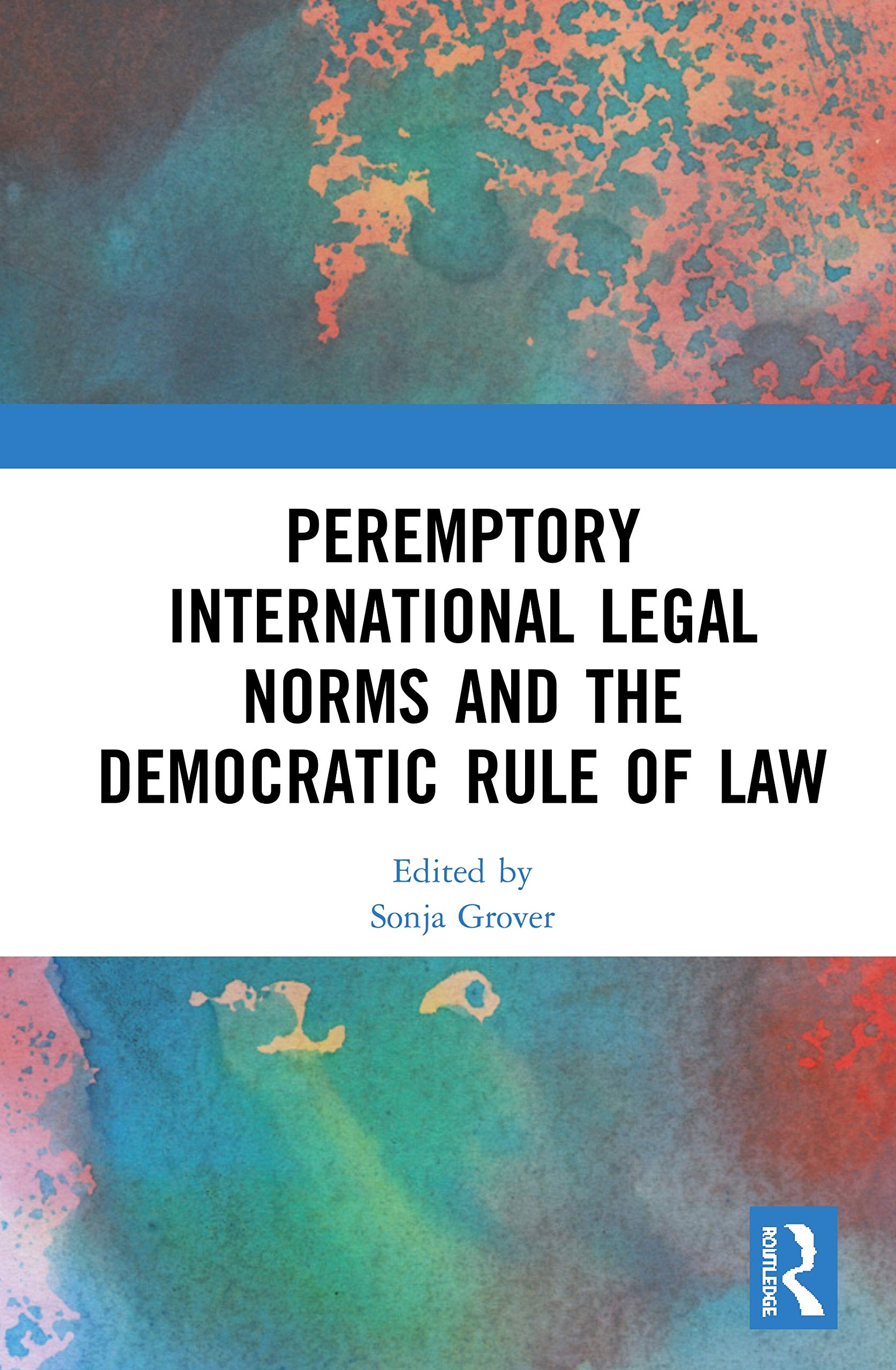
Peremptory International Legal Norms and the Democratic Rule of Law by Grover Sonja – A Deep Dive into Jus Cogens and Co
Inclusive of all applicable taxes. FREE shipping on all orders.
Available Offers
- 🚚Free Delivery — Free shipping on all orders
- 💵Cash on Delivery — Pay when your order arrives
- ↩️15-Day Easy Returns — Hassle-free return policy
- 🔒Cash on Delivery — Pay safely when your order arrives
Check Delivery
Product Description
Introduction
In an era where democratic values are increasingly tested by global pressures, Peremptory International Legal Norms and the Democratic Rule of Law by Grover Sonja offers a timely and rigorous examination of the fragile relationship between state sovereignty and fundamental human rights. This hardcover volume, published by Routledge, is an essential resource for Indian law students, legal practitioners, and policy thinkers who seek to understand how democratic states risk undermining their own foundations by compromising on non-derogable international legal principles. The book challenges readers to reflect on whether the rule of law can survive without an unwavering commitment to peremptory norms such as the prohibition of torture and inhumane treatment.
Book Overview
This scholarly work delves into the tension between democratic governance and the erosion of jus cogens norms—those peremptory international legal standards from which no derogation is permitted. Grover Sonja brings together a compelling analysis of how certain democratic states, in the name of security or political expediency, acquiesce to the weakening of these core human rights protections. Through specific current case examples, the book illustrates the risks to the democratic rule of law when states permit exceptions to absolute prohibitions. The author argues that such acquiescence disrupts the shared culture of human rights values that underpins democratic societies, ultimately threatening the very fabric of democratic governance. This is not merely a theoretical treatise but a practical warning for democracies worldwide, including India, where the balance between state power and individual rights remains a live constitutional debate.
Key Highlights
- Original and timely research: Focuses on the intersection of peremptory international norms and democratic rule of law, a niche but critical area of legal scholarship.
- Real-world case studies: Examines specific instances where democratic states have compromised on non-derogable norms, offering concrete lessons for policymakers.
- Interdisciplinary approach: Blends international law, constitutional theory, and political philosophy to provide a holistic understanding.
- Routledge academic quality: Published by a globally respected academic publisher, ensuring rigorous peer review and authoritative content.
- Hardcover edition: A durable, collectible format suitable for libraries, academic institutions, and serious scholars.
Inside the Book
The book is structured to guide readers through the conceptual framework of peremptory norms before diving into their practical implications. Early chapters establish the legal basis of jus cogens in international law, including the Vienna Convention on the Law of Treaties. Subsequent chapters explore how democratic states have, in recent years, allowed exceptions to the prohibition of torture, arbitrary detention, and other core human rights protections. The author uses comparative analysis of countries such as the United States, the United Kingdom, and Israel to demonstrate how democratic institutions can be hollowed out from within. The final chapters offer a normative argument for recommitting to peremptory norms as a precondition for genuine democratic rule of law, making a powerful case for legal and political reform.
Key Topics
- Definition and scope of peremptory international legal norms (jus cogens)
- The relationship between state sovereignty and human rights obligations
- Case studies of democratic backsliding through norm erosion
- Impact of counter-terrorism measures on absolute human rights prohibitions
- The role of domestic courts in upholding international law standards
- Fragility of shared human rights culture in democratic societies
- Comparative constitutional perspectives on non-derogable rights
Reader Benefits
By engaging with this book, readers will gain a nuanced understanding of how international law interacts with domestic democratic processes. Law students will find it invaluable for coursework in international human rights law, constitutional law, and legal theory. Practitioners and judges will benefit from the detailed case analyses that can inform arguments before Indian courts, especially in matters involving fundamental rights and international treaty obligations. Policy analysts and civil society advocates will acquire a robust framework to critique governmental actions that risk undermining India's constitutional commitments. The book also equips readers with the vocabulary and conceptual tools to participate in global debates on the future of democracy and human rights.
Learning Outcomes
- Understand the legal and philosophical foundations of peremptory international norms
- Analyze how democratic states can inadvertently undermine the rule of law
- Critically evaluate case studies of norm erosion in democratic contexts
- Develop arguments for the indivisibility of human rights and democratic governance
- Apply comparative insights to Indian constitutional and legal frameworks
- Identify warning signs of democratic backsliding in domestic policy
Who Should Read
This book is ideally suited for law students (especially those specializing in international law, human rights, or constitutional law), legal academics and researchers, judges and judicial officers, human rights advocates and NGO professionals, policy makers in government and diplomacy, and political science scholars interested in democratic theory. Indian readers will find the book particularly relevant given the country's vibrant constitutional democracy and its engagement with international human rights frameworks. The accessible yet rigorous writing style makes it suitable for advanced undergraduate and postgraduate courses, as well as for self-study by motivated professionals.
About the Author
Grover Sonja is a distinguished legal scholar with extensive expertise in international law, human rights, and democratic governance. With a career spanning multiple decades, she has contributed significantly to the discourse on peremptory norms and their role in protecting human dignity. Her research is known for its clarity, depth, and real-world relevance, often drawing on comparative legal analysis to illuminate pressing global issues. Sonja's work has been cited in academic journals and policy documents worldwide, establishing her as a leading voice in the field. This book represents the culmination of her long-standing engagement with the tensions between state power and fundamental rights in democratic societies.
About the Publisher
Routledge is a premier global academic publisher, renowned for its high-quality books and journals in the social sciences, humanities, and law. With a history dating back to the 19th century, Routledge has been at the forefront of publishing cutting-edge research that shapes academic discourse and public policy. Their law catalog includes works by leading scholars and practitioners, making them a trusted source for students, researchers, and professionals worldwide. This hardcover edition reflects Routledge's commitment to producing durable, authoritative texts that stand the test of time.
Conclusion
Peremptory International Legal Norms and the Democratic Rule of Law is a vital addition to any serious legal library. In a world where democratic institutions face unprecedented challenges, Grover Sonja's work serves as both a warning and a guide. It reminds us that the rule of law is not self-sustaining—it requires constant vigilance and an unwavering commitment to the most fundamental human rights. For Indian readers, this book offers a unique lens through which to examine our own constitutional journey and the global forces that shape it. Order your hardcover copy from Bookshops.in today and deepen your understanding of the essential link between democracy and international law.
Quick Summary
Peremptory International Legal Norms and the Democratic Rule of Law by Grover Sonja is a critical academic work that examines how democratic states inadvertently weaken their own constitutional foundations by tolerating the erosion of non-derogable international legal norms, known as jus cogens. Using contemporary case examples, the book focuses particularly on the absolute prohibition of torture and inhumane treatment, showing how state acquiescence to violations of these norms disrupts the investiture of democratic rule of law. The author argues that respect for peremptory norms is not optional for democracies; it is essential for maintaining the integrity of constitutional governance. This book is ideal for law students, legal scholars, human rights advocates, and policy makers who seek a deeper understanding of the interplay between international law and domestic democratic systems. Readers will learn about the risks of norm erosion, the role of courts in upholding fundamental principles, and the philosophical underpinnings of state sovereignty versus global legal order. By choosing Bookshops.in, Indian readers gain access to a premium imported edition with fast delivery and reliable service.
Book Highlights
Book Specifications
| ISBN-13 | 9780367419899 |
| ISBN-10 | 0367419890 |
| Publisher | Routledge |
| Language | English |
| Dimensions | 18.42 x 1.27 x 25.4 cm |
| Weight | 386 g |
| Country | India |
| Category | Philosophy › History & Surveys |
| Genre | Law |
| Original Language | English |
Frequently Asked Questions
What are peremptory international legal norms?
Who is the author of this book?
Is this book suitable for Indian law students?
What is the main argument of the book?
Does the book include case studies?
What is the ISBN?
What binding is available?
Is this book relevant to current global events?
Can this book help with legal research?
What language is the book in?
Does the book discuss Indian law?
Where can I buy this book in India?
Readers Also Search For
Customers Also Bought

Islam
Spiritual Economies (English, Daromir Rudnyckyj)

Islam
Who Is Allah? (English, Bruce B. Lawrence)
Islam
Islam and Liberal Citizenship: The Search for an Overlapping Consensus by Andrew F. March

Islam
Fiqh Us-Sunnah: Funerals and Diggers by Al-Sayyid Sabiq – Islamic Funeral Guide

Christianity
Genetics (English, Thomas a. Shannon | Mark P. Aulisio | Françoise Baylis)

Hinduism
Karma and Creativity by Christopher Key Chapple – Indian Philosophy
Related Products
View All
Philosophy
Latin American Philosophy: Currents, Issues, Debates by Eduardo Mendieta

Philosophy
Al-Farabi's Short Commentary on Aristotle's Prior Analytics by Nicholas Rescher – Philosophy

Philosophy
Poetics of Imagining: Modern to Post-modern by Richard Kearney

Philosophy
The Metaphysics of Extrinsic Properties: 11 (Metaphysical Research, 11)

Philosophy
Dialogues on Metaphysics and on Religion by Nicolas Malebranche – Philosophy

Philosophy