
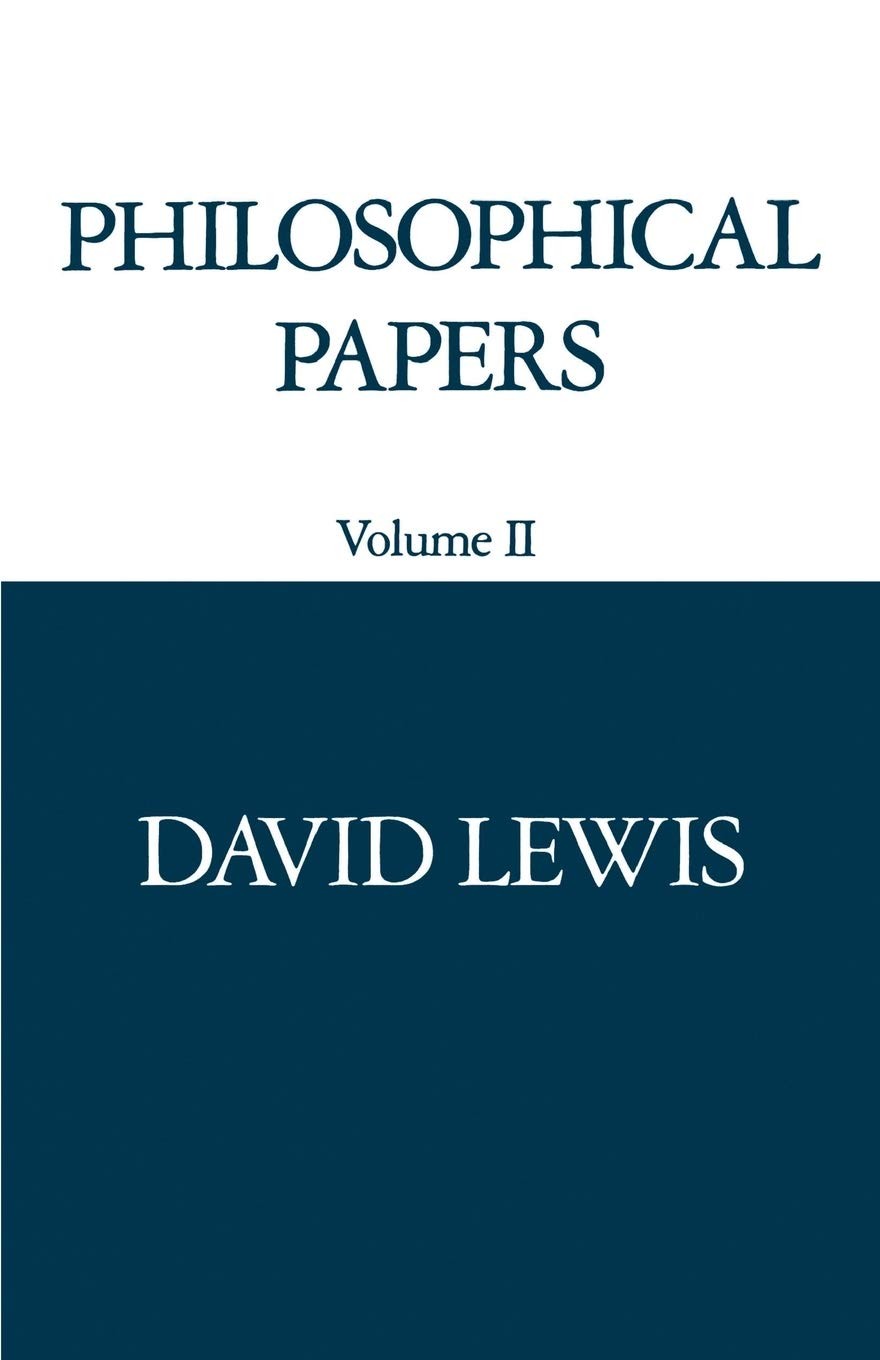
Volume II: Philosophical Essays on Causation, Conditionals, and Rational Decision by David Lewis – Published by Oxford U
Inclusive of all applicable taxes. FREE shipping on all orders.
Available Offers
- 🚚Free Delivery — Free shipping on all orders
- 💵Cash on Delivery — Pay when your order arrives
- ↩️15-Day Easy Returns — Hassle-free return policy
- 🔒Cash on Delivery — Pay safely when your order arrives
Check Delivery
Product Description
Introduction
David Lewis was one of the most original and influential philosophers of the twentieth century, and his work continues to shape contemporary thought across logic, metaphysics, and the philosophy of science. Volume II, published by Oxford University Press, brings together thirteen powerful essays that explore some of the deepest questions about causality, time, probability, and human freedom. This hardbound edition is an essential addition to any serious student’s or scholar’s library, offering a rigorous yet accessible journey through Lewis’s later thinking.
Book Overview
This collection is the second volume of Lewis’s philosophical papers, featuring both newly written essays and previously published works, many of which include extensive new postscripts where the author revisits and refines his earlier arguments. The core of the book revolves around causation and its close relatives: counterfactual reasoning, indicative conditionals, the direction of time, subjective and objective probability, perception, free will, and rational decision-making. Throughout, Lewis develops a unified vision of how global features of the world might supervene on the local arrangement of physical qualities.
Key Highlights
- Thirteen landmark essays by one of the most innovative philosophers of the modern era
- New postscripts that update and deepen the original arguments
- Focus on causation and counterfactuals — foundational topics in metaphysics and philosophy of science
- Rigorous analytical style that rewards careful reading and invites critical engagement
- Oxford University Press quality in a durable hardcover binding
Inside the Book
The volume opens with a set of papers on counterfactual conditionals, where Lewis refines his famous possible-worlds semantics. Subsequent essays tackle the asymmetry of causation, the nature of objective chance, and the relationship between subjective probability and decision theory. Later chapters explore free will, perception, and the philosophy of time. Each paper is self-contained but builds toward a coherent picture of a world where everything — including causation itself — is grounded in the distribution of local qualities across spacetime.
Key Topics
- Counterfactual and indicative conditionals
- Causation and causal explanation
- The direction of time
- Subjective and objective probability
- Free will and determinism
- Rational decision and perception
- Supervenience and global features of reality
Reader Benefits
Students of philosophy will gain a masterclass in analytic reasoning and argument construction. Researchers will appreciate the depth of Lewis’s engagement with foundational issues. This volume also serves as a bridge between metaphysics and the philosophy of science, helping readers connect abstract theories to concrete scientific practice. The postscripts offer rare insight into how a great thinker evolves his views over time.
Learning Outcomes
- Understand the core principles of counterfactual semantics
- Analyze the relationship between causation, time, and probability
- Critically evaluate arguments about free will and determinism
- Apply Lewis’s framework to problems in decision theory and epistemology
- Develop a deeper appreciation for metaphysical supervenience
Who Should Read
This book is ideal for advanced undergraduate and postgraduate students of philosophy, particularly those specializing in metaphysics, philosophy of science, or logic. It is also highly recommended for professional philosophers, researchers in cognitive science, and anyone with a serious interest in the foundations of causality and probability. Indian readers studying analytic philosophy will find this volume especially valuable for its clarity and depth.
About the Author
David Lewis (1941–2001) was a professor of philosophy at Princeton University and is widely regarded as one of the greatest philosophers of his generation. His work on possible worlds, counterfactuals, and convention has become canonical. Lewis’s writing is known for its precision, wit, and willingness to pursue arguments to their most radical conclusions. He was a fellow of the American Academy of Arts and Sciences and received numerous accolades for his contributions to philosophy.
About the Publisher
Oxford University Press is a department of the University of Oxford and one of the oldest and most respected academic publishers in the world. OUP is known for its rigorous editorial standards and its commitment to making scholarly works available globally. This hardcover edition is produced with the care and quality that Indian readers expect from a premium academic publisher.
Conclusion
Volume II by David Lewis is a masterful collection that remains essential reading for anyone serious about philosophy. Whether you are studying causation, time, or decision theory, these essays will challenge and inspire you. Order your copy from Bookshops.in today and add a timeless work of analytical philosophy to your shelf.
Quick Summary
Volume II by David Lewis is a seminal collection of thirteen philosophical essays that delve into causation, counterfactual and indicative conditionals, the direction of time, probability, explanation, perception, free will, and rational decision. Published by Oxford University Press in hardcover, this volume includes both new essays and previously published papers, many with extensive new postscripts that reflect Lewis's evolving thoughts. The book is aimed at advanced philosophy students, researchers, and academics, particularly those interested in analytic philosophy, metaphysics, and philosophy of science. Readers will gain deep insights into how global features of the world supervene on the spatiotemporal arrangement of local qualities, a core theme in Lewis's work. By purchasing from Bookshops.in, Indian readers get a genuine hardcover edition with reliable delivery and competitive pricing, making it an excellent addition to any academic library.
Book Highlights
Book Specifications
| ISBN-13 | 9780195036466 |
| ISBN-10 | 0195036468 |
| Publisher | OUP USA |
| Language | English |
| Dimensions | 14.33 x 2.39 x 21.54 cm |
| Weight | 408 g |
| Category | Philosophy › History & Surveys |
| Series | Philosophical Papers |
| Genre | Non-fiction |
| Original Language | English |
Frequently Asked Questions
What is Volume II by David Lewis about?
Who is David Lewis?
Is this book suitable for beginners in philosophy?
What topics are covered in Volume II?
Is this book available in hardcover?
What is the price of Volume II on Bookshops.in?
Can I use this book for my philosophy research?
Is Volume II part of a series?
Who publishes Volume II?
What is the ISBN of this book?
Is this book available in Indian bookstores?
Does this book cover free will?
Readers Also Search For
Customers Also Bought
Islam
Spiritual Economies (English, Daromir Rudnyckyj)

Islam
Who Is Allah? (English, Bruce B. Lawrence)
Islam
Islam and Liberal Citizenship: The Search for an Overlapping Consensus by Andrew F. March

Islam
Fiqh Us-Sunnah: Funerals and Diggers by Al-Sayyid Sabiq – Islamic Funeral Guide

Christianity
Genetics (English, Thomas a. Shannon | Mark P. Aulisio | Françoise Baylis)

Hinduism
Karma and Creativity by Christopher Key Chapple – Indian Philosophy
Related Products
View All
Philosophy
Latin American Philosophy: Currents, Issues, Debates by Eduardo Mendieta

Philosophy
Al-Farabi's Short Commentary on Aristotle's Prior Analytics by Nicholas Rescher – Philosophy

Philosophy
Poetics of Imagining: Modern to Post-modern by Richard Kearney

Philosophy
The Metaphysics of Extrinsic Properties: 11 (Metaphysical Research, 11)
Philosophy
Dialogues on Metaphysics and on Religion by Nicolas Malebranche – Philosophy
Philosophy